Look at where your escalations cluster and you will usually find the same few faults
going up to the same one or two people. The senior tech becomes the operation’s
single point of resolution, their phone rings all route long, and tier-one keeps
handing up calls they were trained to clear. If that pattern is stuck while your
training calendar is full, the problem is not the routing. It is that the procedure
did not last to the unit.
An escalation is a retention gap
An escalation, the kind that should not have happened, is a tech who knew the
procedure on training day and did not have it when the fault appeared. That is a
capability question, and capability lives in memory. The procedure decays on a
predictable curve, so the question is never whether the tech once learned it. It is
whether it was still there at the unit, or whether reaching for the phone was the
only option left. This is the same gap that governs
all field service training
: completion is not
capability.
There is a second story hiding here, and it is about your senior tech. Right now the
routine escalations pull them off their own work to walk someone through a fix the
crew should already hold. Their hard-won knowledge is the most valuable thing in your
operation, and it is being spent on calls that do not need it. Cut the routine
escalations and you give the senior tech their day back for the genuinely hard
problems that actually use their expertise. The same move
gets their knowledge into the crew
, so
the thing in their head outlasts any one route. That is the opposite of making them
less necessary. It is making the rest of the crew more like them.
Why more training does not move it
The usual fix for a high escalation rate is more delivery: another refresher, a
longer onboarding, one more module. Delivery feels like progress and barely touches
the number, because the forgetting curve does its work in the weeks after, when
nothing reinforces the skill. The class you ran in spring is gone by the fault in
summer. (The science, in plain terms.
)
Escalations are never only a memory problem. Genuinely novel faults and edge cases
should go to a senior engineer, and that is the system working. But the slice
training owns, the routine fault a tech escalates because the steps blurred, is
exactly the slice more delivery keeps failing to fix. That slice responds to being
made to recall and apply the procedure, spaced over time, so it is still there when
the fault appears.
How HeyLoopy lowers the escalation rate
HeyLoopy does not replace your training. It keeps the procedures your crew keeps
escalating from decaying between jobs.
Drills from your own procedures. Short drills built from the service bulletins,
SOPs, and OEM procedures you already run on, so the tech practices the actual fault
they keep handing up, not a generic library. (How the drill loop works.
)
Retrieval on a spaced schedule. About sixty to ninety seconds, one question at a
time, returned to across the weeks between calls, because that is what fights the
curve and keeps the procedure available at the unit instead of on the senior tech’s
phone.
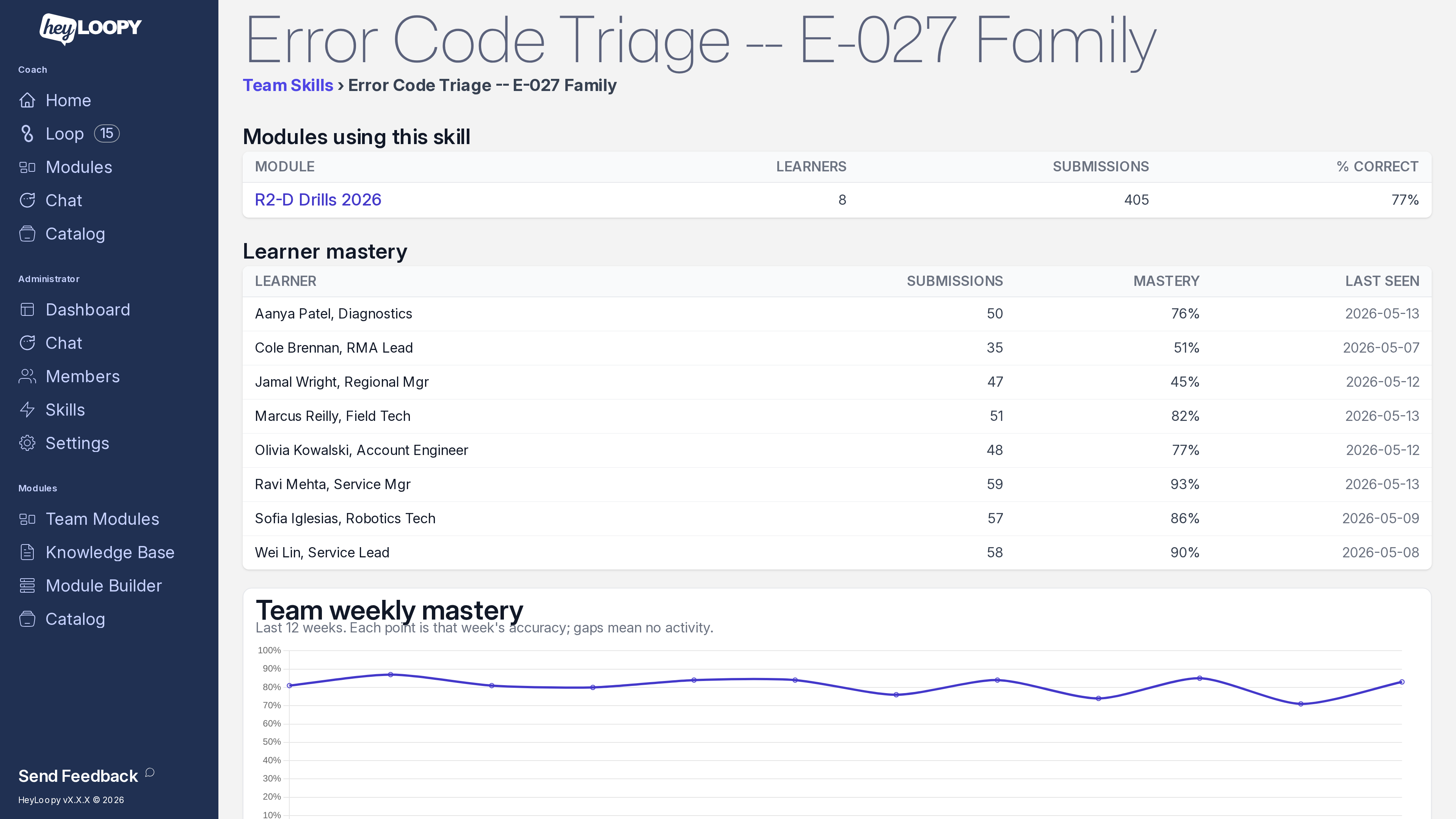
Readiness you can see. A per-role, per-product-line mastery view, so a procedure
the crew is starting to lose is a trend you catch before it becomes a spike in
escalations. The same view tells you when first-line resolution has climbed enough
that a fault no longer needs to leave the truck for an answer.
You will keep leaning on your senior people for the genuinely hard calls. The
question is whether the routine ones reach them too, because the procedure faded.
Start free on the fault your crew keeps escalating, and watch first-line resolution
climb.