If you are looking for knowledge retention software because your team keeps
being trained and still cannot do the thing when it counts, this page is about
your problem. There is a second product that also answers to “knowledge
retention software,” and it is worth ruling out fast so you are not shopping for
the wrong one.
Two meanings, one search box
The kind most people actually need retains knowledge by keeping it in
people. The information was never lost; it is sitting right in the document.
What is gone is the skill: your team learned it, and the forgetting curve took
it back. A file you can search does nothing about that. It is technically
findable and practically gone, which is exactly the gap that drives the cost of
skill decay
.
The other kind retains knowledge by storing it: wikis, documentation
platforms, searchable repositories whose job is to keep what a departing
employee knew from leaving with them. That is a real category, and if
institutional memory walking out the door is your only worry, that is the one to
buy. For everyone whose trained skills keep fading on the floor, it is the wrong
shelf.
| What you are comparing | A knowledge repository (wiki, KM tool) | HeyLoopy |
|---|
| What it retains | The document, the institutional record | The skill, in your team’s heads |
| Where the knowledge lives | In a system you search | In the person, ready to use |
| How it is reinforced | It is not; it waits to be looked up | Active recall, spaced over time |
| The failure mode | Knowledge nobody remembers to use | Solved: the skill resurfaces on schedule |
| What you measure | Pages, searches, what is stored | Mastery per person, slipping skills flagged |
| Best when | Turnover threatens institutional memory | Trained skills keep fading on the floor |
Why storage alone leaves the gap open
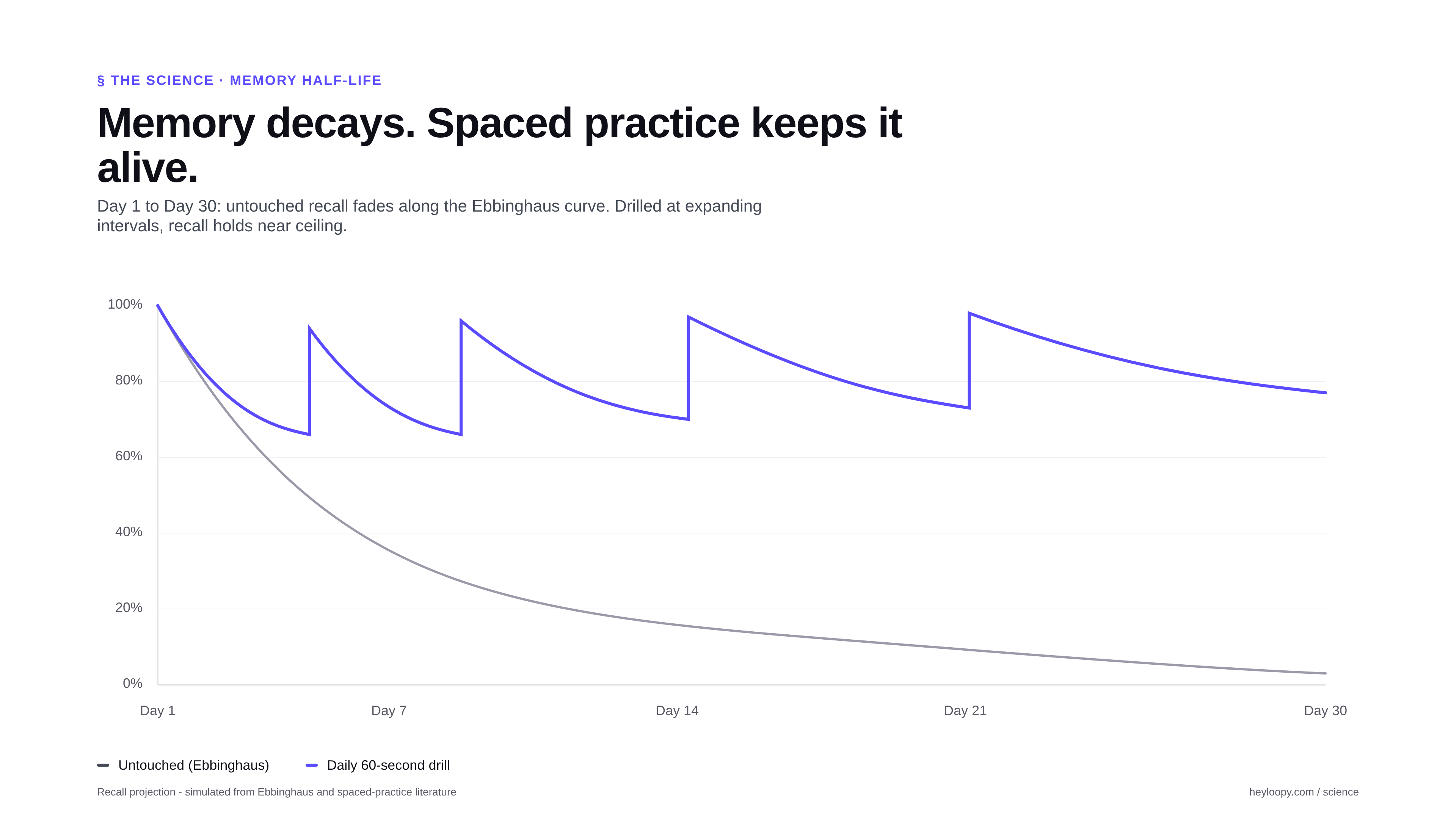
The forgetting curve, described by Hermann Ebbinghaus more than a century ago,
is blunt: without deliberate reinforcement, most of what we learn decays within
days. A repository is built to defeat loss of the record. It was never built
to defeat decay in the person, and the two are not the same gap. The research
on closing the second one is settled. You retain what you are made to recall,
not what you filed away to read again. (The science, in plain terms.
)
That is the line HeyLoopy is built on, and it is the whole idea behind
training that sticks
. It takes the documents and
procedures you already have, the same ones that would otherwise sit in the
repository, and turns them into spaced retrieval practice, so the knowledge ends
up where it is useful: in the person, under pressure, when the document is the
last thing they have time to open. (How the practice loop works.
)
If your team was trained and still cannot do it when it counts, a better filing
system will not touch that. (A strong repository is the right buy only if your
single worry is knowledge walking out the door with the people who hold it.)
That is the gap HeyLoopy is built to close. Start free on a procedure your team
keeps having to look up, and watch it become something they actually retain.