Every field operation has one: the senior tech who knows the fix nobody else does,
who gets the call when a job goes sideways, whose head holds years of faults the
documentation never captured. That depth is a real asset. It is also a real risk,
because right now it lives in one place, and that place takes calls all day and
will retire someday.
The single point of failure
When the knowledge lives in one head, the whole operation depends on one phone
staying answered. A tough fault on a route becomes a call to the senior tech, who is
on their own job, so two techs are now slowed and one customer is waiting. Multiply
that across a region and the senior tech is not a resource, they are a bottleneck,
and the day they leave the operation loses capability it cannot quickly rebuild.
This is the sharpest version of the gap that runs through
field service training
: the procedure exists, but only
in a place that cannot scale.
The instinct to lean on the senior tech is right, because they do know the answer.
The format that forces every hard call through one person is what needs fixing.
Why the usual fixes fail
The standard answers do not hold. Asking the senior tech to write a manual produces
a document nobody reads and the curve erases anyway. A ride-along moves knowledge to
one tech for one day, then fades. A recorded session is delivery, and delivery
without retrieval drains away within days. (The science, in plain terms.
)
The knowledge does not stick on the crew for the same reason any training does not
stick: it was delivered once and never practiced.
What moves knowledge durably is retrieval, spaced over time, the same mechanism that
keeps any procedure available at the call.
How HeyLoopy moves it to the crew
HeyLoopy turns one tech’s knowledge into practice the whole crew runs.
Capture it once, from the source. The senior tech uploads a procedure, pastes
it, or chats the fix to Loopy, the assistant that drafts the drills. The fault that
lived only in their head becomes a drill set. (How the drill loop works.
)
Move it with retrieval. Short drills, spaced over the weeks, make the crew
recall and apply the procedure instead of phoning for it, which is how it becomes
their knowledge and not just the senior tech’s.
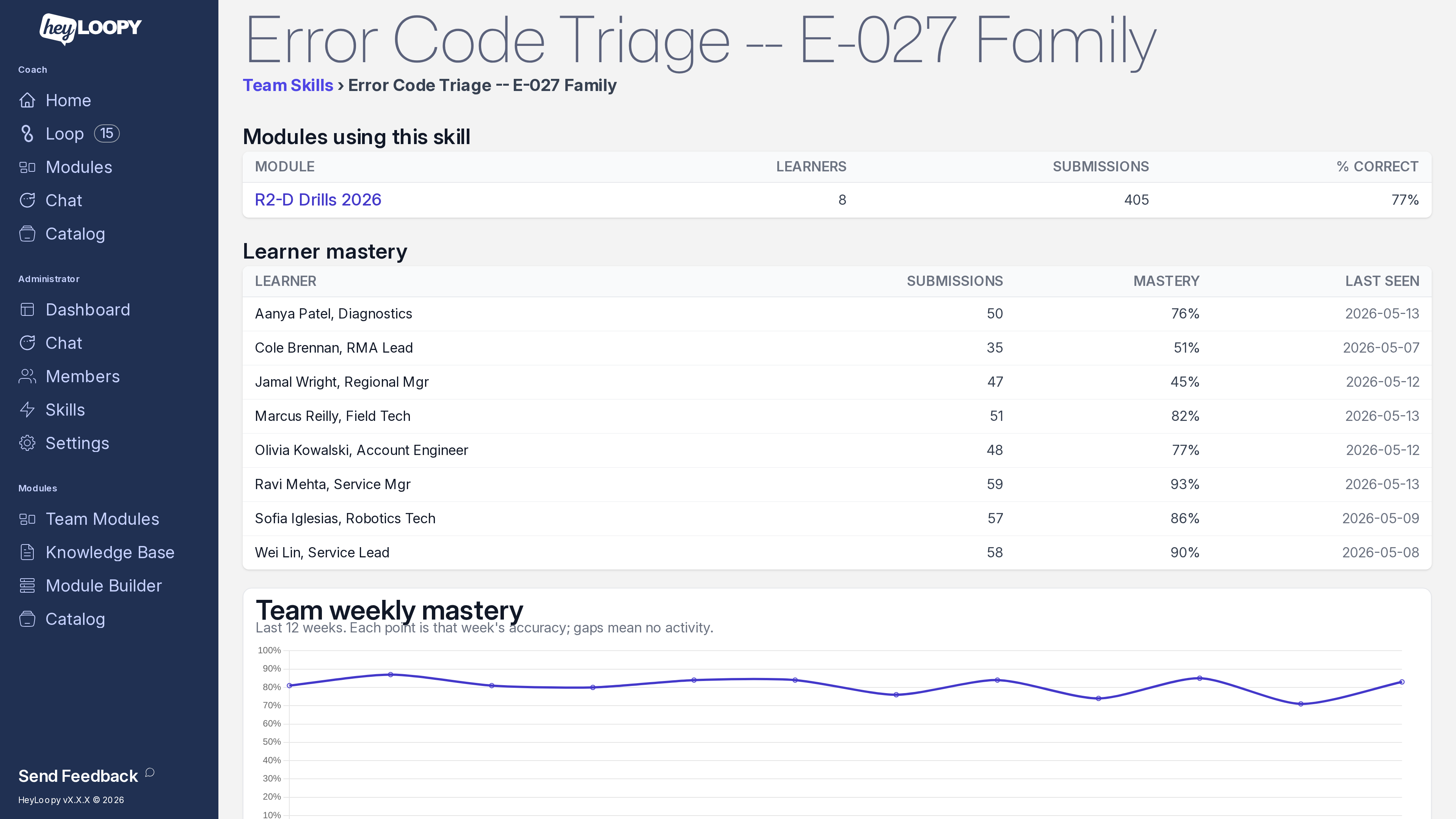
See where it still lives in one head. A per-role, per-person mastery view shows
which procedures depend on a single technician, so you can move them before that
technician is the bottleneck or the one who walks out the door with it. It is the same signal
that protects your
first-time fix rate
and cuts the
repeat truck roll
.
Your senior tech will always be your best. The goal is that they stop being your
only. Start free on the fault that lives in one head, and watch the crew learn to
run it.