The Amazon Effect: Why Good Service is No Longer Good Enough
You are standing behind the counter, or sitting at your desk, and the phone rings. It is a customer. They placed an order or requested a service yesterday. It is now 10:00 AM on a Tuesday.
They are agitated.
They want to know why it has not arrived yet. Or why the draft isn’t in their inbox. Or why the technician isn’t in their driveway.
You look at the schedule. You are well within the standard delivery window. In fact, you are early. You explain this politely. You tell them that the industry standard is three days.
They do not care.
To them, you are failing. You are slow. You are opaque. And they are frustrated.
This interaction leaves you feeling baffled. You did everything right. You followed the process. You provided quality work. Why is the customer treating you like you committed a crime?
The answer lies in a phenomenon that economists and sociologists call the Amazon Effect. It is a fundamental rewiring of the consumer brain that has taken place over the last fifteen years.
We have been conditioned to believe that if we press a button on a piece of glass, the physical world should rearrange itself to bring us what we want within hours. We have been trained to expect total transparency, real-time tracking, and instant gratification.
When a customer interacts with your business, they are not comparing you to your direct competitors. They are comparing you to the best service experience they have ever had. They are comparing you to the seamless, friction-free experience of a trillion-dollar tech giant.
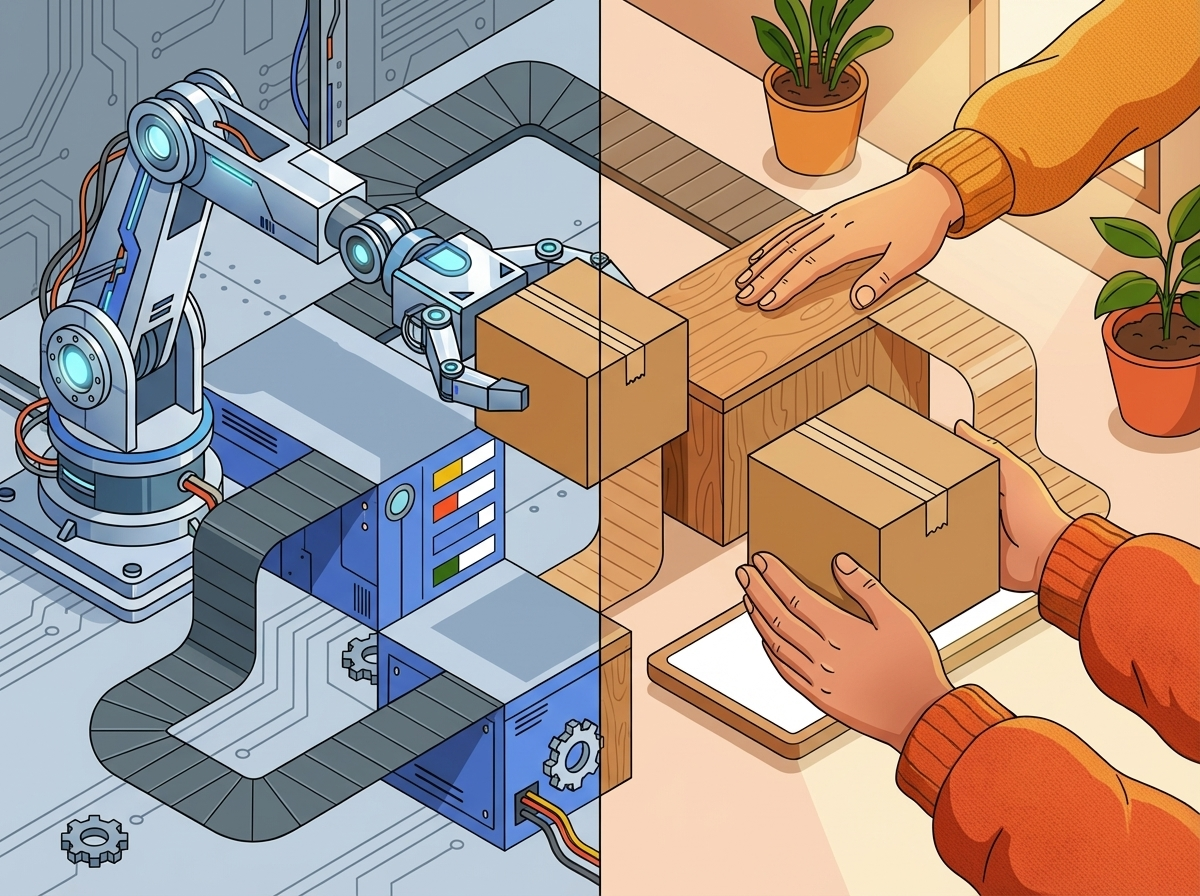
This is terrifying for a small business owner. You do not have a fleet of jets. You do not have robots in a warehouse. You have a team of five people and a coffee machine that breaks sometimes.
How do you bridge this gap? How do you train your team to meet expectations that seem impossible?
The Psychology of Certainty
To solve this, we first have to understand what the customer is actually buying.
Amazon did not just sell speed. They sold certainty.
When you order a package, you know exactly where it is. It has been scanned at the facility. It is out for delivery. It is ten stops away. This constant stream of data triggers a dopamine loop in the brain. It reduces anxiety. It creates a sense of control.
When a customer gets angry at your team, it is usually not because you are slow. It is because you are silent.
The anxiety of the unknown is what triggers the hostility. If I don’t know where my project is, I assume it is lost or forgotten.
Therefore, the first step in training your team is to shift their focus from doing the work to communicating the work.
Most employees think their job is to fix the sink or design the logo. They view communication as a distraction from the real work. You need to teach them that the update is part of the product.
- The Proactive Ping: Train your team to send an update before the customer asks for one. If you tell the customer We are working on it before they get anxious, you build trust. If you tell them after they ask, you are just making excuses.
- The Why Explanation: When there is a delay, explain the mechanics. Don’t just say It will be late. Say It will be late because we want to apply a second coat of sealant to ensure it lasts for ten years. Now the delay is a feature, not a bug.
The Empathy Advantage
You cannot beat the giants on logistics. You will lose that race every time. But you can beat them on humanity.
The weakness of the algorithmic service model is that it is cold. It is efficient, but it does not care.
This is your opening.
The goal of your training should be to de-program your staff from acting like bad robots. We often give our employees scripts. We tell them to say specific phrases. We force them to memorize policies.
When a customer is frustrated, a script is like gasoline on a fire. The customer wants to feel heard, not processed.
You need to train your team in the art of Compassionate Autonomy.
Compassionate Autonomy means giving your frontline staff the permission to act like human beings.
- If a customer is upset because a delivery was late for their child’s birthday, a robot says, I apologize for the inconvenience.
- A human says, I am so sorry we missed the birthday. That is heartbreaking. I cannot change the past, but I am going to refund the shipping cost and send a personal note to your child.
This requires you to trust your team. You have to give them a budget to fix problems without asking for a manager’s permission. The Ritz-Carlton famously gives every employee a $2,000 discretion to solve a guest’s problem.
You might not have $2,000, but can you give them $50? Can you give them the authority to send a bouquet of flowers or waive a fee?
When you empower your team to solve the emotional problem, not just the logistical problem, you create a level of loyalty that Amazon cannot buy.
The Recovery Paradox
There is a fascinating concept in service marketing called the Service Recovery Paradox.
Data suggests that a customer who has a problem that is resolved quickly and empathetically ends up being more loyal to the brand than a customer who never had a problem at all.
Why? Because the problem gave you a chance to prove your character.
When everything goes right, the transaction is invisible. When things go wrong, the spotlight is on you.
Your team needs to understand this. They often fear complaints. They try to hide mistakes or deflect blame because they don’t want to get in trouble.
You need to change the culture around failure. You need to teach them to run toward the fire.
Train them on the LAST framework (Listen, Apologize, Solve, Thank). But go deeper.
- Own the Outcome: Teach them to say I will take personal responsibility for fixing this, even if the mistake happened in a different department.
- Close the Loop: The number one reason customers leave is that they feel ignored. Train your team to follow up twenty-four hours after the solution to ensure the customer is still happy.
This turns a negative experience into a defining moment for your brand.
The Fatigue of Perfection
As we look to the future, we have to ask ourselves where this trend stops.
If expectations keep rising, will we eventually reach a breaking point? There is a growing sentiment that the demand for instant perfection is actually making us miserable.
We are seeing the early signs of a slow movement in business. Customers are starting to appreciate craftsmanship over speed. They are starting to value the story behind the product more than the tracking number.
This is where your business can shine.
If you can train your team to be educators, you can change the customer’s expectations.
Instead of apologizing for taking time, celebrate it. Teach your team to explain the craft.
- We are not slow; we are thorough.
- We are not inefficient; we are artisanal.
When you frame your process as a deliberate choice for quality, you attract the kind of customers who are willing to wait. You filter out the ones who just want a commodity.
The Data Dilemma
However, we cannot ignore the role of technology. Your customers expect you to know them.
If I call your office, I expect you to know who I am, what I bought last year, and what my preferences are.
This means your team needs to be data-literate. They need to be diligent about using your CRM (Customer Relationship Management) tools.
The most empathetic employee in the world will fail if they don’t have the information.
You have to train your team that entering data is not administrative busywork. It is a service act.
- Recording that a client prefers email over phone calls is an act of service.
- Noting that a customer has a deadline in September is an act of service.
When your team has the data, they can anticipate needs. They can offer solutions before the problem arises. This is the ultimate goal: proactive service.
Building a Remarkable Culture
The bar has been raised. There is no going back to the days of average service.
But this is not a death sentence for the small business. It is a clarifying moment.
It forces us to decide what we really are. Are we just vending machines dispensing products? Or are we partners in our customers’ lives?
To build a team that can meet these elevated expectations, you have to invest in them. You have to treat them with the same respect and care that you want them to show your customers.
You cannot scream at your staff and then expect them to be empathetic to a client. It doesn’t work that way.
Model the behavior. Show them that you value their time. Show them that you listen to their frustrations.
When your team feels supported, confident, and empowered, they will naturally extend that feeling to the people they serve.
You might not deliver in two hours. You might not have a drone. But you have something better.
You have a team that actually gives a damn.







