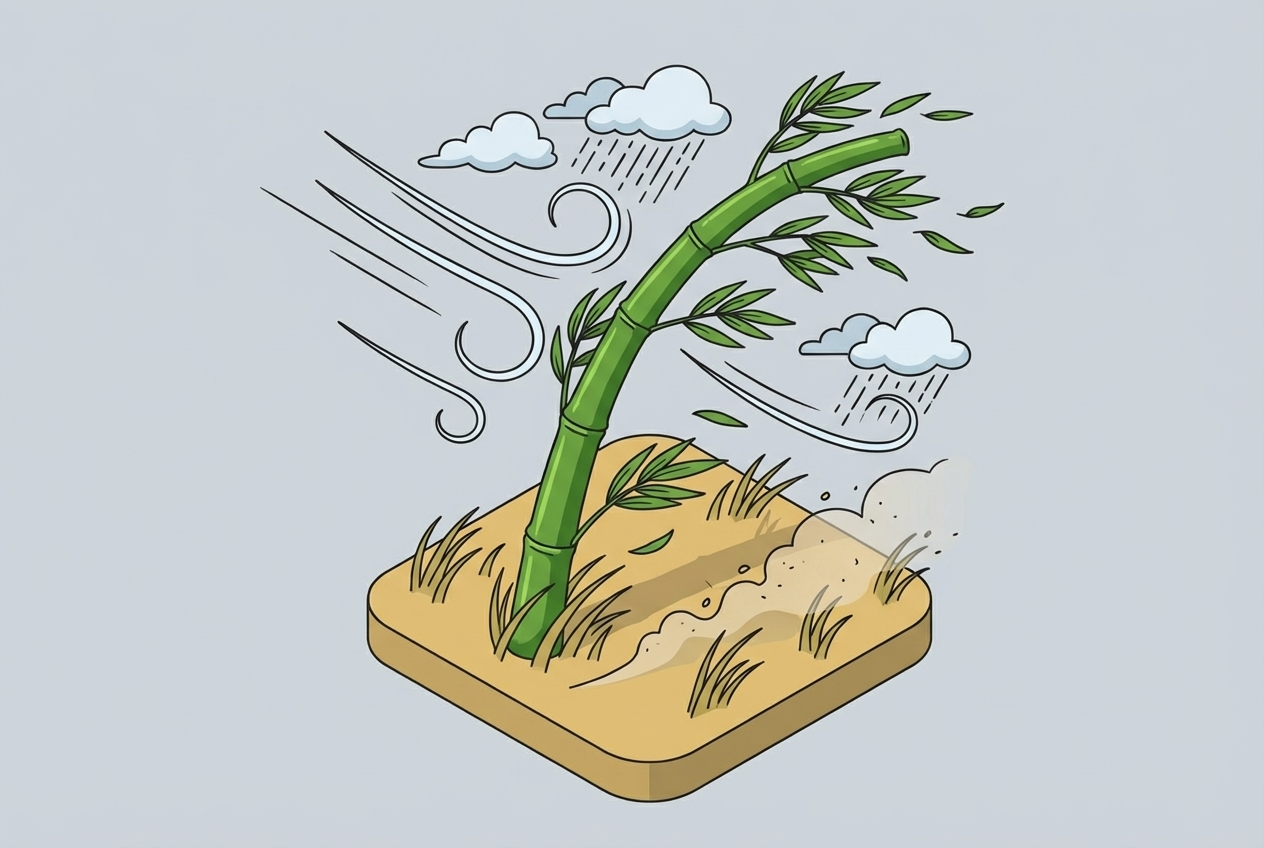
The Biology of Bounce: building a team that bends without breaking
It is Monday morning. You open your laptop.
A major client has paused their contract. A key software tool is down. Two employees are out sick. And the deadline for your biggest project of the year is Friday.
You can feel the tension in the Slack channels. The messages are short and sharp. The emojis have disappeared. Your team is in survival mode.
Some of them are freezing up. They are staring at their screens, unable to prioritize. Others are snapping at each other. The atmosphere is brittle. You feel like one more piece of bad news will shatter the entire organization.
This is the stress test.
Every business faces these moments. They are inevitable. The market shifts. Technology fails. Humans make mistakes.
The difference between a team that crumbles and a team that rallies is not intelligence. It is not funding. It is resilience.
But resilience is often misunderstood. We think of it as toughness. We think of it as the ability to endure pain without complaining. We think of it as grit.
That is a dangerous definition.
True resilience is not about hardening yourself against the world. It is about adaptability. It is the biological capacity to recover from stress and return to a baseline of calm and focus.
And the good news is that it is not a fixed trait. It is a skill. It is a muscle that can be trained.
We need to stop telling our teams to “toughen up” and start teaching them the specific mechanics of emotional regulation and cognitive reframing.
The Anatomy of the Spiral
To build resilience, you first have to understand why people fall apart.
When a human being encounters a threat—like a lost client or an angry boss—the brain activates the sympathetic nervous system. This is the fight or flight response. Cortisol and adrenaline flood the bloodstream. The heart rate increases. The pupils dilate.
Crucially, the prefrontal cortex—the part of the brain responsible for logic, planning, and creative problem solving—goes offline.
This is why stressed people make bad decisions. They are biologically incapable of complex thought.
When a team is in this state, they often fall into a Catastrophic Spiral.
One bad thing happens. They assume it will lead to another bad thing. “The client paused the contract. We are going to miss our revenue goal. We are going to have layoffs. I am going to lose my house.”
In three seconds, they have gone from a business problem to homelessness.
Your job as a leader is to interrupt this spiral. You have to be the circuit breaker.
You do this by naming the biological reality. “Hey everyone, I know the adrenaline is high right now. That is a natural reaction. But we cannot solve this problem while we are in panic mode. Let’s take five minutes. Step away from the screen. Breathe. Then we will regroup.”
By acknowledging the physiology, you validate their feelings while also signaling that the panic is a temporary state, not a permanent reality.
The Reframing Protocol
Once the cortisol has settled, you need to engage the logic brain. You do this through a technique called Reframing.
Resilient teams tell themselves a different story about the setback.
A fragile team says: “This is a disaster. Why does this always happen to us?”
A resilient team says: “This is a puzzle. What is the data telling us?”
You can train this shift by asking specific questions during a crisis.
1. The Scope Question “Is this a permanent problem or a temporary problem?” Most problems are temporary. Reminding the team of this restores perspective.
2. The Control Question “What parts of this can we control, and what parts are out of our hands?” Stress often comes from trying to control the uncontrollable. By listing the things you cannot change (the client’s budget, the server outage), you give the team permission to stop worrying about them. By listing the things you can change (our response, our workaround), you give them agency.
3. The Opportunity Question “Is there a hidden benefit in this situation?” This is the hardest question. But often, a crisis forces innovation. A software outage might force you to pick up the phone and have a real conversation with a customer, which strengthens the relationship.
By guiding the team through these questions, you are manually rebooting their prefrontal cortex.
The ‘Not Yet’ Mindset
Carol Dweck’s research on Growth Mindset is essential here. In a fixed mindset, failure is a verdict. It means you are not good enough.
In a growth mindset, failure is just information. It means you haven’t solved it yet.
You need to embed the word “yet” into your team’s vocabulary.
When a developer says, “I can’t fix this bug,” you correct them. “You haven’t fixed it yet.”
When a sales rep says, “I can’t close this deal,” you say, “You haven’t closed it yet.”
This subtle linguistic shift changes the timeline. It implies that success is inevitable if we keep working. It turns a dead end into a steep hill.
It removes the shame of the current struggle and replaces it with the anticipation of future success.
The Circle of Safety
Resilience is not just an individual sport. It is a team sport.
Soldiers in combat do not fight for the flag or the government. They fight for the person next to them.
Your team will be able to handle immense pressure if they feel connected to each other. If they feel alone, they will break.
You need to foster a culture of mutual support. This means normalizing the act of asking for help.
In many businesses, saying “I am overwhelmed” is seen as a weakness. It should be seen as a data point.
Create a system where flagging burnout is rewarded. “Thank you for telling us you are red-lining. Let’s redistribute your load.”
When the team sees that you will protect them when they are down, they will run through walls for you when they are up.
Start your meetings with a “Red, Yellow, Green” check-in. Ask everyone to rate their energy level. If someone is Red, the team knows to support them. If someone is Green, they know they can take on more.
This creates a dynamic equilibrium where the team balances the load automatically.
The Post-Traumatic Growth
Finally, you must close the loop.
After the crisis is over, after the deadline is met or missed, you must debrief. But do not just look at what went wrong. Look at how you survived.
This is called Post-Traumatic Growth.
Sit the team down and say:
“That was incredibly hard. But look at what we did. We didn’t kill each other. We found a workaround. We learned X about our system.”
You are banking the evidence of their resilience. You are building a mental library of survival stories.
The next time a crisis hits, you can point back to this moment. “Remember that week in November? We got through that. We can get through this.”
Confidence comes from the memory of overcome obstacles.
The Leader’s Example
None of this works if you are panicking.
Your team is watching you. They are calibrating their emotional response based on yours. If you are frantic, they will be frantic. If you are calm, they will find a way to be calm.
This does not mean you have to be a robot. You can admit stress. You can say, “This is a tough situation.”
But you must demonstrate the resilience you want to see. You must take the deep breath. You must ask the reframing questions. You must support the person who is struggling.
You are the anchor in the storm.
Building a resilient team is the best insurance policy you can buy. You cannot predict the future. You cannot prevent every disaster.
But you can build a team that bends without breaking.
And a team that can bend can survive anything.







