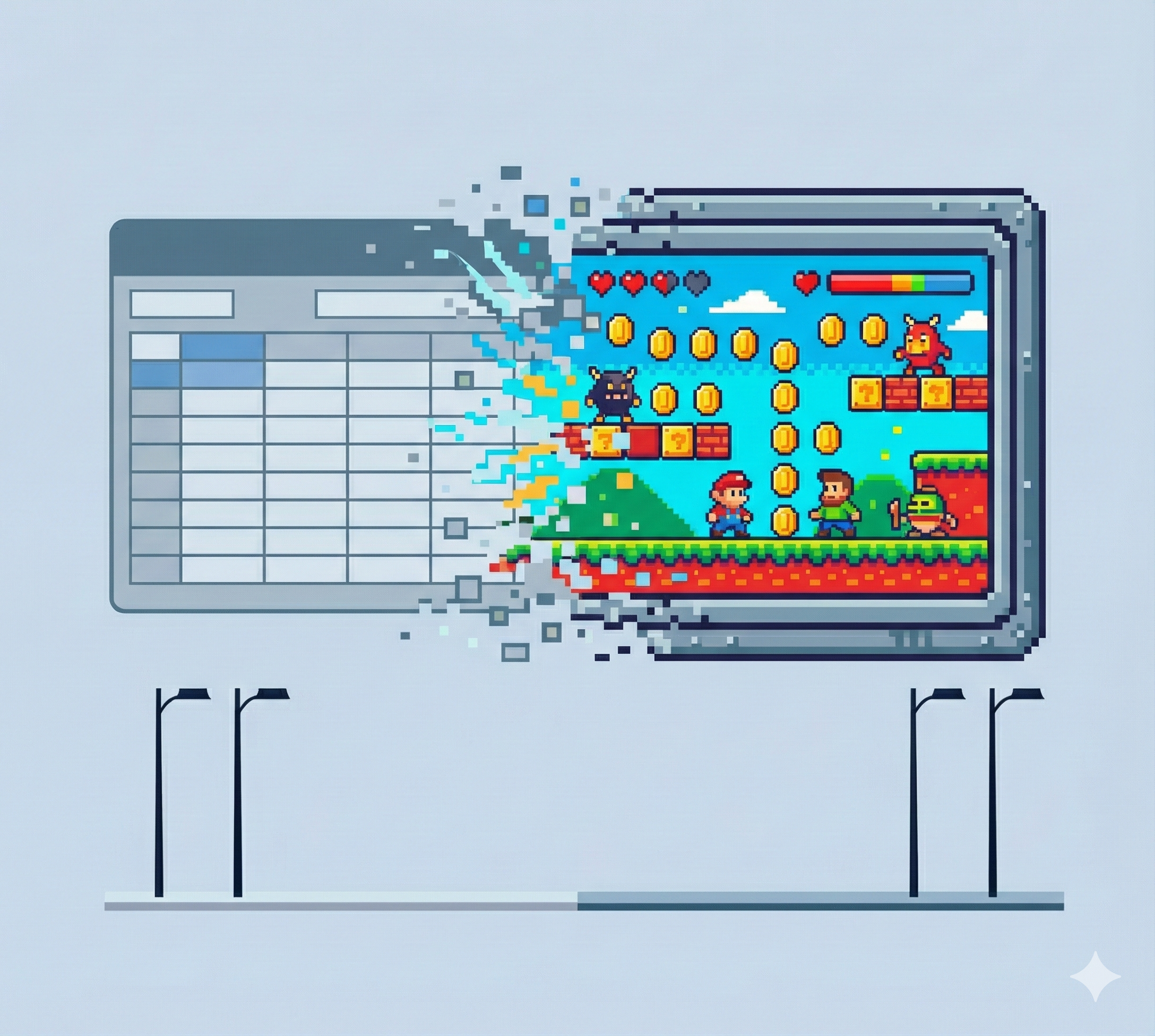
The Dopamine Deficit: Turning the Most Boring Parts of Business Into a Game
There is a specific sound that occurs in a conference room when a manager announces that it is time for the annual compliance training. It is a collective exhale. It is the sound of the air leaving the room. It is the sound of fifteen people mentally checking out at the exact same moment.
You know this sound. You have probably made it yourself.
As a business owner or a manager, you are stuck in a terrible position. You know that these processes are vital. You know that if the safety checks aren’t done, people can get hurt. You know that if the data security protocols aren’t followed, the company could be sued.
But you also know that the human brain was not designed to stare at a spreadsheet for two hours or to read a forty-page PDF about password hygiene without losing its mind.
We tend to treat this boredom as a discipline problem. We think that if our employees were just more professional, they would pay attention. We think they should care because we pay them to care.
But boredom is not a character flaw. It is a biological feedback loop. When the brain detects that an activity is repetitive and lacks a clear reward, it disengages to save energy. It creates a dopamine deficit.
If we want to fix compliance and process adherence, we cannot just demand more focus. We have to change the chemical equation of the work. We have to stop fighting human nature and start engineering around it. We have to talk about gamification.
The Biology of the High Score
To understand why gamification works, we have to look at video games. Why will a grown man spend hours organizing a virtual inventory in a game like Diablo or Minecraft when he won’t spend ten minutes organizing the inventory in his actual warehouse?
The action is the same. The context is different.
Games provide three things that standard business processes usually lack. Clear goals. Immediate feedback. And a visible score.
In a game, when you do the right thing, you get a ding. You get points. A bar fills up. Your brain gets a tiny hit of dopamine that says, “Good job. Do it again.”
In a business setting, compliance is usually a thankless task. If you do it right, nothing happens. No one notices. You only hear about it if you do it wrong.
This is a broken feedback loop. The brain learns that the best possible outcome is silence, and the worst possible outcome is punishment. That is a recipe for anxiety and avoidance, not engagement.
Gamification is simply the act of taking the feedback loops from games and applying them to non-game contexts. It is about making the invisible progress visible. It is about validating the effort in real time.
When we do this, we flip the script. We turn the boring stuff into a source of status and satisfaction.
The Power of the Streak
One of the most powerful mechanics in behavioral psychology is the streak. You see this in apps like Duolingo or Snapchat. The goal is simply not to break the chain.
When you track a streak, you are leveraging a psychological concept called loss aversion. Humans hate losing things more than they like gaining things. Once you have built up a streak of thirty days of perfect safety checks, you become irrationally protective of that number. You will go out of your way to do the check just to keep the streak alive.
Imagine applying this to your daily processes. Instead of nagging your team to fill out their end-of-day reports, you create a visual dashboard that shows the current streak for the team.
“We have hit 14 days of 100% reporting accuracy.”
Suddenly, the dynamic shifts. It is no longer You vs. The Team. It is The Team vs. The Streak. No one wants to be the person who breaks the chain for everyone else. The social pressure works in your favor. Peer accountability kicks in.
This works for personal development too. If an employee is trying to learn a new skill, tracking their daily progress creates a visual narrative of their growth. They can look at the calendar and say, “I am a person who shows up.”
Status, Leaderboards, and the Danger of Competition
Another tool in the gamification kit is the leaderboard. Humans are social animals. We are hardwired to care about our status within the tribe. We want to know where we stand.
However, leaderboards are a double-edged sword. If you implement them poorly, you can destroy your culture.
If you have a leaderboard that only celebrates the top performer, you demotivate everyone else. If the same person wins every month, the rest of the team stops trying. They decide the game is rigged or that they just aren’t good enough.
Worse, if you pit people against each other in a zero-sum game, you discourage collaboration. Why would I help my teammate fix a bug if it helps them beat me on the leaderboard?
The solution is to design leaderboards that celebrate different types of wins. Don’t just rank by “Total Sales” or “Fastest Completion Time.”
Rank by “Most Improved.” Rank by “Consistency.” Rank by “Helpfulness” (measured by peer kudos).
You can also use team-based leaderboards where the entire department plays against a target or against their own past performance. “Can we beat last month’s score?”
This harnesses the competitive drive without turning the office into a gladiator arena. It keeps the focus on the metric, not the ego.
Instant Feedback is the Key
The single most important element of gamification is speed. The reward must follow the action immediately.
The annual performance review is the opposite of gamification. It is like playing a video game for a year and only finding out your score at the end. It is useless for behavior modification.
We need to shorten the loop. If someone watches a training video, they should get a “Completed” badge instantly. If someone spots a safety hazard, they should be recognized in the Slack channel within the hour.
This is where technology helps. Modern learning management systems and employee engagement apps can automate this. They can send that digital confetti the moment the task is done.
But you don’t need fancy software to do this. A simple whiteboard in the breakroom where you tally wins every morning works just as well. The medium matters less than the timing.
When the brain associates the boring task with a moment of recognition, the task becomes less boring. It becomes a transaction where effort buys status.
Designing the Game Economy
So what do they win? This is the question every manager asks.
Do I have to give out cash? Do I have to buy gift cards every week?
Not necessarily. While tangible rewards are nice, they are often less effective than social rewards. Remember, the points in a video game are worthless in the real world, yet people fight for them.
The value comes from what the points represent. Mastery. Dedication. Status.
You can create a “Game Economy” where points can be traded for privileges rather than cash. Maybe earning a certain certification level unlocks the ability to work from home on Fridays. Maybe hitting a streak allows them to pick the lunch spot for the next team meeting.
Maybe the reward is simply a “Badge of Expertise” that goes on their email signature. This signals to clients and peers that this person is a master of their craft. That is a powerful motivator.
The key is to ask your team what they value. Do not guess. Some people want public recognition. Some people want time off. Some people want deeper responsibility. Design your game to offer rewards that actually matter to the players.
Changing the Narrative of Work
When you successfully gamify the boring stuff, you are doing something deeper than just increasing compliance rates. You are changing the narrative of the workday.
Work often feels like a series of obligations. “I have to do this.” Gamification shifts it to a series of challenges. “I want to complete this.”
It introduces a sense of playfulness into serious business. And we need to be clear here. Playfulness does not mean unprofessionalism. You can be deadly serious about safety protocols while being playful about how you track them.
In fact, play is the natural state of learning for mammals. Watch kittens fight. They are playing, but they are also learning how to hunt and survive. Play is how nature encodes skills.
By bringing a sense of play back into the office, you lower stress. You reduce the friction of the daily grind. You create a language of shared goals and friendly competition.
Suddenly, the compliance training isn’t a chore. It is the next level. And everyone wants to level up.
So look at that stack of paperwork or that list of safety checks. Don’t look at it as a burden. Look at it as a game board waiting to be designed. Your team is ready to play. You just have to set the rules.







