The Fear of Feedback: Why Your Team Dreads Your 'Quick Chat'and How to Fix It
You send a Slack message to an employee. “Do you have five minutes for a quick chat?”
On your end, this is innocuous. You just want to talk about a minor error in a report. On their end, their heart rate spikes to 120. Their palms sweat. They start mentally packing their desk. They assume they are getting fired.
This physiological reaction is the enemy of growth. When the brain is in a threat state, it cannot learn. It can only defend.
We have a cultural problem with feedback. We have framed it as punishment. We save it for the annual review, dumping a year’s worth of critique on someone all at once. Or we deliver it in a “sandwich” of fake praise that everyone sees through.
If you want a high-performing team, you have to detoxify feedback. You have to transform it from a weapon into a tool. You have to move from being a judge to being a coach.
We need to explore the neuroscience of criticism and the practical mechanics of delivering hard truths in a way that actually lands.
The Biology of Being Wrong
Why does criticism hurt so much? Because to the primitive brain, social rejection is a death sentence. Being told “you are wrong” feels like being told “you are being kicked out of the tribe.”
The amygdala hijacks the system. The employee stops hearing your words and starts scanning your face for signs of aggression. They might nod and say “okay,” but they aren’t processing the lesson. They are just trying to survive the encounter.
To bypass this defense mechanism, you have to signal safety first. You have to establish that the relationship is secure before you attack the problem.
This is why the “feedback sandwich” (compliment, critique, compliment) fails. The brain recognizes the pattern. It knows the compliment is just the bread holding the poison. It waits for the “but.”
“You’re doing great, BUT…”
Instead of the sandwich, use the “bridge.” Connect the feedback to their goals. “I know you want to lead this project next year. To get there, we need to fix how you handle these client emails.”
Now, the feedback is not a threat to their status. It is a vehicle for their ambition.
Specificity is Kindness
The most damaging feedback is vague. “You need to be more proactive.” “Your attitude is off.” “The quality isn’t there.”
This is not feedback. It is a riddle. The employee leaves the room confused and anxious. They try to guess what you mean, and they usually guess wrong.
To be kind, you must be specific. You must focus on behavior, not personality.
- Instead of “You’re lazy,” say “You missed the deadline on Tuesday and Thursday.”
- Instead of “You’re rude,” say “You interrupted Sarah three times in the meeting.”
Behavior is objective. It is data. Personality is subjective. It is an attack. When you focus on the behavior, you give them something they can fix. You can’t fix being “lazy.” You can fix missing a deadline.
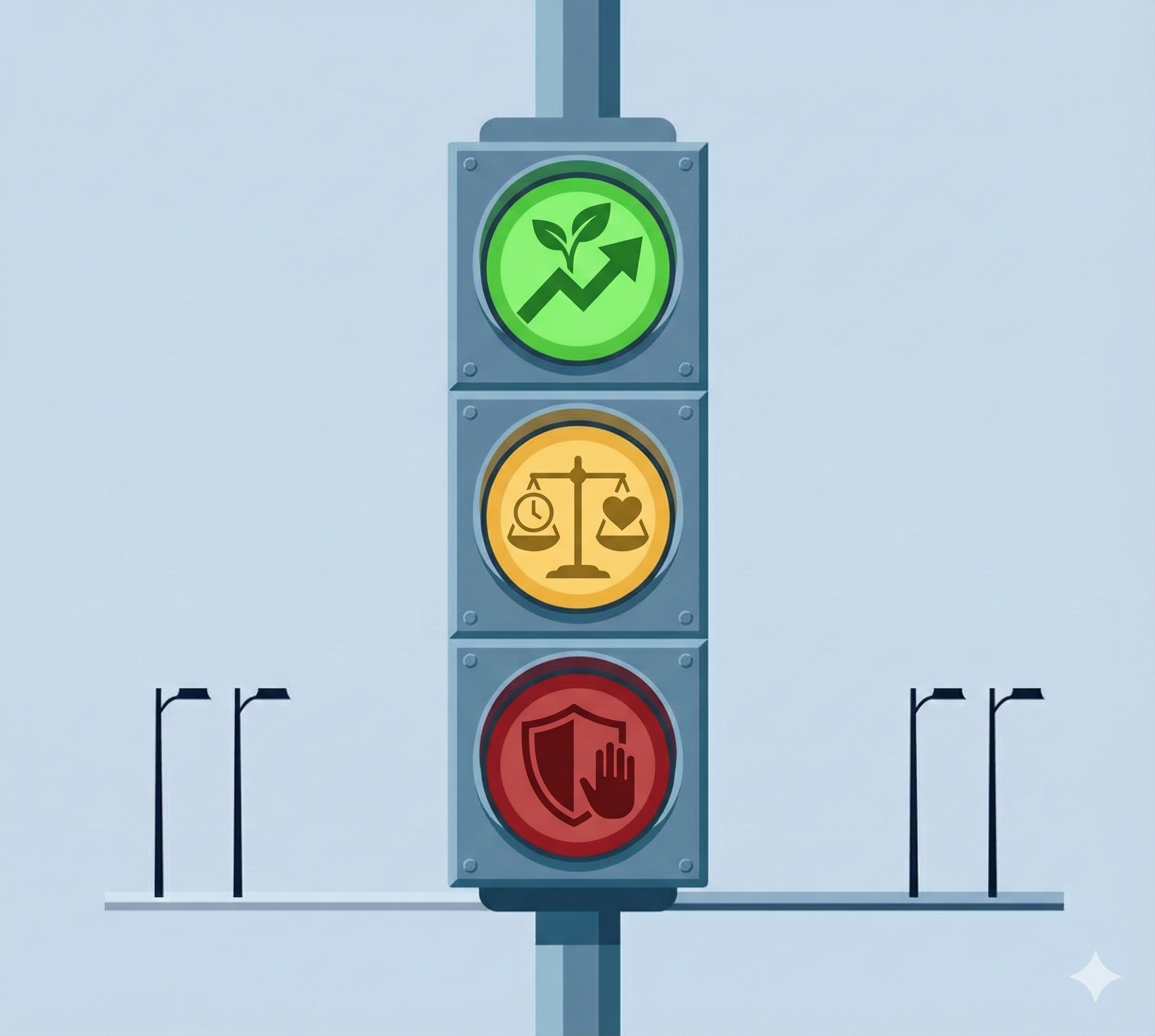
The Traffic Light System
One way to normalize feedback is to categorize it. Not all feedback is a crisis.
Use a Traffic Light system:
Green Feedback: Positive reinforcement. “Do more of this.” We often forget this. We assume people know when they are doing well. They don’t. Tell them specifically what worked so they can repeat it.
Yellow Feedback: Course correction. “This isn’t a big deal yet, but let’s tweak it.” This should be 80% of your feedback. It is the gentle nudge on the steering wheel.
Red Feedback: Stop immediately. “This behavior is dangerous to the business or the culture.” This requires a formal conversation.
When you clarify the level, you reduce the anxiety. If you give Yellow feedback but the employee thinks it is Red, they panic. If you give Red feedback but they think it is Yellow, they ignore it.
“This is a Yellow light. I just want to tweak the formatting for next time.”
Watch the tension leave their shoulders.
Timing is Everything
The half-life of feedback is short. If you wait two weeks to mention an error, the learning opportunity is gone. The employee doesn’t remember the context. It feels like you are holding a grudge.
Feedback should be immediate. The closer to the event, the better. “Hey, on that call just now, you handled the pricing objection perfectly.” Or, “Hey, in that email you just sent, the tone was a bit sharp.”
This micro-feedback prevents the buildup of resentment. It turns correction into a continuous loop rather than a scary event.
However, there is one exception. Do not give feedback when you are angry. If you are emotional, wait. Vent to a peer. Write a draft and delete it. Never deliver feedback when your own amygdala is hijacked.
Radical Candor: Care Personally, Challenge Directly
Kim Scott’s concept of “Radical Candor” is the gold standard. It sits in the upper right quadrant of a graph where the axes are “Care Personally” and “Challenge Directly.”
If you challenge directly but don’t care personally, that is Obnoxious Aggression. You are just being a jerk.
If you care personally but don’t challenge directly, that is Ruinous Empathy. You are letting them fail because you want to be nice.
To practice Radical Candor, you have to do both. You have to build a reservoir of trust through genuine care so that when you challenge them, they know it comes from a good place.
You can say hard things if the person knows you are on their side. “I am telling you this because I want you to succeed, and right now, this behavior is holding you back.”
Asking for Feedback First
The fastest way to build a feedback culture is to model it. Ask for it. Publicly.
“I think I rushed the end of that meeting. Did anyone else feel that?”
When the leader admits imperfection, it grants permission for everyone else to be imperfect. It shows that feedback flows up, not just down.
When an employee gives you feedback, do not defend yourself. Do not explain. Just say, “Thank you. I’ll think about that.”
If you argue, you teach them never to do it again. If you listen, you teach them that truth is safe.
The Aftermath: The High Five
After a difficult feedback conversation, do not just walk away. The employee is likely feeling bruised. They are wondering if your relationship is damaged.
You need to perform “Repair.” Send a follow-up message later that day. Not about the issue, but a normal, positive interaction. A joke. A relevant article. A “Have a good night.”
This signals: “We had a hard talk, but we are good. You are still part of the tribe.”
This reassurance is what allows them to process the feedback without spiraling. It closes the loop.
Feedback is not about proving you are right. It is about helping them get it right. It is an act of investment.
Stop avoiding it. Stop sugarcoating it. Be clear. Be kind. And watch your team grow.







