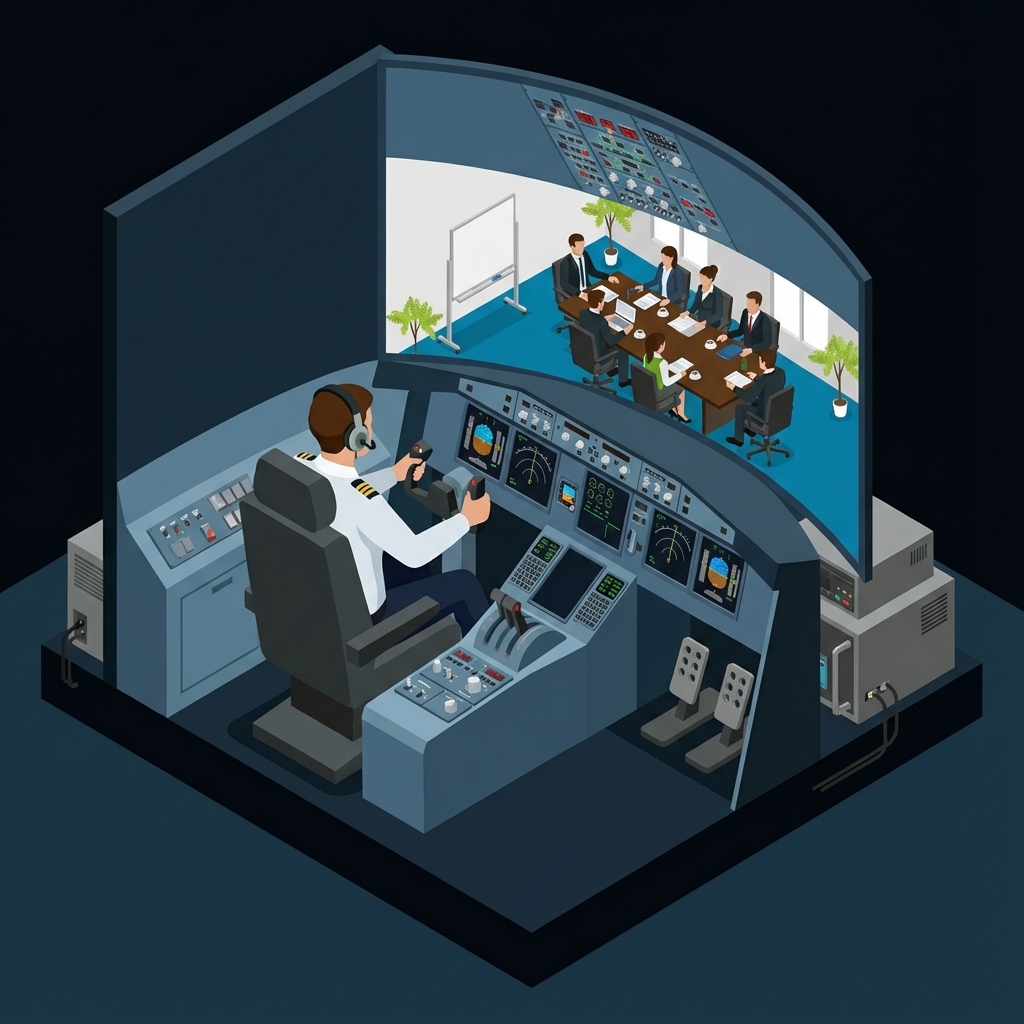
The Flight Simulator for Business: Why You Should Never Practice on a Real Customer
There is a universal moment of dread in sales and customer service. It is the moment when a new employee picks up the phone to handle their first angry client. Their hands are shaking. Their voice is tight. They are trying to remember the script, the de-escalation techniques, and the product details all at once.
Usually, they fail. They stumble. The client gets angrier. The manager has to step in.
We accept this as the “cost of doing business.” We say, “They have to learn sometime.” But this is a wildly expensive way to learn. You are burning a real customer relationship to train a novice.
Imagine if we trained pilots this way. “Okay, take the 747 up. If you crash, we will debrief it later.” That would be insane. Pilots train in simulators. They crash a thousand times in a virtual world so they never crash in the real one.
Business needs a flight simulator. And for the first time in history, we have one. AI allows us to create hyper-realistic roleplay scenarios where employees can practice, fail, and try again without risking a dime of revenue.
The Psychology of High-Stakes Conversation
Why do people freeze in difficult conversations? It is the amygdala hijack. When a customer yells, the brain perceives a threat. It goes into fight-or-flight mode. The prefrontal cortex—the part that knows the product specs and the script—shuts down.
The only way to override this hijack is exposure therapy. You have to face the threat enough times that your brain realizes it isn’t actually dangerous. You have to build muscle memory.
In the past, roleplaying was awkward. It required pulling a manager away from their work to pretend to be an angry customer. The employee felt silly. The manager felt rushed. It rarely happened enough to be effective.
AI changes the dynamic. An AI bot never gets tired. It never judges. It can be infinitely patient or infinitely difficult. It allows the employee to take the “reps” needed to desensitize their amygdala.
Use Case 1: The Angry Customer De-Escalation
This is the most obvious and valuable application. You can program an AI persona to be “Furious Frank.” Frank purchased a product that arrived broken. He wants a refund immediately, but it is against policy.
The employee logs in. The AI voice starts yelling (or typing in all caps). “This is unacceptable! I want to speak to your manager!”
The employee has to navigate this. They try to apologize. The AI pushes back. “I don’t want an apology, I want my money!”
If the employee gets flustered and hangs up, nothing happens. No bad review on Yelp. No churn.
The system gives immediate feedback. “You interrupted the customer three times. Try listening longer before offering a solution.”
The employee tries again. And again. By the fifth try, they are calm. They know exactly what to say to defuse Frank. When they finally get a real angry customer on the phone, their brain says, “Oh, I know this. This is just like Frank.”
Use Case 2: The High-Ticket Sales Negotiation
Negotiation is an art. It requires reading subtle cues and knowing when to hold firm on price. Most salespeople learn this by losing deals.
With AI, you can simulate a “Tough Buyer” persona. This buyer loves the product but hates the price. They use every trick in the book. They threaten to go to a competitor. They use silence as a weapon.
The salesperson practices their value prop. They practice the “flinch.” They practice the silence.
The AI can analyze the transcript. “You dropped the price too early. You gave a 10% discount before they even asked for it. Next time, try trading value instead of price.”
This turns negotiation from a terrifying gamble into a practiced game. The salesperson walks into the real meeting with a playbook they have already battle-tested.
Use Case 3: Delivering Bad News
Managers need practice too. One of the hardest things a manager has to do is give negative feedback or fire someone.
Most managers delay this conversation for months because they are scared. When they finally do it, they botch it. They are too vague, or too harsh.
An AI simulator can play the role of the “Defensive Employee.” The manager says, “Your performance is slipping.” The AI replies, “That’s not fair! I’ve been working so hard!”
The manager has to practice holding the line while maintaining empathy. They practice the specific phrasing. They practice managing their own emotions.
By the time they sit down with the real employee, they have rehearsed the difficult turn. They can be present and compassionate because they aren’t panicking about what to say next.
The Safety of the Sandbox
The crucial element here is safety. In a roleplay with a boss, the employee is always auditioning. They are worried about their job security. They mask their weaknesses.
With an AI, the mask comes off. They can ask stupid questions. They can try a risky joke to see if it lands. They can fail spectacularly.
This “Sandbox Mode” accelerates learning. We learn faster when we play. We learn faster when the consequences are removed.
It also allows for micro-training. An employee can do a 5-minute roleplay while drinking their morning coffee. It doesn’t require scheduling a meeting room. It becomes a daily hygiene habit, like brushing teeth.
Customizing the Scenarios
Generic training is fine, but custom training is transformative. You can feed the AI your specific product data, your specific competitors, and your specific customer personas.
If you sell roofing software, the AI can pretend to be a busy roofing contractor who hates technology. If you sell luxury travel, the AI can be a demanding high-net-worth individual who wants impossible upgrades.
This specificity matters. It creates “contextual competence.” The employee isn’t just learning “sales skills”; they are learning “how to sell our product to our customers.”
The Feedback Loop to Management
While the individual sessions should be private to build trust, the aggregate data is a goldmine for management.
If you see that 80% of your team fails the “Price Objection” scenario, you know exactly what your next training session needs to be about. You aren’t guessing at their weaknesses. You have data.
You can see which objections are the hardest to handle. You can see which scripts are working and which are failing. You can A/B test different sales approaches in the simulator before rolling them out to the field.
Building the Confidence Culture
Ultimately, this technology is about confidence. Confidence is not a personality trait. It is a byproduct of competence. It comes from knowing that you have faced the dragon before and won.
When you equip your team with an AI flight simulator, you are giving them the gift of preparation. You are telling them, “I want you to succeed so much that I am going to let you fail here, where it is safe.”
You stop throwing them into the deep end. You put them in the pool with a swim instructor who never gets tired.
And when they finally face the real world, they don’t flinch. They fly.







