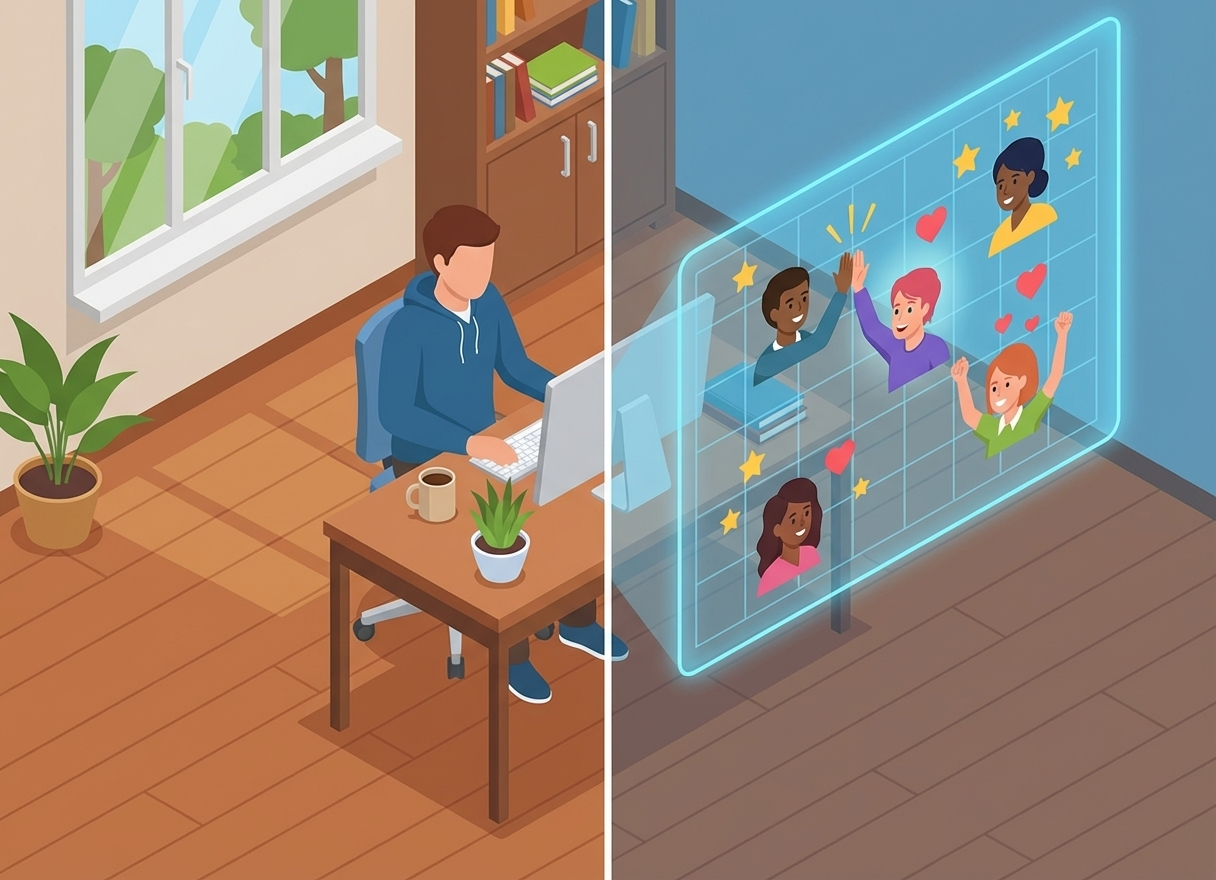
The Invisible Employee: Why Remote Onboarding Requires a Total Rewrite of Your Playbook
You are sitting at your desk in your home office. You have just hired a new remote employee. Let’s call him Alex. Alex lives three time zones away. You have met him twice on Zoom. He seems smart. He seems capable.
It is 9:00 AM on his first day. You send him a welcome email. You send him the login credentials for Slack and the CRM. You send him a link to the company handbook.
And then… silence.
In a physical office, you would see Alex. You would see him struggling to adjust his chair. You would see him looking around confusedly for the coffee machine. You would walk by and give him a thumbs up. You would overhear him asking the person next to him a question.
But Alex is invisible. You don’t know if he is reading the handbook or if he is staring at his wall wondering if he made a huge mistake. You don’t know if he is setting up his software correctly or if he is creating a mess that you will have to clean up next week.
This is the fundamental anxiety of the remote manager. The feedback loop is broken. The visual cues are gone.
We often try to solve this by treating remote onboarding just like in-person onboarding, but with more Zoom calls. This is a mistake. Remote onboarding is not just a digital version of the physical process. It is a completely different psychological challenge.
We need to understand what is lost when we lose the physical space, and how we can use technology not just to simulate the office, but to build something better.
The Death of Osmosis Learning
The biggest casualty of remote work is “Osmosis Learning.” This is the learning that happens by accident.
In an office, a junior employee learns how to handle an angry client by overhearing a senior employee on the phone three desks away. They learn the company culture by watching how people interact in the hallway. They learn who the real decision-makers are by seeing who sits where in the meeting room.
This information is not written down. It floats in the air. It is absorbed through the skin.
In a remote environment, the air is empty. There is no ambient information. If you do not explicitly write it down or say it on a call, it does not exist.
This means that remote onboarding requires a level of intentionality that feels unnatural to most managers. You cannot rely on Alex “picking things up.” You have to hand them to him.
This requires a shift from implicit training to explicit documentation. We have to externalize the culture. We have to record the sales calls so Alex can listen to them, since he can’t overhear them. We have to write down the unwritten rules of communication.
If we don’t, Alex will operate in a vacuum. He will make up his own rules. And six months from now, you will wonder why he isn’t culturally aligned.
The Silence of the Chat Window
In a physical office, asking a question is low friction. You lean over. You whisper. “Hey, how do I print this?”
In a remote setting, asking a question is high friction. You have to type it out. You have to decide which Slack channel to put it in. You have to worry if you are interrupting everyone. You have to worry if the question makes you look stupid in a public forum.
So, new remote hires often stay silent. They struggle alone for hours on a problem that could be solved in thirty seconds.
We need to lower the barrier to asking. We need to create “Digital Open Doors.”
This is where digital coaching platforms shine. Instead of forcing Alex to ask a public question, we can give him an AI-driven guide. He can ask the system, “What is the policy on expense reports?” and get an instant answer without the social anxiety.
We can also create designated “Office Hours” where a manager sits in an open Zoom room. Alex can drop in just to hang out or ask a quick question. It simulates the open door of a physical office.
The goal is to make the silence less terrifying. We want to encourage the “stupid” questions because those are the questions that prevent mistakes.
Trust and the Digital Leash
The other side of the remote coin is the manager’s trust issues. Because you can’t see Alex working, you might feel the urge to micromanage. You might check his “Active” status on Slack. You might ask for endless updates.
This is a disaster for morale. It tells Alex, “I hired you, but I don’t trust you.”
In a remote environment, we have to shift from managing activity to managing output. You cannot manage hours in a chair. You have to manage deliverables.
This means your onboarding plan needs to be incredibly specific about outcomes. Instead of saying, “Work on the project today,” you say, “By 5 PM, I need to see a draft of the first three slides.”
When the output is defined, you don’t need to worry about what Alex is doing at 2 PM. Did he deliver the slides? Yes? Then he is working.
This shift brings peace to both sides. Alex knows exactly what he needs to do to prove his value. You get the reassurance of seeing work get done. The “digital leash” is replaced by a contract of deliverables.
Manufacturing Connection
Loneliness is the silent killer of remote teams. A new hire can go weeks without having a non-work conversation. They become a transaction processor, not a team member.
In an office, connection happens in the margins. It happens while waiting for the elevator or heating up lunch. Remote work has no margins. Every interaction is scheduled and purposeful.
We have to manufacture the margins. We have to schedule the inefficiency.
This means building “social time” into the onboarding schedule. Pair Alex with a “Culture Buddy” for a virtual coffee. The rule is: no work talk. They just talk about their dogs or their hobbies.
Start your team meetings with five minutes of personal updates. Ask a question of the week. “What is the best meal you cooked recently?”
It feels forced at first. It feels inefficient. But it is the glue that holds the team together. If Alex doesn’t feel a human connection to his teammates, he will quit the moment a recruiter offers him a slightly higher salary. Loyalty is built on relationships, not just paychecks.
The Role of Asynchronous Video
Text is efficient, but it is cold. It lacks tone. It lacks emotion. It is easy to misinterpret a Slack message as angry when it was just brief.
To bridge the physical distance, we need to inject more humanity into the digital stream. This is where asynchronous video comes in.
Instead of sending Alex a long email explaining a task, record a two-minute Loom video. Let him see your face. Let him hear your voice. Let him see you smile.
Video conveys nuance. It conveys warmth. It creates a parasocial bond. Even if Alex is thousands of miles away, seeing your face on his screen makes you real to him.
Encourage him to reply with video. It breaks down the digital wall. It reminds everyone that there are human beings behind the avatars.
The Continuous Check-In
Finally, remote onboarding never really ends. In an office, you can see when someone is fully settled. You see their body language relax.
Remotely, you have to ask. You have to be proactive.
Schedule a 30-day, 60-day, and 90-day check-in that is purely about their experience. “How is the isolation treating you? Do you feel connected? Do you have the tools you need?”
These questions surface the hidden struggles. Maybe Alex’s internet connection is terrible and he is too embarrassed to say it. Maybe he feels left out of the joke channel.
By asking, you validate his experience. You show him that his well-being matters as much as his output.
Remote onboarding is harder than in-person onboarding. It requires more effort, more documentation, and more intentionality. But if you get it right, it unlocks a massive advantage. You can hire the best talent in the world, not just the best talent within a ten-mile radius.
You just have to build the bridge to reach them.







