The Paradox of Scale: How to Grow Without Losing Your Soul
Do you remember the first hundred customers?
You probably knew their names. You might have known their dogs’ names or the fact that they were renovating their kitchen. When they emailed support, you didn’t just answer a ticket; you continued a conversation. There was a warmth to the chaos. You were small, but you were significant to the people you served.
Then, the thing you wanted to happen actually happened.
You grew.
Now, you look at your dashboard and see thousands of transactions. You walk through your office, or scroll through your Slack channels, and you see employees whose names you struggle to recall instantly. You see customer complaints handled with generic templates rather than personal empathy.
A cold realization hits you.
You are becoming the kind of company you swore you would never be. You are becoming a monolith. This is a specific type of grief that high-growth founders feel. It is the grief of lost intimacy.
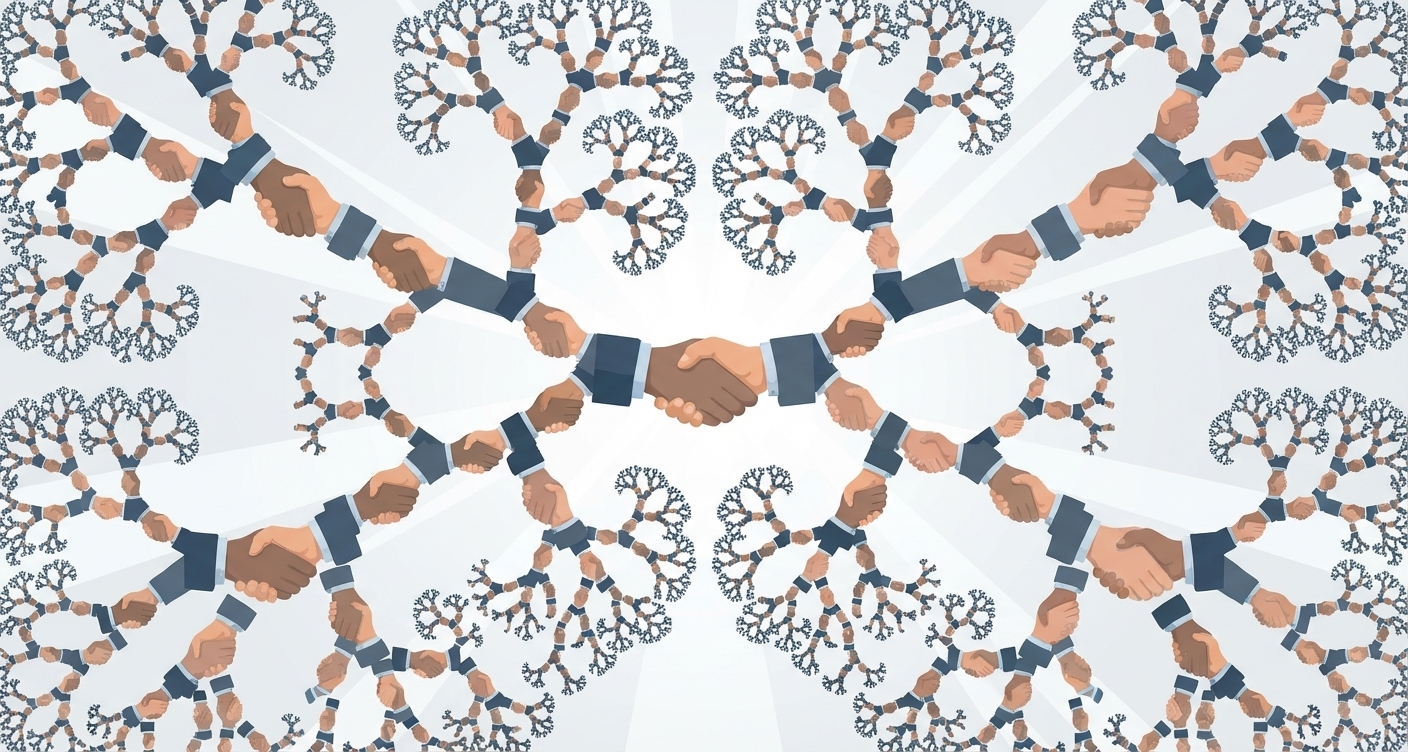
Is this inevitable? Is the price of success the loss of your soul? We need to investigate if there is a way to cheat the physics of business growth. We need to explore how to scale the handshake.
The Biology of Bureaucracy
Before we beat ourselves up about this, we have to look at the anthropology. Humans were not designed to scale.
Evolutionary psychologist Robin Dunbar famously proposed that there is a cognitive limit to the number of stable social relationships a human can maintain. That number is roughly 150. Once a group exceeds this size, the brain simply cannot track the complex web of relationships, obligations, and reputations required to keep a community tight.
When your business was ten people, you operated on tribal knowledge. You didn’t need a policy manual because everyone sat in the same room. You didn’t need a CRM script because you all heard the phone calls.
When you cross that biological threshold, the social fabric tears. To patch it, we introduce bureaucracy. We introduce rules, layers, and managers. These are necessary evils, but they act as insulators. They stop the flow of electricity between the leadership and the front line, and between the brand and the customer.
The challenge, then, is not to avoid structure. It is to build a structure that mimics the biology of the small tribe, even when the population is large. We have to engineer intimacy.
Systematizing the Personal Touch
The biggest mistake scaling companies make is trying to automate the relationship rather than automating the context.
When you were small, you had the context in your head. You knew Client A preferred morning calls. Now, that data is lost in the void.
To scale without losing your soul, you must treat data as a proxy for memory.
We often use CRMs (Customer Relationship Management tools) purely for sales tracking. We track revenue, probability to close, and last contact. This is utility, not humanity.
What if we changed the data architecture? What if the primary KPI for your system was context retrieval?
- Your support team should not just see a ticket number; they should see that this customer has been with you for five years and just launched a new product.
- Your sales team should see notes about the client’s communication style, not just their budget.
The Ritz-Carlton is famous for this. They are a massive global chain, yet they feel boutique. They achieve this through a relentless system of recording preferences. If you ask for extra pillows in New York, the staff in Tokyo knows about it three years later.
They didn’t just scale the bed; they scaled the memory of what you like.
For your business, this means investing in the unsexy work of data hygiene. It means training your team that recording a small detail about a client is not administrative busywork. It is the act of caring at scale.
Cellular Division: The Team Structure
If the Dunbar number tells us we can’t bond with a thousand people, the solution is not to force it. The solution is to stop trying to be one giant family.
Biologically, when an organism gets too big, it doesn’t just get fatter. It divides. Cells split to create new, autonomous units.
You can apply this to your organizational chart. Instead of building a massive pyramid with you at the top, consider a cellular structure.
Create small, cross-functional squads. Give them a specific mission and a specific customer segment. Let’s say you have a team of six: a developer, a designer, a marketer, and two support agents. Their mission is solely focused on your onboarding experience for new users.
Because the group is small, they regain the tribal connection. They know each other. They move fast. They have their own inside jokes.
More importantly, they can have a direct relationship with their specific slice of the customer base.
- The customer doesn’t feel like they are talking to a faceless department.
- They are talking to the ‘Onboarding Squad.’
- They start to recognize names.
This method allows you to be big and small at the same time. You are big in resources, but small in interface. You are essentially creating a fleet of speedboats rather than trying to steer one giant Titanic.
The Commander’s Intent
There is a terrifying moment for every founder when they realize they can no longer make every decision. You used to inspect every product before it shipped. You used to read every newsletter before it went out.
Now, you physically can’t.
So, how do you ensure the quality remains high without becoming a bottleneck? How do you stop your team from creating generic, soulless work when you aren’t looking?
The answer lies in a military doctrine called Commander’s Intent.
In the chaos of battle, specific orders often fail because the situation changes rapidly. If a general tells a soldier to ‘capture that specific hill from the north,’ and the north is blocked, the soldier is stuck.
Instead, the general gives the intent: ‘We need to secure the hill to prevent enemy supply lines from passing through.’
Now, the soldier is empowered. If the north is blocked, they attack from the south. The method changes, but the soul of the mission remains intact.
To scale your culture, you must move from giving instructions to giving intent.
- Instruction: Send this email template to anyone who complains.
- Intent: Every customer who complains should feel heard and respected, even if we cannot solve their problem immediately. We prioritize dignity over speed.
When you define the why and the feeling of the interaction, you empower your team to use their judgment. You treat them like adults.
This prevents the ‘I’m just following policy’ robot behavior that customers hate. It gives your staff permission to break the script to save the relationship.
The Unknowns of the Automated Future
As we implement these strategies, we have to acknowledge that the ground is shifting under our feet. We are entering an era where AI can simulate intimacy.
We have chatbots that can express empathy. We have algorithms that can predict needs better than a human.
This raises uncomfortable questions that we do not have the answers to yet.
- Where is the line between convenient automation and deception? If a customer thinks they are texting a person but it is an AI, have we violated their trust?
- Does efficiency eventually erode culture? If we use tools to eliminate all the friction, do we also eliminate the serendipity that builds relationships?
- Can a remote-first company ever truly replicate the bonds of a physical office, or are we just pretending?
We are all running this experiment in real time. There is no textbook for this phase of the economy.
Choosing to Care
Here is what we do know.
Effiency scales easily. Caring does not.
Caring is friction. It takes time to listen. It takes money to fix a mistake that you technically aren’t required to fix. It takes energy to treat your five hundredth employee with the same curiosity as your first.
But this friction is your competitive advantage.
Most of your competitors will take the easy road. They will hide behind phone trees. They will outsource their support to the lowest bidder. They will treat their team like units of production.
They will grow big, yes. But they will be hollow.
You have the opportunity to build something different. You can build a giant that still has a heartbeat.
It requires you to be intentional. It requires you to structure your teams, your data, and your communication around the human element.
It is the harder path. It is exhausting. There will be days when you just want to implement a policy and be done with it.
But when you look back in ten years, you won’t just see a profitable ledger. You will see a community. You will see a legacy. And you will still recognize the soul of the thing you built.







