The Pixelated Handshake: reclaiming human connection in a virtual world
You have likely felt it.
It is 4 PM on a Tuesday. You have been sitting in the same chair for six hours. You have jumped from one video meeting to the next. You have spoken to your team. You have given directions. You have listened to reports.
But as you close the laptop you feel a strange sense of emptiness.
You feel drained in a way that is different from physical exhaustion. You feel socially malnourished.
And worse you have a nagging suspicion that your team feels it too. You worry that despite the hours of face time you are drifting apart. You worry that the culture you worked so hard to build is evaporating into the ether of the internet.
This is not just in your head.
It is a physiological response to a technological problem.
When we moved our offices into the cloud we left behind millions of years of evolutionary biology. We stripped away the subtle signals that human beings use to build trust and safety.
We lost the ability to smell pheromones. We lost the ability to see micro movements of the hands. We lost the ability to make true eye contact.
In the physical world our brains process these signals instantly and unconsciously. We know if someone is safe. We know if they are listening.
In the virtual world our brains are working overtime to find these missing cues. We are staring at a grid of low resolution faces trying to decode intent from a two dimensional image. It is cognitively expensive. That is why you are so tired.
But here is the good news.
We can hack the system.
We can use specific techniques to mimic these biological signals and bring warmth back to the cold glass of the monitor. We can learn to speak a new language of non verbal communication that bridges the digital divide.
The Paradox of the Camera Lens
The single biggest destroyer of trust in a video call is the geometry of the gaze.
In a real conversation I look at your eyes. You look at my eyes. We connect. This signals attention and honesty.
On a video call this is physically impossible.
If I look at your eyes on my screen I appear to be looking down or to the side. I am not looking at you. I am looking at a picture of you.
To you it looks like I am disengaged. It looks like I am reading a script or checking my phone.
To make you feel like I am looking at you I have to look at the black circle of the camera lens. I have to look at a piece of plastic. This means I cannot see your reaction. I have to sacrifice my ability to read you in order for you to feel read by me.
This is the eye contact paradox.
So how do we solve it?
We have to treat the camera as a person.
When you are speaking you must train yourself to ignore the faces on the screen and speak directly to the lens. This feels unnatural. It feels lonely.
But to your team it looks like confidence. It looks like you are speaking directly to their soul. It conveys a level of focus that arrests attention.
When you are listening you can look at the screen. But when it is your turn to lead you must look at the dot.
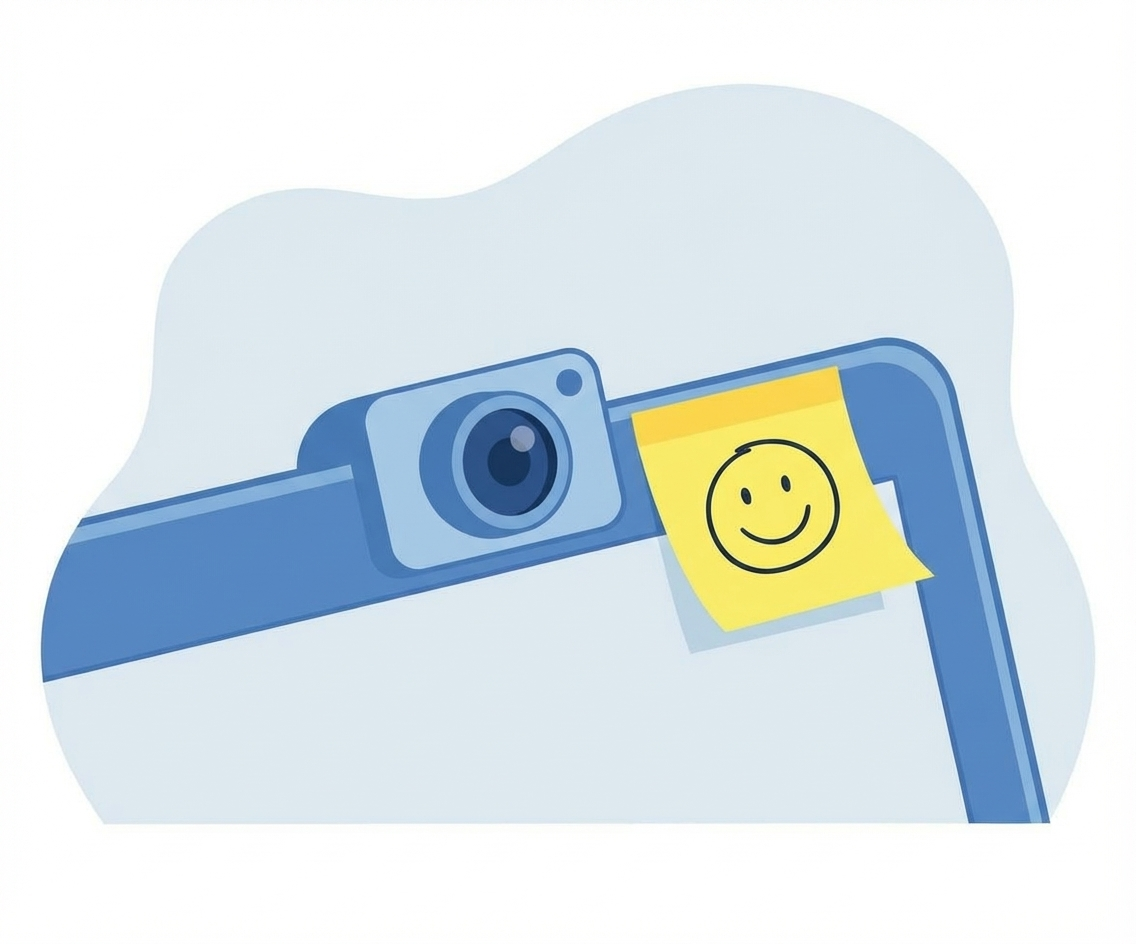
Try this practical trick. Put a sticky note with a smiley face and an arrow right next to your camera lens. It serves as a reminder. Look here for trust.
Are you brave enough to stare at a piece of plastic to make your team feel seen?
The Evolutionary Safety of Hands
Think about a news anchor. Or a politician giving a speech. Or a TED talk speaker.
What do they all have in common?
You can see their hands.
There is a deep evolutionary reason for this. For our ancestors hidden hands meant a hidden weapon. Hidden hands meant danger. When we can see someone’s open palms our reptilian brain relaxes. We know they are not holding a rock or a spear.
Now look at your current Zoom setup.
You are likely a floating head. Your shoulders are cut off. Your hands are invisible.
To your team’s subconscious mind this is a low grade threat. They cannot see what you are doing. Are you typing an email? Are you texting? Are you hiding something?
We need to change the framing.
Push your camera back. Or push your chair back. You want to create a frame that includes your head, your shoulders, and your upper chest. This is often called the bust shot in photography.
This wider frame allows you to use your hands to gesture. When you are explaining a complex concept use your hands. When you are welcoming the team open your arms.
Even if the gesture is blurry the motion registers.
It signals passion. It signals openness. It signals that you have nothing to hide.
Watch a recording of your last meeting. Were you a floating head? Or were you a whole person?
The Geometry of Authority and Lighting
Cinema directors have known this for a century.
If you want a character to look scary you light them from below. If you want them to look mysterious you use heavy shadows. If you want them to look weak you film them from above. If you want them to look domineering you film them from below.
Most managers are accidentally signaling the wrong things because of poor lighting and bad angles.
If your laptop is on your desk and you are looking down at it you are looming over your team. You are literally looking down your nose at them. This triggers a subconscious feeling of being dominated or scolded.
Conversely if your camera is too high you look small and diminished.
The lens should be at eye level. Exactly parallel to the ground. You might need to put your laptop on a stack of books. You might need a stand.
This simple adjustment changes the power dynamic. It creates a peer to peer conversation rather than a hierarchy.
Now consider the light.
If you sit with a window behind you, you become a silhouette. Your face is dark. Your expressions are unreadable.
Human beings need to see facial expressions to feel empathy. If I cannot see the crinkle of your eyes when you smile or the concern on your brow when we discuss a problem I cannot connect with you.
You do not need expensive studio lights. You just need a lamp in front of you. You need to light your face so that your team can read your emotional map.
Are you hiding in the shadows? Or are you illuminating your intent?
The Lag of Digital Silence
In a physical room silence is nuanced. We can feel the energy of the room. We can see people thinking.
In a virtual room silence is terrifying.
Audio lag creates a delay of milliseconds to seconds. When you ask a question and there is silence you assume the worst. You assume they hate the idea. You assume they are tuned out.
And when they are listening to you they are often muted. You cannot hear their mm-hmm or their laughter.
This creates a vacuum of feedback.
To counter this we must exaggerate our non verbal feedback. We must become slightly more theatrical than we would be in person.
When someone makes a good point do not just nod slightly. Nod visibly. Give a thumbs up. Smile bigger than usual.
You are not being fake. You are compensating for the compression algorithm. You are making sure the signal is strong enough to survive the trip through the fiber optic cables.
Encourage your team to use the chat for emotional feedback. A stream of agreed or fire emojis in the chat serves as the digital equivalent of nodding heads in a boardroom.
It reassures the speaker that they are not shouting into the void.
The Environment as Body Language
Finally we have to talk about what is behind you.
Your background is part of your non verbal communication. It tells a story about who you are and how you work.
A messy room with an unmade bed signals chaos. It signals that you are overwhelmed. It distracts the viewer as they try to identify the laundry on the floor.
A blurred background is better but it can feel secretive. It feels like you are hiding something.
A fake virtual background of a tropical beach or the Golden Gate Bridge is fun for a moment but often feels unprofessional or distracting as your hair glitches in and out of the image.
The best background is a curated reality.
A bookshelf. A clean wall with a piece of art. A plant.
These things signal stability. They signal that you are grounded. They provide a calm visual anchor for your team.
You are the captain of the ship. If the captain’s quarters are a mess the crew gets nervous.
This does not mean you need a perfect home office. It just means you need to control the four feet of reality that are visible to the world.
Reclaiming the Human Element
We are all learning this together.
We are immigrants to this digital land. We speak the language with an accent. We make mistakes.
But the goal is not to be a television producer. The goal is to be a leader.
The goal is to remove the friction that technology places between you and your people.
When you fix your eye contact, when you show your hands, when you light your face, you are doing a kindness to your team. You are reducing their cognitive load. You are making it easier for them to trust you.
You are telling them that they are worth the effort.
And in a world of avatars and algorithms that humanity is your greatest competitive advantage.
Turn on your camera. Look at the lens. And let them see you.







