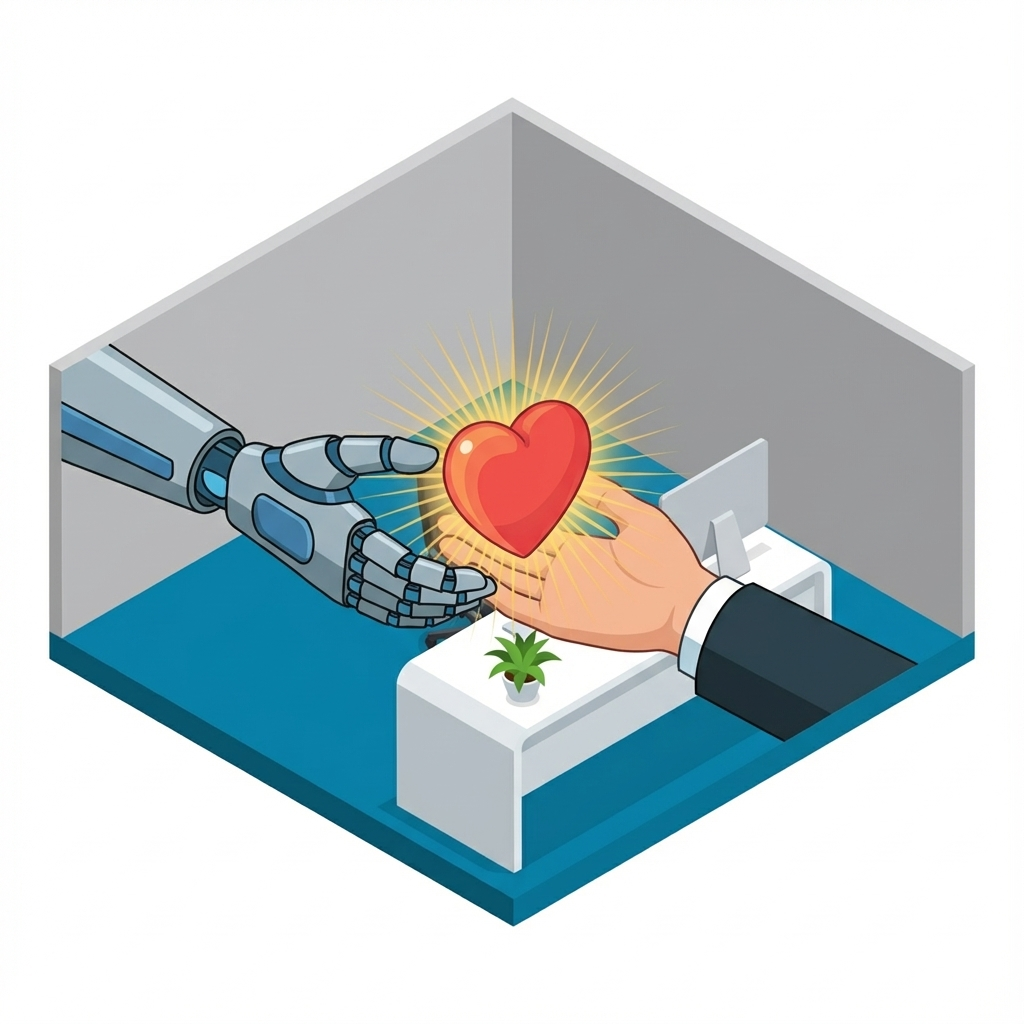
The Renaissance of the Human: Why Empathy is the Last Competitive Advantage
There is a prevailing narrative that AI will make humans obsolete. That we are all destined to be replaced by algorithms that can write faster, calculate better, and never sleep.
This narrative is half-true. The algorithm will replace the part of you that acts like a robot. It will replace the part of you that memorizes facts, sorts data, and processes transactions.
But this replacement is not an end. It is a beginning. By stripping away the robotic tasks, AI is clearing the stage for the one thing it cannot do. It cannot care.
We are entering an era where the “Human Touch” is no longer a soft skill. It is the primary product. In a world where information is free and instant, connection becomes the premium asset.
We need to stop viewing AI and humans as competitors in a zero-sum game. We need to view them as partners in a symbiosis. AI handles the competence. Humans handle the warmth. And together, they create something that neither could achieve alone.
The Commodity of Knowledge
For the last hundred years, the economy has valued knowledge. We paid doctors because they knew the symptoms. We paid lawyers because they knew the case law. We paid engineers because they knew the math.
But knowledge is becoming a commodity. An AI can pass the Bar Exam. An AI can diagnose a rare disease faster than a human. An AI can write code in seconds.
If your business model is based solely on “knowing things,” you are in trouble. The price of “knowing” is dropping to zero.
However, the price of “understanding” is skyrocketing. A patient doesn’t just want a diagnosis; they want someone to hold their hand and explain what it means for their life. A client doesn’t just want a legal contract; they want someone to reassure them that they are making the right choice for their family.
The value has shifted from the “What” to the “How.” The AI provides the answer. The human provides the context and the comfort.
Unleashing Empathy at Scale
Think about your customer support team. Right now, they are probably drowning. They are answering the same question about passwords fifty times a day. By the time they get to a customer with a complex, emotional problem, they are exhausted. Their empathy tank is empty.
Now imagine an AI handling the fifty password questions instantly. The customer is happy because they didn’t have to wait. And your support agent is fresh.
When the complex call comes in—the customer who is angry, confused, or scared—your agent has the energy to listen. They have the patience to de-escalate. They can spend thirty minutes solving that one problem because the AI cleared the backlog.
This is “Empathy at Scale.” Automation doesn’t remove the human; it reserves the human for the moments that matter.
It allows you to deliver a level of service that was previously impossible because your best people were too busy doing low-value work.
The New Definition of Expertise
If knowledge is cheap, what does it mean to be an expert in the future?
Expertise will be defined by three things: Curation, Synthesis, and Connection.
Curation: The AI can give you ten options. The expert knows which one is right for this specific situation.
Synthesis: The AI can analyze data points. The expert can see the story behind the data. They can connect the dots between market trends, customer sentiment, and operational reality.
Connection: The AI can communicate information. The expert can communicate trust. They can build the relationship that turns a one-time buyer into a lifelong partner.
We need to train our teams for these skills. We need to stop testing them on rote memorization and start testing them on judgment and emotional intelligence.
The Cyborg Manager
This shift applies to management as well. We discussed the AI Coach in previous articles. If the AI is handling the tactical coaching (“Here is how to improve your sales script”), what does the manager do?
The manager becomes a Mentor. They focus on the career path. They focus on the blocker in the employee’s personal life that is affecting their work. They focus on the team dynamics.
The “Cyborg Manager” uses data to identify the problem but uses humanity to solve it.
For example, the AI might flag that an employee is logging in late every day. That is data. A bad manager sends a warning email. A Cyborg Manager sees the data and invites the employee for coffee. “I noticed you’re starting later. Is everything okay at home?”
Maybe they find out the employee’s childcare situation changed. They work out a flexible schedule. They save the employee.
The machine provides the signal. The human provides the solution.
Trust in an Artificial World
As AI generates more content—more emails, more articles, more videos—the world will become noisy. People will become skeptical. “Is this real? Did a human write this?”
In this environment, authenticity becomes the ultimate currency. Your customers will crave the evidence of humanity.
This means you might actually need to use less automation in certain areas. You might need to pick up the phone more. You might need to send handwritten notes. You might need to host live events.
You use AI to automate the backend so you can afford to be inefficient on the frontend. You save time on the invoice so you can spend time on the handshake.
Training for the Renaissance
So how do you prepare your team for this? You have to change what you celebrate.
Stop celebrating the person who works the longest hours doing data entry. That person is doing a robot’s job.
Start celebrating the person who turned an angry customer into a fan. Start celebrating the person who mediated a conflict between departments. Start celebrating the person who had a creative breakthrough.
You need to explicitly train for soft skills. Roleplay difficult conversations. Workshops on active listening. Seminars on negotiation.
These used to be “nice to have.” Now they are “need to have.”
The Permission to Be Human
For too long, we have asked our employees to check their humanity at the door. “Be professional.” “Don’t get emotional.”
But in the AI era, your humanity is your only defense against obsolescence. Your emotions, your intuition, your ability to read a room—these are the things the machine cannot touch.
So give your team permission to be human. Encourage them to bring their weirdness, their passion, and their empathy to work.
The robot can handle the spreadsheet. Only you can handle the relationship.







