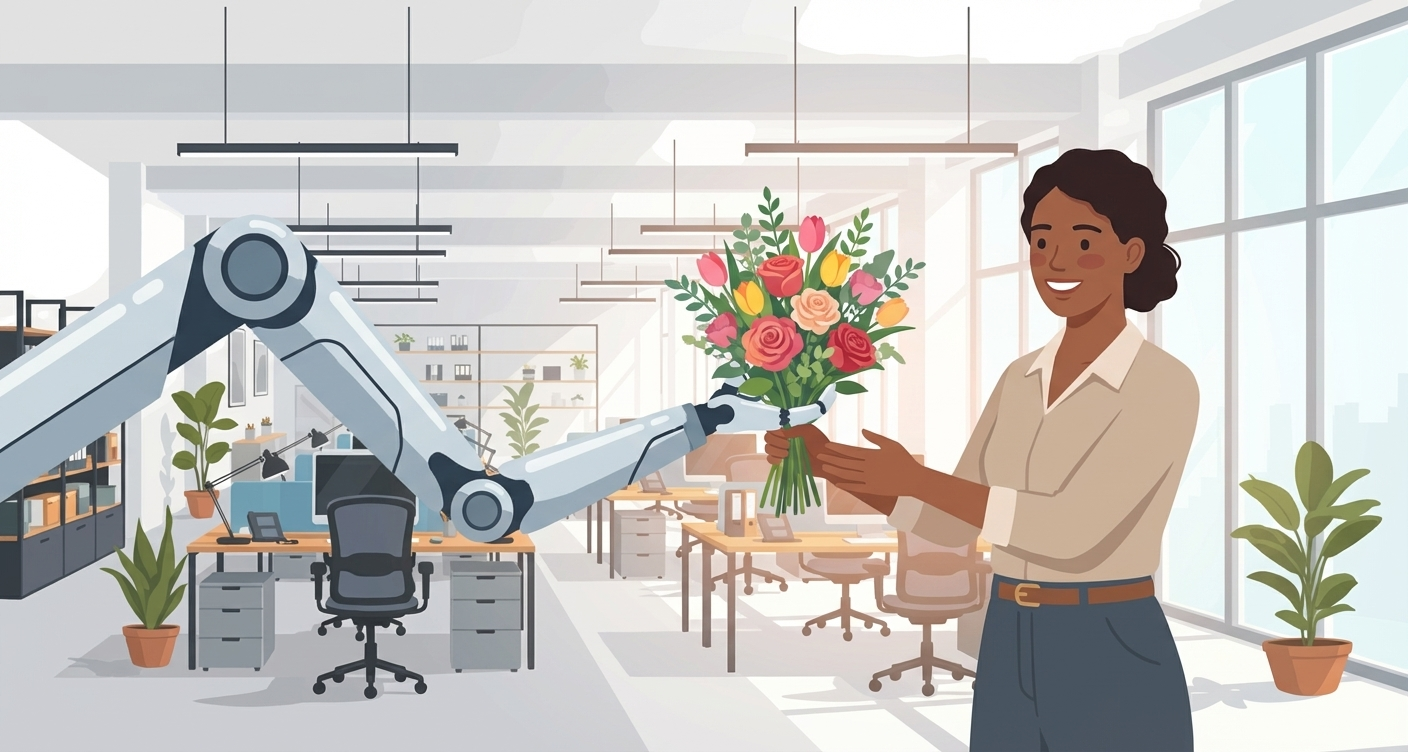
The Robot is Not Coming for Your Job: It is Coming for Your Boredom
There is a pervasive fear in the modern workforce. It is the fear that a robot, or an algorithm, or an AI is coming to take our jobs. We see headlines about automation and we imagine a future where humans are obsolete.
But if you look at the actual day-to-day reality of most small businesses, the opposite is true. We are not suffering from too much automation. We are suffering from too little.
Walk into any office and you will see intelligent, creative, empathetic human beings acting like robots. You will see them copying data from a spreadsheet and pasting it into an email. You will see them manually scheduling calendar appointments. You will see them filing invoices by hand.
This is a tragedy. It is a waste of human potential. The human brain is the most complex machine in the known universe. Using it to copy-paste data is like using a supercomputer to prop open a door.
We need to reframe automation. It is not an enemy. It is a liberation movement. The goal of automation is not to remove the human from the loop. It is to remove the robot from the human.
The Cognitive Cost of the Mundane
Why does repetitive work drain us so much? Why is an hour of data entry more exhausting than an hour of strategic planning?
It is because the human brain craves novelty and problem-solving. When we force it to do repetitive, low-stakes tasks, it rebels. We zone out. Our attention drifts. And crucially, we make mistakes.
Humans are terrible at repetition. We get bored. We get tired. We get distracted. Machines love repetition. They never get bored. They never get tired. They never make a typo because they haven’t had their coffee yet.
When you ask a human to do a machine’s job, you are setting them up for failure. You are guaranteeing errors. And you are burning out their dopamine reserves, leaving them with no energy for the work that actually requires humanity—like calming an angry client or designing a new product.
The Low-Hanging Fruit of Automation
So where do we start? Many business owners avoid automation because they think it requires a team of developers or expensive enterprise software.
That was true ten years ago. It is not true today. The “No-Code” revolution has democratized automation. Tools like Zapier and Make allow anyone who can drag and drop to build powerful workflows.
Start with the “Swivel Chair” tasks. These are tasks where you look at one screen, get data, swivel your chair (or switch tabs), and put that data into another screen.
- Example: A lead comes in via a Facebook ad. You copy the name. You open your CRM. You paste the name. You open your email. You write a welcome message.
This takes five minutes. If you get ten leads a day, that is nearly an hour of dead time.
An automation tool can do this instantly. The lead comes in. The tool puts it in the CRM. The tool sends the email. And it notifies you on Slack. Total human time: zero seconds.
Now multiply that by every administrative process in your business. Invoicing. Onboarding. Scheduling. Reporting. You are likely losing 20 to 30 percent of your total payroll to tasks that could be done by a $50 piece of software.
The Fear of the Black Box
Why don’t we do this immediately? Fear. We trust our own hands. We worry that if we let the machine do it, something will break and we won’t know.
This is a valid concern. Automation requires trust. But it also requires verification.
The way to overcome this fear is to start small. Don’t automate your entire payroll system on day one. Automate a notification.
Start with internal processes where the risk is low. Automate a reminder for the team meeting. Automate the collection of weekly status reports.
As you see the machine working reliably, your trust will grow. You will start to see the “Black Box” not as a mystery, but as a reliable teammate.
Freeing the Team to be Human
The most powerful argument for automation is what happens to your team when you implement it. You might worry they will feel threatened. “If the software does my data entry, what do I do?”
The answer is: “You do the things the software can’t do.”
The software cannot empathize with a client who is going through a divorce. The software cannot negotiate a complex partnership. The software cannot brainstorm a creative marketing angle.
When you take the administrative burden off your team, you are giving them a promotion. You are telling them, “I value your mind, not just your typing speed.”
This increases retention. People rarely quit jobs because they have too much creative work. They quit because they are drowning in bureaucracy. Automation kills bureaucracy.
The Customer Experience Dividend
Automation doesn’t just help your team; it delights your customers. In the age of Amazon and Uber, customers expect speed. They expect instant confirmation. They expect real-time updates.
If a customer fills out a form on your website and has to wait 24 hours for a human to manually review it and send a PDF, you have lost them. They have already moved on to a competitor who gave them the PDF instantly.
Automation allows a small business to punch above its weight class. It allows you to offer a “Big Company” experience with a small team. You can have 24/7 responsiveness without working 24/7.
This builds trust. It signals competence. It tells the customer that you have your act together.
The Automation Audit
How do you find the opportunities? You need to run an Automation Audit.
Ask your team to track their time for a week. Ask them to highlight every task that they do more than three times a week that requires zero judgment. If they could write down the instructions on a napkin and hand it to a stranger, it is a candidate for automation.
Look for the word “Just.” “I just have to copy this file.” “I just have to update the status.” “Just” is the keyword for low-value work.
Make a list. Pick the one that causes the most frustration. And solve it.
You don’t need to build a perfect system. You just need to build a better system than the one you have today.
The Future is Hybrid
We are moving toward a hybrid workforce. Not just remote and in-person, but human and digital.
The winning businesses of the next decade will be the ones that figure out the right division of labor. Machines for the repetitive, the precise, and the data-heavy. Humans for the creative, the emotional, and the ambiguous.
This is not a future to fear. It is a future to build toward. Because when we stop acting like robots, we finally get the chance to see what we are truly capable of as humans.







