The Seven Most Dangerous Words in Business: Why Nostalgia is a Strategy for Bankruptcy
There is a phrase that kills companies. It does not sound dangerous. It sounds comfortable. It sounds stable. It is the phrase: “We have always done it this way.”
When you hear this phrase, you are not hearing a defense of a strategy. You are hearing the sound of a business that has stopped thinking. You are hearing the sound of inertia masking itself as wisdom.
Every process in your business was created at a specific moment in time to solve a specific problem. But time moves on. The problem changes. Technology changes. The market changes.
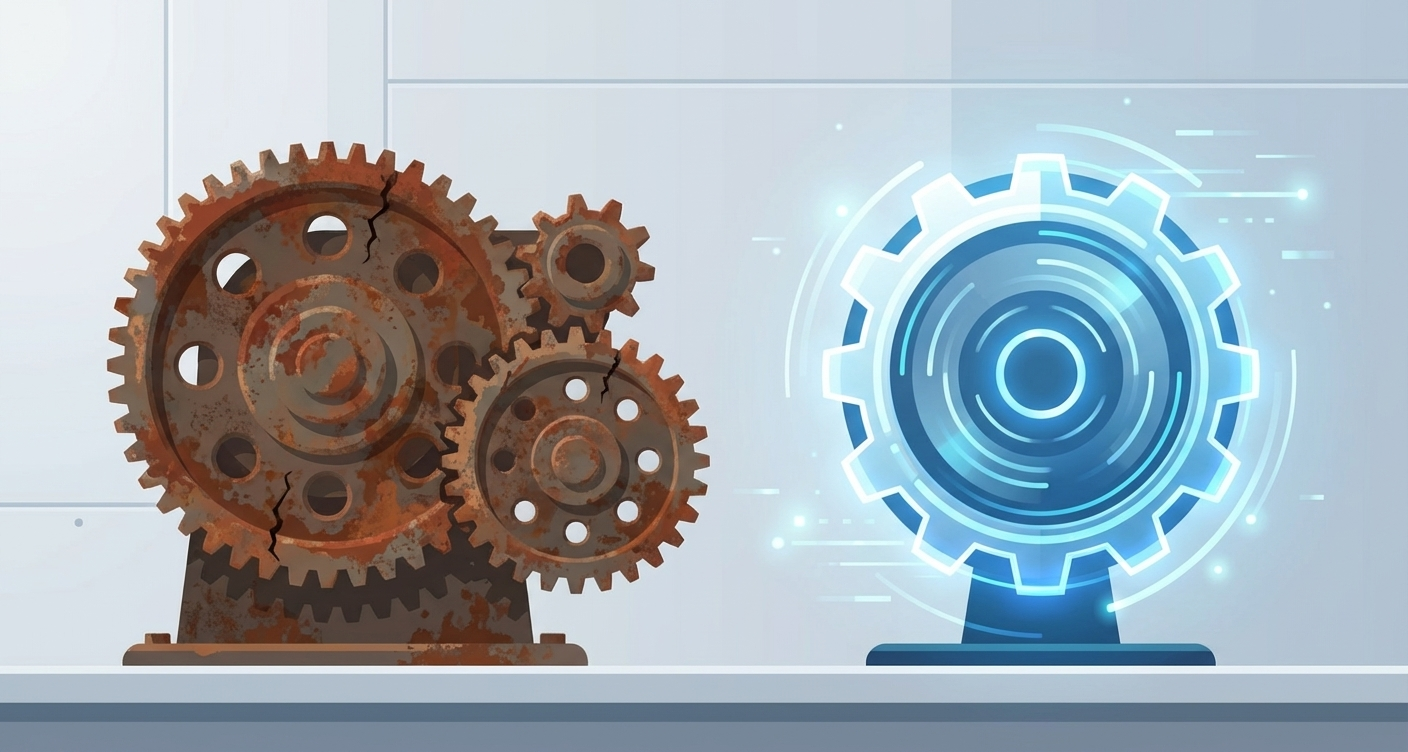
If the process remains static while the world is dynamic, the process becomes a liability. It becomes rust.
We need to talk about how to scrape the rust off your business. We need to talk about how to challenge the sacred cows of your operations without destroying the morale of your team. And we need to understand why success is often the biggest barrier to future growth.
The Trap of Past Success
The reason “we have always done it this way” is so seductive is that, usually, it worked. At some point, that way of doing things made you money. It got you to where you are today.
This creates a cognitive bias known as “Outcome Bias.” We assume that because the outcome was good, the process must be perfect.
But often, we succeed despite our processes, not because of them. Or we succeed because the market conditions were so favorable that even a mediocre process could win.
As you grow, the margin for error shrinks. The inefficiencies that were annoying when you were a team of three become crippling when you are a team of thirty.
When a manager defends a legacy process, they are usually defending their own history. They built that process. Attacking the process feels like attacking them. We have to separate the ego from the mechanics.
The Boiling Frog of Inefficiency
Inefficiency rarely arrives with a bang. It creeps in. It is the boiling frog syndrome.
You add one extra approval step because of a mistake made three years ago. You add one extra field in the CRM because a sales manager wanted it five years ago. You add a weekly meeting because of a specific project that ended last month.
Over time, these layers of sediment harden into rock. Your team stops questioning them. They just assume this is how the world works.
New hires notice it immediately. They ask, “Why do we print this form and then scan it back in?” The veterans shrug and say, “That’s just the process.”
Eventually, the new hires stop asking. They assimilate. And the opportunity for improvement is lost.
To fight this, you have to artificially induce a crisis. You have to force the team to look at the sediment.
The “Kill a Stupid Rule” Session
One of the most effective ways to break inertia is to hold a “Kill a Stupid Rule” session. This is a concept popularized by Lisa Bodell.
Gather your team. Give them permission to be brutal. Ask them: “If you could kill one rule or process that makes your job harder and adds no value to the customer, what would it be?”
At first, they will be hesitant. They will test the waters with small things.
But once they realize you are serious, the floodgates will open. You will hear about reports that nobody reads. You will hear about software that takes ten clicks to do what should take one. You will hear about meetings that exist only to plan other meetings.
Your job in this session is not to defend the rules. It is to listen. And then, right there in the room, kill something.
“Okay, the Friday report is dead. We aren’t doing it anymore.”
The energy that releases is palpable. You have just given them time back. You have proven that the status quo is not a prison.
The Audit of Assumptions
Beyond specific rules, you need to audit your assumptions. These are the deep beliefs about your business model.
“Our customers will never buy online.” “We can’t raise prices.” “We need an office to be productive.”
Are these true? Or were they true in 2019?
You need to run experiments to test these assumptions. If you believe you can’t raise prices, try raising them for new clients only. See what happens. If you believe customers won’t buy online, put up a simple landing page and test it.
Data beats opinion. “We have always done it this way” is an opinion. “We tested it and conversion dropped 10%” is data.
The Psychology of Change Resistance
When you start changing things, you will face resistance. This is normal. The human brain hates change. Change burns calories. The brain wants to conserve energy.
To overcome resistance, you have to sell the problem before you sell the solution.
Do not just say, “We are changing the CRM.” Say, “We are losing 20% of our leads because our current system is too slow. That is costing us $50,000 a month. That is why we are changing the CRM.”
When the team understands the cost of the status quo, the pain of change becomes bearable.
You also need to identify your “Champions.” In every group, there are early adopters who are excited about new things. Empower them. Let them test the new process first. Let them be the ones to tell the rest of the team, “Hey, this is actually way better.”
Continuous Improvement as a Lifestyle
The goal is not to fix the processes once and then stop. The goal is to build a culture of Kaizen—continuous improvement.
This means that every process is “in beta.” Nothing is final. Everything is subject to review.
When an employee finds a better way to do something, celebrate it. Make it the new standard. And then expect someone else to improve on that in six months.
This creates a dynamic, agile organization. It removes the fear of critique because we are criticizing the process, not the person.
The Danger of Nostalgia
Business owners are often nostalgic. We remember the “good old days” when the team was small and we knew everyone’s name. We cling to the rituals of that era.
But nostalgia is a strategy for bankruptcy. You cannot drive a car by looking in the rearview mirror.
Honor your past. Respect the work that got you here. But do not let it hold you hostage.
The most successful companies are the ones that are willing to cannibalize their own successful products to build the next one. They are the ones willing to tear down a working system to build a better one.
Look at your business today. Look at the things you do simply because of habit. Pick one. Ask “Why?”
If the answer is “Because we always have,” stop.
That is not a reason. That is an excuse. And you are too busy for excuses.







