The Silence at the Top: Navigating the Structural Isolation of Leadership
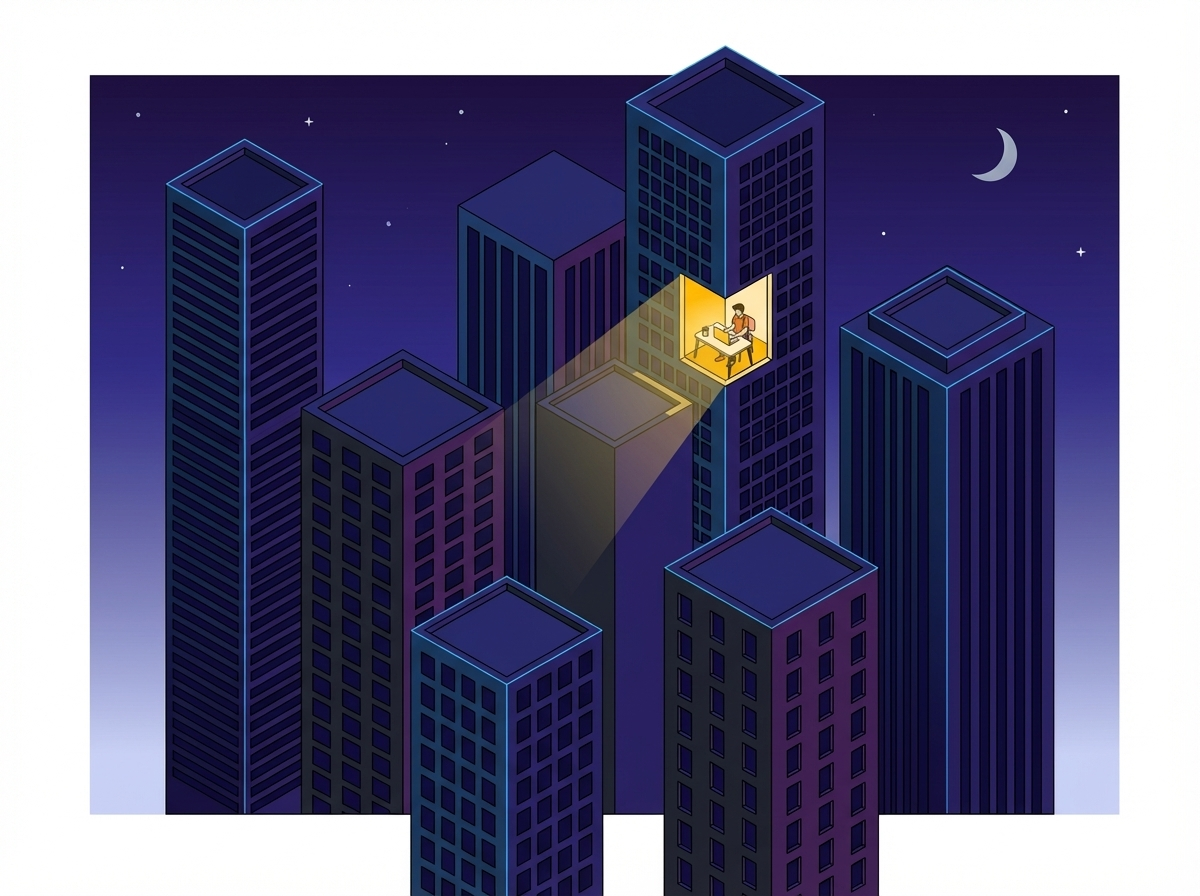
There is a very specific frequency of silence that settles over an office at 7 PM on a Tuesday. The team has gone home. The slack notifications have finally stopped chirping. The janitorial staff hasn’t arrived yet. It is just you and the glow of a monitor and a decision that needs to be made by morning.
Most people think the hardest part of building a business is the work itself. They think it is the sales calls or the product development or the logistics of supply chains. Those things are difficult. They require effort and skill.
But the hardest part is actually the silence.
It is the realization that you are the final backstop for every problem. It is the fear that you are missing a critical piece of information that everyone else seems to have. It is the creeping suspicion that you are making it up as you go along while everyone looking at you expects you to have a master plan.
We often talk about the financial risks of entrepreneurship. We rarely talk about the emotional tax of isolation. This isn’t just about feeling lonely. It is about the structural reality of being a leader. You cannot vent down to your employees because you need to maintain morale. You cannot always vent to your family because they may not understand the context or the stakes.
So you keep it inside. You hold the stress in your shoulders and your jaw. You tell yourself that this is the price of admission for building something remarkable.
But is it? Is this isolation a necessary component of success or is it a design flaw in how we approach modern leadership? We need to look at this not as a personal failing but as a structural challenge that can be engineered away.
The Physiology of Decision Fatigue
When you are operating in a vacuum the weight of decision making becomes heavier. This is not a metaphor. It is biology.
Every time you make a choice you burn cognitive resources. It doesn’t matter if you are deciding on a multimillion dollar merger or what to order for lunch. The mechanism in your brain is the same. Psychologists call this decision fatigue.
When you work in a collaborative environment with peers you can offload some of that cognitive load. You can sanity check ideas. You can distribute the weight.
When you are the sole owner or the head manager the load is entirely yours. You are constantly processing inputs and generating outputs without a filter or a buffer.
This leads to a state of chronic low level anxiety. You start to second guess your instincts. You delay making choices because you are afraid of being wrong. You spend hours researching simple things because you feel like you have to be an expert in everything from tax law to social media algorithms.
This is where the fear of missing information kicks in. You worry that there is a secret handbook that other successful founders have read. You see competitors scaling and you wonder what they know that you don’t.
Here is the reality. There is no secret handbook. Everyone is figuring it out in real time. The difference is that some leaders have built systems to mitigate the isolation while others are trying to muscle through it alone.
We need to stop treating endurance as a strategy. Burning yourself out does not help your business thrive. It does not help your team succeed. We have to find a way to replicate the support structures of a large corporation within the agility of a growing business.
The Danger of the Echo Chamber
Isolation does more than just tire you out. It actually makes you dumber. When you are the only voice in the room you are trapped in your own echo chamber. You only see the data that confirms your biases. You only hear the arguments that support your preconceived notions.
This is dangerous for a business that wants to last. You need friction. You need someone to tell you that your pricing model is broken or that your marketing copy is confusing. You need an outside perspective to see the bottle label because you are stuck inside the bottle.
Many leaders try to solve this by reading more books or listening to more podcasts. This is passive consumption. It feels like learning but it is actually just another form of isolation. You are listening to a monologue when you need a dialogue.
We need to shift from consumption to connection. We need to move from gathering information to synthesizing wisdom. And that cannot happen in a vacuum.
So how do we break the seal? How do we build a support system when we are busy running a company?
Engineering Your Peer Network
The first step is to acknowledge that you need peers. Not employees. Not fans. Not family. Peers.
You need people who are in the trenches. You need people who understand the visceral panic of a cash flow crunch or the frustration of a key hire quitting. You need a space where you can be vulnerable without risking your authority.
This is where the concept of a mastermind or a peer advisory group comes into play. This isn’t about networking to get new business. It is about networking to save your sanity.
Look for groups that are industry agnostic. If you are a software founder sitting in a room with five other software founders you will just talk about software. If you sit in a room with a manufacturer and a retailer and a service provider you will talk about business. You will realize that the problems of leadership are universal.
Human beings are social animals. We evolved to solve problems in tribes. The modern myth of the solitary genius is just that. A myth. Even the most famous individual innovators had circles of trust. They had people they argued with late into the night.
Start small. Find two other business owners who are at a similar stage of growth. Agree to meet for coffee once a month. Set a rule that you are not there to sell to each other. You are there to ask questions. You are there to say the things you cannot say at the office.
When you vocalize a fear it loses its power. When you say out loud that you are worried about making payroll or that you feel like an imposter you often realize how common those feelings are. The shame evaporates in the light of shared experience.
Technology as a Strategic Partner
There is another layer to solving isolation that is often overlooked. It is the role of information systems. Sometimes we feel alone because we are trying to hold too much data in our heads.
We try to remember every deadline and every metric and every process. We treat our brains as hard drives rather than processors.
This is where technology shifts from being a tool to being a partner. We are living in a golden age of business intelligence. We have access to platforms that can automate the mundane and surface the important.
When you have a dashboard that gives you a clear picture of your business health you are no longer guessing. You are not lying awake at 2 AM wondering if you are profitable. You know.
Good systems provide clarity. And clarity is the antidote to anxiety. When you trust your data you don’t need to carry the emotional weight of uncertainty.
This ties back to the fear of missing out. The internet is flooded with information. It is overwhelming. It is complex. It is often contradictory. Trying to navigate it alone is a recipe for paralysis.
You need to curate your inputs. You need to find sources of truth that cut through the fluff. You need practical insights rather than motivational platitudes. Whether that is a trusted analytics tool or a reliable knowledge base or a community of practice you need to build a stack that supports your cognition.
Think of it as building an external brain. Move the storage and the sorting to the machines so you can keep the creative and the strategic for yourself.
The Return on Perspective
What happens when you combine a strong peer network with reliable information systems? You get perspective.
Perspective allows you to step back from the daily grind and see the horizon. It allows you to remember why you started this journey in the first place. It reminds you that you are building something of value.
It also allows you to be a better leader for your team. When you are not drowning in decision fatigue you have more patience. You have more empathy. You have the capacity to mentor and empower your staff.
Your team wants you to be successful. They want to work for a stable and thriving company. By taking care of your own mental ecosystem you are actually taking care of them.
We have to stop glorifying the lonely grind. We have to stop pretending that suffering in silence is a badge of honor. It is just bad management.
Building a business is hard enough. Don’t make it harder by doing it alone. Reach out. build your circle. Curate your information. Trust that you are capable of learning what you need to learn.
There are still going to be late nights. There are still going to be tough calls. But when that silence settles over the office next Tuesday you will know that you have the resources to handle it. You will know that the silence is just a quiet moment to think and not a void to fear.
We are all just figuring this out together. The only mistake is thinking you have to have all the answers right now.







