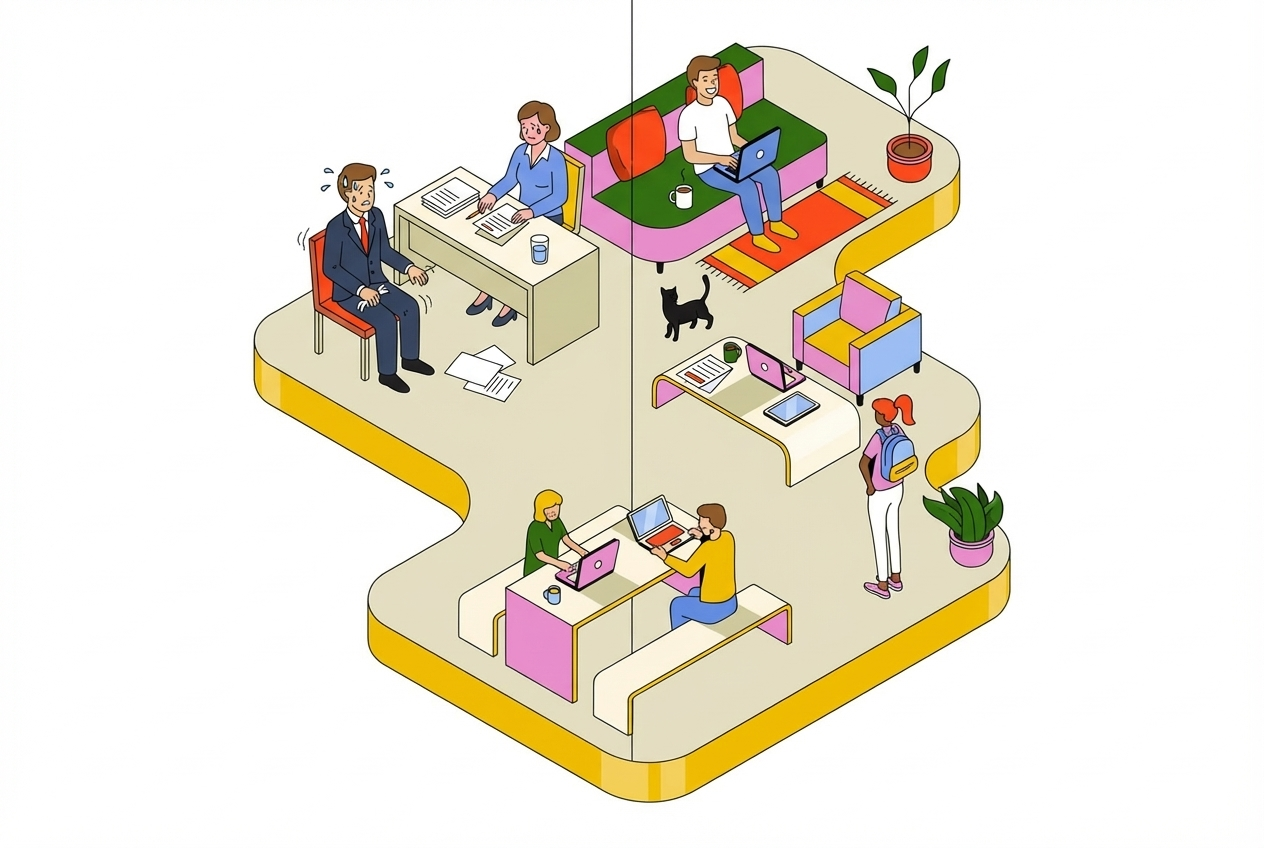
The Simulation: why the best interview is actually a paid project
You are about to make a decision that will cost you fifty thousand dollars. Maybe more.
It is Friday afternoon. You have narrowed the stack of resumes down to two finalists. One is charming and has a great degree. The other is quiet but has an impressive portfolio. You have done the phone screen. You have done the in person interview. You have called the references.
And yet, you are paralyzed.
Because you know the truth. You know that hiring is a gamble. You know that the person they are pretending to be in the interview might vanish the moment they sign the offer letter.
You are afraid of making a mistake. You are afraid of the disruption, the lost time, and the emotional toll of having to fire someone in three months.
So you guess. You go with your gut.
But what if you didn’t have to guess? What if you could test drive the car before you bought it?
The traditional interview process is fundamentally flawed because it tests for the wrong things. It tests for extroversion. It tests for the ability to recite rehearsed answers. It tests for likability.
It does not test for the work.
There is a better way. It is called the Try Out Project. It is a mechanism designed to strip away the performance art of the interview and reveal the raw data of how a person actually thinks, works, and reacts.
The Failure of the Conversation
Why do standard interviews fail so often?
Because talking about work is not the same thing as doing work.
I once hired a marketing manager who could talk endlessly about brand strategy. She knew every framework. She could quote the leading authors. She sounded brilliant.
Then I asked her to write a single email campaign.
She froze. She procrastinated. When she finally turned it in, the copy was dry and riddled with errors. She was a theorist, not a practitioner.
I could have avoided that bad hire if I had simply asked her to write the email before I hired her.
The Try Out Project is a paid, discrete task that mimics the actual day to day reality of the role. It is not a trick. It is not free labor. It is a simulation.
It allows you to answer the questions that actually matter.
- Can they follow complex instructions?
- Do they ask clarifying questions or just guess?
- How do they handle feedback?
- Do they hit the deadline?
These are the vectors of success in your business. And you cannot find them in a conversation.
Designing the Perfect Test
To make this work, you have to design the project carefully. It cannot be too big, or you will overwhelm them. It cannot be too small, or you will learn nothing.
A good Try Out Project takes about three to five hours to complete.
For a developer, it might be fixing a specific bug in a sandbox environment. For a writer, it might be drafting a blog post based on a specific brief. For an executive assistant, it might be planning a complex travel itinerary with conflicting constraints.
Crucially, it must be paid.
This is non negotiable. If you ask for free work, you are signaling that you do not value their time. You are starting the relationship on a foundation of exploitation. When you pay them, even a flat fee of a few hundred dollars, you change the dynamic.
It becomes a professional contract.
It says: “I respect you enough to pay for your time, and I expect professional results.”
This also removes the legal ambiguity of ownership. If they produce something great, you own it. If they produce something terrible, you paid a small fee to avoid a massive hiring mistake.
That is the best money you will ever spend.
Testing for Responsiveness
The most valuable data point you will get from this experiment is not the work itself. It is the communication around the work.
Watch how they handle the assignment.
Do they confirm receipt immediately? Do they ask intelligent questions upfront? Or do they go silent for three days and then submit something that completely missed the mark?
I usually intentionally leave one small part of the instructions vague. This is a trap.
I want to see if they spot the ambiguity. I want to see if they have the confidence to reach out and ask for clarification.
If they guess and get it wrong, that is a red flag. It means they would rather be wrong than ask for help.
If they email me and say, “Hey, section three is a bit unclear, did you mean X or Y?” that is a massive green flag. That is a person who cares about accuracy.
In a remote or hybrid world, written communication is the lifeblood of your company. This project is your only chance to see their communication style in the wild before they are on the payroll.
The Feedback Loop
Here is the advanced move.
Once they submit the work, do not just accept it. Even if it is perfect, find something to critique.
Give them feedback. Say, “This is a great start, but the tone in the second paragraph is a bit too formal. Can you take another pass at it?”
Then watch what happens.
This is the most critical moment of the hiring process. You are testing for ego.
Do they get defensive? Do they argue with you? Do they seem annoyed that they have to do more work?
Or do they say, “Great catch. I see what you mean. I’ll have a revision to you by 5 PM.”
You are not hiring a product. You are hiring a human being who will need to learn and grow. If they are resistant to feedback during the interview process, when they are on their best behavior, imagine what they will be like six months from now when things get stressful.
Responsiveness to feedback is the single best predictor of long term growth.
The Reality Check for the Candidate
This process is not just for you. It is for them.
Candidates are often just as scared as you are. They are afraid of joining a toxic company. They are afraid the work will be boring or impossible.
The Try Out Project gives them a window into your world.
They get to see how you give instructions. They get to see how you give feedback. They get to feel the actual weight of the work.
Sometimes, a candidate will do the project and realize, “I actually hate this kind of work.” And they will withdraw.
This is a victory.
You just saved both of you from a miserable breakup. You want them to know exactly what they are signing up for. You want them to come in with their eyes wide open.
Implementing the Protocol
So how do you add this to your already busy schedule?
You make it the final gate.
Do not do this for every applicant. That is a waste of money. Do the resume screen. Do the phone call. Do the first interview. Get it down to your final two or three candidates.
Then, make the offer.
“We love what we see so far. The final step in our process is a small, paid freelance project to see how we work together. We will pay you $200 for this task. Are you interested?”
If they are currently employed, give them a deadline that respects their time. “You can do this over the weekend.” or “Take a few days.”
If they refuse, that is data too. It might mean they are not that interested. It might mean they are arrogant.
But usually, the top performers love this. They love the chance to prove themselves. They are tired of losing jobs to smooth talkers. They know their work is good, and they are eager to show it.
Building Confidence in Your Decision
Think back to that Friday afternoon paralysis.
Imagine how different it feels when you have the project results in front of you.
Candidate A talked a big game but their code was sloppy and they argued about the feedback.
Candidate B was quiet in the interview but their code was elegant, they asked great questions, and they improved the work instantly after your notes.
The decision is no longer a guess. It is a data driven conclusion.
The knot in your stomach disappears. You are not hoping they are good. You know they are good.
Building a business is hard enough. You have to deal with market changes, supply chains, and cash flow. You do not need the added stress of wondering if your team can actually do the job.
Test the work. Pay for the time. Trust the evidence.
That is how you build a team that lasts.







