The Tower of Babel in Your Office: Why Your Best Training Materials Are Failing Half Your Team
You spend three hours writing a process document. You are meticulous. You use bullet points. You bold the important warnings. You even add a table of contents. You send it to your new hire and they confirm they have read it.
Two days later, you watch them perform the task. They miss the second step. They ignore the warning you bolded. They do it completely wrong.
Your immediate reaction is frustration. You think they are lazy. You think they are not paying attention. You think, “I wrote it down right there. How could they miss it?”
But they didn’t miss it. They just didn’t process it.
The problem is not the employee’s intelligence. The problem is that you are broadcasting on FM radio and they are trying to tune in on AM. You are sending text to a brain that is wired for images. You are sending static instructions to a brain that needs movement to understand.
For decades, small businesses have been forced to choose one format for training because of resource constraints. Writing is the cheapest and fastest way to get information out of your head. So we build libraries of text and get angry when people don’t learn from them.
We need to dismantle the idea that “reading the manual” is the gold standard of learning. We need to look at the biology of how humans acquire skills and how modern technology has finally solved the resource problem of personalized training.
The Myth of the Standard Brain
We tend to assume that other people think the way we think. If you are a founder who loves to read dense business books, you assume that handing a dense SOP to an employee is a kindness. You are giving them all the details.
But the science of learning tells us that the “standard brain” does not exist. The VARK model identifies four primary modes of learning. Visual, Aural, Read/Write, and Kinesthetic.
Most of the corporate world is built for the Read/Write learner. But a massive percentage of the population feels physical anxiety when faced with a wall of text. It is not that they cannot read. It is that their cognitive load spikes so high trying to decode the text that they have no energy left to retain the information.
Think about the visual learner. They think in spatial relationships. If you describe a complex workflow in a paragraph, they are lost. But if you draw three boxes with arrows connecting them, they get it instantly.
Think about the auditory learner. They need to hear the tone. They need the inflection to understand what is important. Text is flat to them. They read the warning with the same internal voice as the welcome message, so the warning doesn’t stick.
When we force everyone to learn via text, we are effectively handicapping half our team. We are creating a filter where only the people who think exactly like the boss can succeed.
The Kinesthetic Gap
The hardest group to train in a traditional office environment is the kinesthetic learner. These are the “doers.” They learn by trial, by touch, and by muscle memory.
In the past, the only way to train them was apprenticeship. They had to sit next to you and watch you do it, then try it themselves.
But in a remote or hybrid world, or simply a busy office, we rarely have time for apprenticeship. So we send them a PDF.
For a kinesthetic learner, reading a PDF about how to use software is like reading a book about how to play the piano. You can memorize the notes, but until your hands touch the keys, you do not know how to play.
This gap creates a specific kind of imposter syndrome. The employee feels stupid. They read the words but the concepts slip away. They make mistakes not out of malice, but because the neural pathway was never actually formed.
We have to stop viewing these different styles as preferences. They are requirements. If we want competence, we have to provide the right fuel for the engine.
AI as the Universal Translator
Historically, the argument against catering to learning styles was practical. “I don’t have time to make a video and a diagram and a podcast for every single process.”
And that was true. Until about two years ago.
This is where Artificial Intelligence shifts from a buzzword to a fundamental infrastructure tool. We need to stop looking at AI as a generator of new text and start seeing it as a translator of existing knowledge.
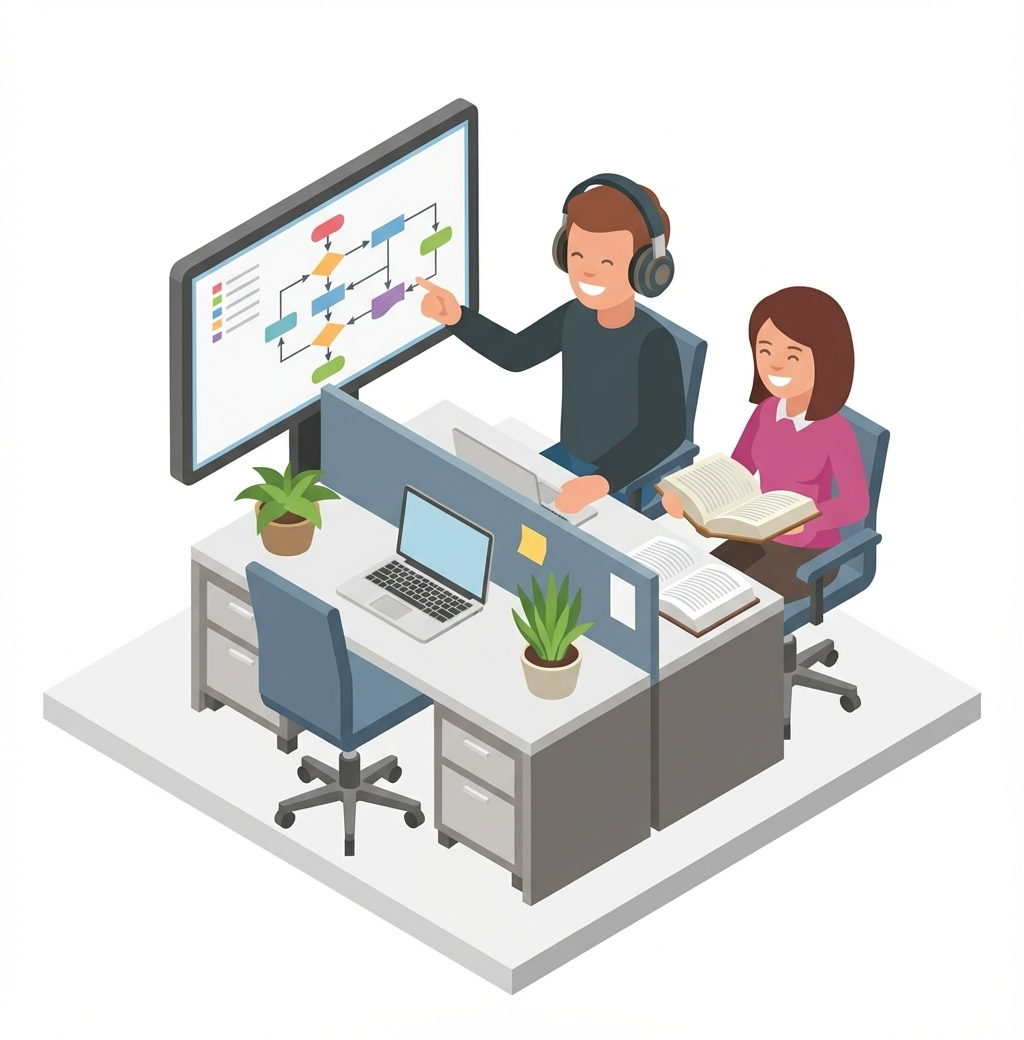
Today, you can take that three-page SOP you wrote and feed it into a system that instantly turns it into a flowchart for your visual learners.
You can take that same text and generate a conversational audio script, or even a synthetic voiceover, for your auditory learners to listen to on their commute.
You can turn that static list of rules into an interactive quiz or a simulation game for your kinesthetic learners. You can create a scenario where they have to “choose the right email response” rather than just reading about it.
This destroys the resource excuse. The cost of adapting content to different brains has dropped to near zero.
The Psychological Impact of Adaptation
When you start offering training in multiple formats, something shifts in the culture. It is an act of empathy.
You are telling your team, “I want you to succeed so much that I am willing to speak your language.”
Imagine the relief of an employee who struggles with reading comprehension when they see a “Watch Video” button next to the “Read Guide” button. Their anxiety drops. Their engagement goes up.
They stop skimming. They actually consume the content because it is in a format that their brain welcomes.
This also democratizes success. You might have a brilliant salesperson who is terrible at reading manuals but amazing at reading people. If you force them to learn via text, they might fail during onboarding. If you give them audio or role-play simulations, they become your top performer.
We are moving from a “sink or swim” mentality to a “choose your vessel” mentality. We are acknowledging that the destination is competence, and we don’t care which vehicle you take to get there.
Implementing the Multi-Modal Approach
So how do you actually do this without getting overwhelmed?
Start with your “Red Flag” processes. These are the tasks where people make the most mistakes. The high-risk areas.
Look at your current documentation for those tasks. It is likely a wall of text. That is your source code.
Use tools to convert that source code. Create a one-page visual summary. Create a two-minute Loom video where you talk through the process while showing your screen. Create a checklist that requires them to click boxes (kinesthetic) as they do the work.
Store these assets together. Your knowledge base should not be a library of books. It should be a media center. The entry for “How to Process a Refund” should have the text, the video, and the flowchart all on the same page.
Let the employee choose. You will be surprised by the data. You might find that 80 percent of your team ignores the text you spent hours writing and watches the video instead.
Or you might find that they watch the video to get the concept, and then use the checklist to execute the task. They are mixing and matching to build their own comprehension.
The Return on Clarity
When you align your teaching method with the employee’s learning method, the friction of management disappears.
You stop having to repeat yourself. You stop having to fix the same mistakes over and over. You stop feeling like you are surrounded by people who “just don’t get it.”
They do get it. They just needed to see it, or hear it, or touch it.
This is how you build a team that can scale. You remove the bottleneck of your own communication style. You ensure that your standards are accessible to everyone, not just the people who are wired exactly like you.
The goal of business information is transfer. It is to move an idea from your brain to theirs with zero loss of fidelity. If the signal isn’t getting through, stop blaming the receiver. Change the frequency.
It is time to build a business that is fluent in every language of learning.







