You Don't Need to Know How the Engine Works to Drive the Car: A Guide to AI for the Tech-Averse
There is a specific look I see on the faces of business owners when the conversation turns to Artificial Intelligence. It is a mix of curiosity and dread. It is the look of someone who knows they are standing on the edge of a revolution but is terrified they don’t have the right shoes.
They say things like, “I’m not a tech person.” Or, “I still struggle with Excel.” Or, “I’m too old to learn to code.”
If this is you, I have good news. You do not need to learn to code. You do not need to understand neural networks. You do not need to be a “tech person.”
The barrier to entry for AI has collapsed. In the past, talking to a computer required you to learn the computer’s language (C++, Python, Java). Today, the computer has learned your language. It speaks English (and Spanish, and French, and German).
If you can write an email, you can use AI. In fact, if you are a good communicator—if you are good at delegating tasks to humans—you are already better at using AI than most software engineers.
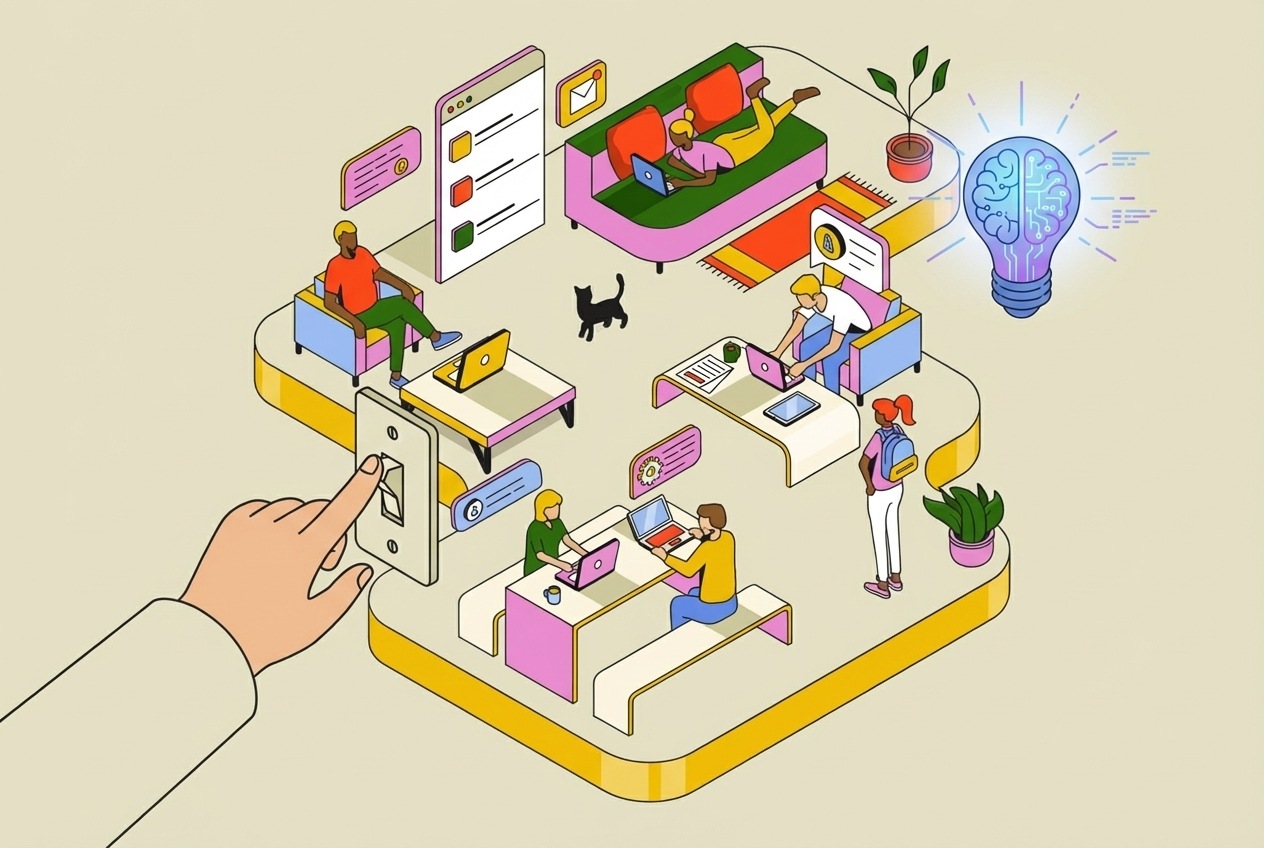
We need to strip away the mystique. We need to stop looking at AI as “Technology” with a capital T and start looking at it as a utility, like electricity or running water. You don’t need to be an electrician to turn on the lights. You just need to flip the switch.
The Evolution of the Interface
To understand why this moment is different, we have to look at the history of interfaces. In the 80s, we had the command line. You had to type specific, obscure commands to get the computer to do anything. It was hard.
Then we got the Graphical User Interface (GUI). Windows and Mac icons. You just had to point and click. This democratized computing.
Now, we have the Conversational Interface. You just type what you want. “Write a sales email.” “Summarize this report.” “Create a training plan.”
This is the most intuitive interface in human history because it uses the skill we have been practicing since we were two years old: language.
The friction is gone. The learning curve is flat. The only skill required is the ability to articulate what you want clearly.
Prompt Engineering is Just Delegation
You will hear people talk about “Prompt Engineering” as if it is a dark art. It isn’t. It is just delegation.
Think about how you assign a task to an intern. If you say, “Write a blog post,” the intern will write something terrible. They don’t know the topic, the tone, or the audience.
If you say, “Write a 500-word blog post about the benefits of our new coffee blend. Make it sound friendly and energetic. Target busy moms. Include three bullet points about caffeine content.”
The intern will write something great.
AI works exactly the same way. It is the world’s fastest, most eager, most literal intern. If you give it vague instructions, you get vague results. If you give it specific context, you get magic.
You are already a prompt engineer. You do it every day with your staff. You just need to apply the same logic to the text box on your screen.
The “Blank Page” Syndrome
The biggest hurdle for non-technical people isn’t the technology; it’s the imagination. “I don’t know what to ask it.”
Start with the things you hate doing. Start with the blank page. Writing a job description. Drafting a difficult email to a client. Creating an agenda for a meeting.
These tasks are high-friction. They require activation energy. AI removes that friction.
Type: “Draft a job description for a Warehouse Manager in Chicago. We need someone with 5 years experience who is good with people.”
Boom. In 3 seconds, you have a draft. It might not be perfect. It might be 80% right. But editing that 80% takes five minutes. Writing it from scratch takes an hour.
Use AI as a “First Draft Machine.” It gets you off the starting block.
Fear of Breaking It
Many older business owners have a deep-seated fear of “breaking the computer.” They remember a time when pressing the wrong button could delete the hard drive.
Modern AI tools are unbreakable. You cannot delete the internet. You cannot crash the server. The worst thing that happens is the AI gives you a weird answer. And then you just say, “Try again.”
It is a sandbox. It is safe. Treat it like a conversation with a smart friend who has had too much coffee. If they say something off-topic, you just steer them back.
The Security Question
The one valid fear is security. “What happens to my data?”
This is where you need to exercise basic business hygiene. Do not put sensitive customer data (credit cards, social security numbers) into a public AI tool. Treat it like a public conversation in a coffee shop.
However, for 99% of business tasks—marketing copy, process documentation, brainstorming—there is no sensitive data involved. You are working with general concepts.
As you get more comfortable, you can use enterprise versions of these tools that guarantee data privacy. But to start, just use common sense. Don’t paste the nuclear codes.
Integrating, Not Overhauling
You don’t need to “transform your business with AI” overnight. That is a consultant’s sales pitch. You just need to integrate it into the margins.
Keep using email. Keep using your CRM. Just have an AI tab open on the side. Use it to polish the email before you send it. Use it to summarize the notes from the CRM.
It is a helper, not a replacement. It is a calculator for words.
The Advantage of Wisdom
Here is the secret weapon that older, non-technical business owners have over the young tech wizards: Context.
You know your industry. You know your customers. You know what quality looks like. You have wisdom.
A 22-year-old might know how to code, but they don’t know how to handle a supplier negotiation. You do.
When you combine your deep industry wisdom with the speed of AI, you become unstoppable. You can generate ideas and verify them against thirty years of experience. The AI provides the raw material; you provide the judgment.
This is not a game for the young. It is a game for the experienced.
So open the tab. Create an account. Type “Hello.” Ask it a question about your business. “What are the top three trends in commercial plumbing right now?”
See what it says. You might be surprised. And you might realize that the future isn’t as scary as it looks. It’s just a tool. And you’ve been mastering tools your whole life.







