Breaking the Hero Complex: Why Your Cape is Choking Your Business
It starts with a notification on your phone at 9 PM on a Tuesday. A client is unhappy. A shipment is delayed. A server is down. Your heart rate spikes, not just from stress, but from a familiar rush of adrenaline. You know exactly what to do.
You open your laptop. You make three calls. You write a masterful email smoothing things over. Within thirty minutes, the crisis is averted. You close the computer and let out a sigh of relief. You saved the day. Again.
But as you sit there in the quiet of your home, a nagging question creates an open loop in your mind. Why are you the only one who could fix it? Is it true that no one else cares as much as you do? Or is there a structural invisible force at play that you inadvertently created?
We need to talk about the Hero Complex. It is not about vanity. It is about the terrifying realization that your business might stop functioning the moment you stop sprinting.
The Dopamine Loop of the Rescue
There is a biological component to being the hero. When we solve a problem, our brains release dopamine. It feels good to be competent. It feels good to be needed. For founders and managers, this becomes a primary feedback loop. You built this business to be impactful, and every fire you put out validates your identity as the builder.
However, this chemical reward system creates a dangerous dependency. You become addicted to the speed of your own solutions. Teaching someone else takes an hour. Doing it yourself takes ten minutes. Your brain chooses the efficiency of the now over the stability of the future.
But what happens to the observers? What happens to the employee who was cc’d on that email you sent?
They learn a lesson, but perhaps not the one you intended to teach. They learn that when things get difficult, you will step in. They learn that their role is not to solve, but to alert. We have to ask ourselves if we are building a team of problem solvers or a team of alarm bells.
The Science of Learned Helplessness
In the late 1960s, psychologists discovered a phenomenon called learned helplessness. When subjects felt they had no control over an outcome, they eventually stopped trying to influence it, even when opportunities to escape or change the situation were presented later.
When you swoop in to save the day, you are removing the agency of your team. You are signaling that their judgment is either unnecessary or untrusted. Over time, high-performing individuals will atrophy. They stop looking for solutions because the environment has conditioned them to wait for the hero.
This is where the fear sets in for you. You look around and see a team that seems hesitant or incapable of making decisions. You think to yourself that you cannot possibly step away because they are not ready. But the uncomfortable truth we must face is that your intervention is the very thing preventing their readiness.
The Bottleneck is You
If every critical decision must pass through your neural pathways, your business can only grow as fast as you can think. You become the lid on the jar. No matter how incredible your vision is or how world-changing your product might be, it is physically limited by the hours in your day.
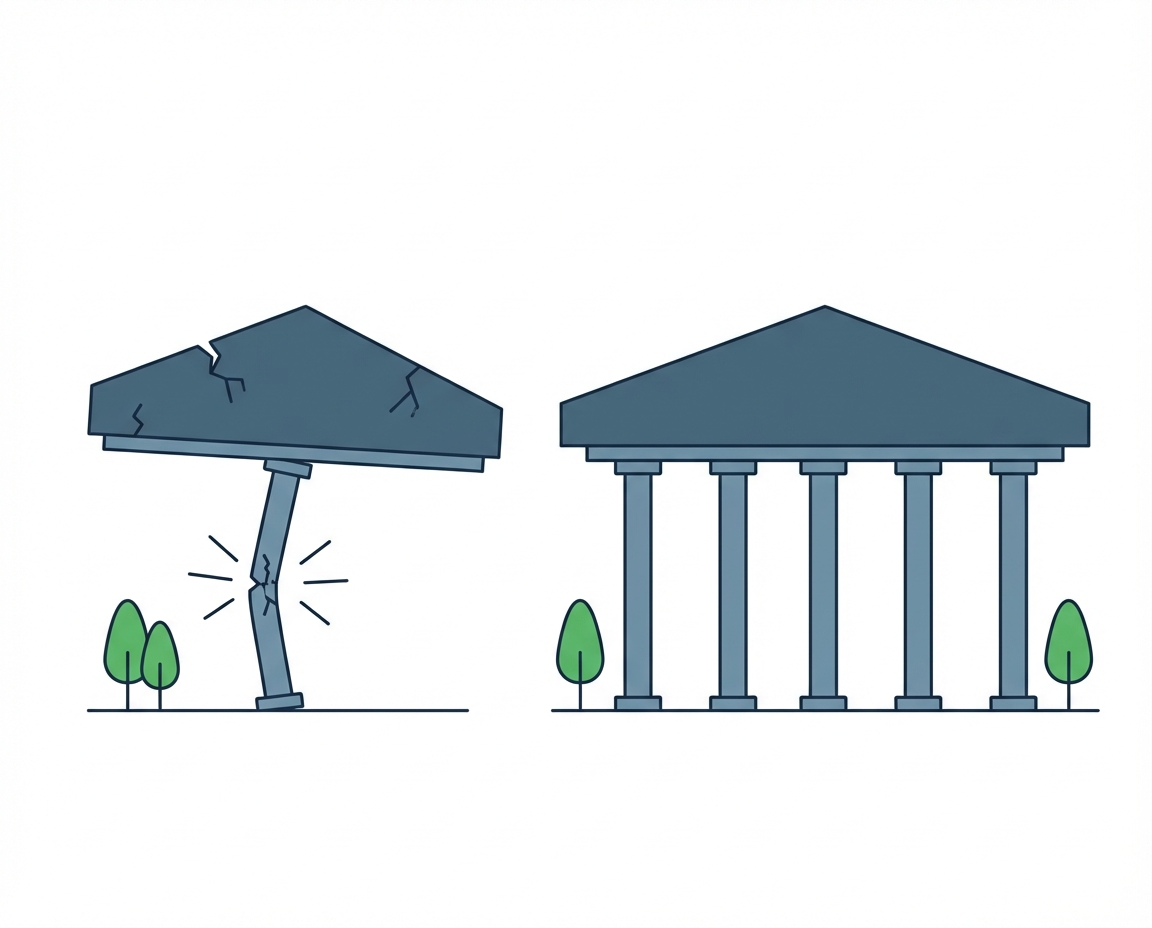
Consider the architecture of a bridge. If all the weight rests on a single pillar, the structure is fragile. If that pillar cracks, the bridge collapses. A resilient structure distributes the load.
We want to build something that lasts. Something solid. To do that, we have to dismantle the single pillar of the owner-hero and distribute the weight of responsibility.
Shifting from Savior to Socratic Guide
The next time a crisis lands on your desk, your instinct will be to provide the answer. You must resist this urge.
Instead of the answer, provide a question. This is the Socratic method of management. When an employee brings you a fire, ask them:
- What do you think is the best path forward?
- What are the risks of that approach?
- What resources do you need to handle this?
This will be painful at first. The silence will be awkward. They might struggle. You have to sit on your hands and let them struggle.
By asking questions, you force their brain to engage with the problem. You are moving them from passive observers to active participants. You are rewiring the neural pathways of your organization to prize critical thinking over compliance.
Creating Safety in Failure
There is a missing piece of information that makes this transition possible. Why are they scared to decide? usually, it is because they are afraid of your reaction if they get it wrong.
To break the Hero Complex, you must subsidize the cost of failure. You have to tell your team that a wrong decision is better than no decision. You must be willing to let them scrape their knees on small issues so they can learn to run on the big ones.
This does not mean negligence. It means setting guardrails. Define the budget they can spend without asking. Define the policies they can bend to make a customer happy. Give them a playground where the fences are clear, but inside those fences, they are free to move.
Closing the Loop
Remember that late-night Tuesday crisis? Imagine a different scenario.
Your phone buzzes. It is a notification. But it is not a cry for help. It is a message from your manager saying, “We had a server issue and a frustrated client. I authorized a credit and the team rerouted the traffic. The client is happy and we are doing a post-mortem tomorrow to prevent it from happening again.”
You read the message. You do not open your laptop. You do not make a call. You sit back.
The dopamine hit is different this time. It is not the rush of the rescue. It is the deep, quiet satisfaction of having built a machine that works without you. That is the only way to build something that truly lasts.







