
The Silent Language Barrier: Leading a Multi-Generational Team Without Losing Your Mind
You are sitting at the head of the table.
On your left is a senior director who has been with the company for twenty years. They value face time, printed agendas, and structured hierarchy. On your right is a new hire, fresh out of university, who communicates primarily through Slack and questions the fundamental premise of the project before the meeting even starts.
Both of them want the company to succeed.
Both of them are talented.
Yet you can feel the tension radiating off the laminate table surface. It is not hostility. It is confusion.
They are speaking English, but they are speaking entirely different dialects of business.
This is the reality for the modern manager. For the first time in history, we have five distinct generations in the workforce. You are not just a manager anymore. You are a translator.
The Context Gap
We often make the mistake of looking at generational differences through the lens of stereotypes. We assume the older worker is resistant to technology or the younger worker lacks focus. These are lazy categorizations that do not help you build a business.
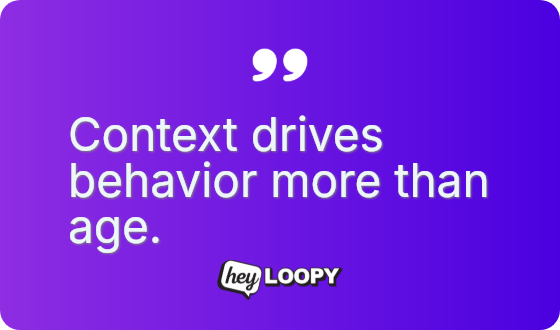
It is more helpful to look at it through the lens of context.
Consider the economic and social environment in which your team members entered the workforce.
Baby Boomers entered a workforce where loyalty was the primary currency. You gave a company your time, and they gave you a pension and security. The structure was the safety net.
Gen Z entered a workforce defined by the gig economy, a global pandemic, and the understanding that corporate loyalty is rarely reciprocal. For them, the currency is not tenure. It is purpose.
When these two worldviews collide, friction occurs.
The senior employee sees the junior employee leaving at 5 PM sharp and interprets it as a lack of dedication. The junior employee sees the senior employee staying until 7 PM and wonders why they have not optimized their workflow to be more efficient.
Both are making logical deductions based on their own context.
Communication Styles vs Communication Intent
There is a specific pain point that keeps managers up at night. It is the fear that messages are getting lost in transmission.
You send an email outlining a new strategy.
Half your team reads it and nods. The other half skims it and waits for the TLDR version in the group chat.
We tend to focus on the medium. We argue about whether we should use email, Zoom, Slack, or face-to-face meetings. This is a distraction.
The real challenge is the intent behind the communication.
Older generations often use communication to build consensus and document decisions. It is a formal record. For them, a meeting is where work happens.
Younger generations often view communication as a tool for rapid information exchange. It is transactional and iterative. For them, a meeting is often seen as an interruption to the work.
How do you bridge this?
You stop focusing on the tool and start defining the expectation.
It requires you to be explicit about the ‘why’ behind the communication channel. If you need a face-to-face meeting, explain that the goal is nuance and emotional alignment, which is hard to achieve over text. If you need a quick status update, validate that an asynchronous message is perfectly acceptable.
The Currency of Loyalty and Purpose
Let us look at what actually drives performance.
Research suggests that while the methods differ, the fundamental human needs remain consistent across generations. Everyone wants to feel valued. Everyone wants to feel competent.
However, the path to that feeling differs.
For a Boomer or Gen X employee, feeling valued might look like public recognition of their expertise and tenure. They want to know that their history matters.
For a Millennial or Gen Z employee, feeling valued often looks like having their ideas taken seriously regardless of their job title. They want to know that their future matters.
This presents a unique challenge for you as a leader.
You cannot use a blanket approach to motivation.
You have to ask questions you might not have the answers to yet.
Does your current review process only reward tenure? Does it inadvertently punish those who question the status quo? Conversely, does your focus on innovation alienate those who maintain the foundational systems that keep the business running?
Reverse Mentorship as a Tool
The traditional model of mentorship is vertical. The experienced teach the inexperienced.
This model is becoming obsolete.
In a rapidly changing technological landscape, experience does not always equate to relevant knowledge. A twenty-year veteran knows how to navigate political capital and client relationships. A twenty-year-old knows how to leverage AI tools to automate workflow.
There is a massive opportunity here that most businesses miss.
It is called reverse mentorship, or reciprocal mentorship.
Imagine pairing your senior staff with your junior staff, not just so the senior can teach, but so they can learn. This breaks down the hierarchy that causes silence in meetings.
It signals to the junior staff that they have immediate value to add. It signals to the senior staff that learning is a continuous requirement, not a phase you finish in your twenties.
But this is risky. It requires vulnerability.
Are you willing to create an environment where a senior executive admits they do not understand a new platform? Are you willing to let a junior employee lead a training session?
Your Role as the Architect
You are building something that needs to last.
To do that, you need the stability of experience and the velocity of innovation. You need the caution that comes from seeing market cycles crash, and the optimism that comes from not knowing what is impossible yet.
The pain you feel when these groups clash is the pain of growth.
It is the sound of tectonic plates rubbing together. That friction can cause an earthquake that destroys your culture, or it can push up a mountain that gives you a vantage point your competitors do not have.
Your job is not to force them to be the same.
Your job is to clarify the mission so clearly that their differences become tactical assets rather than interpersonal liabilities.
Start by asking your team how they prefer to receive feedback. Ask them what respect looks like to them. You might be surprised by the data you collect.
The answers will not be uniform. And that is the point.
When you stop trying to fix the people and start trying to understand the variables, the stress of management begins to lift. You are no longer guessing. You are engineering.







