When the Teacher Forgets: Fixing the Supervisor Failure Mode in Frontline Safety
6min read
The Reconvene After the Near Miss
Picture the post incident reconvene at the end of a long, stressful shift. The plant manager is looking across the table at you. A near miss just happened on the warehouse floor involving a piece of heavy equipment that should have been locked out. The uncomfortable reality surfaces quickly. The shift supervisor ran a Tuesday toolbox talk on that exact lockout tagout procedure just six weeks ago. The team signed the attendance sheet. The box was checked in the system.
Why did the incident still happen? We often look at the frontline workers first to find the root cause. But there is a quiet failure mode in the supervisor tier that compromises the entire safety program. Are we asking the right questions about how our leaders retain critical information over time?
The Limits of the Toolbox Talk
Think about the timeline of a newly promoted shift supervisor in logistics or light manufacturing. They completed their own formal lockout tagout training nine months ago. They passed the test and received the certificate. Now they are asked to lead the toolbox talk on that very subject.
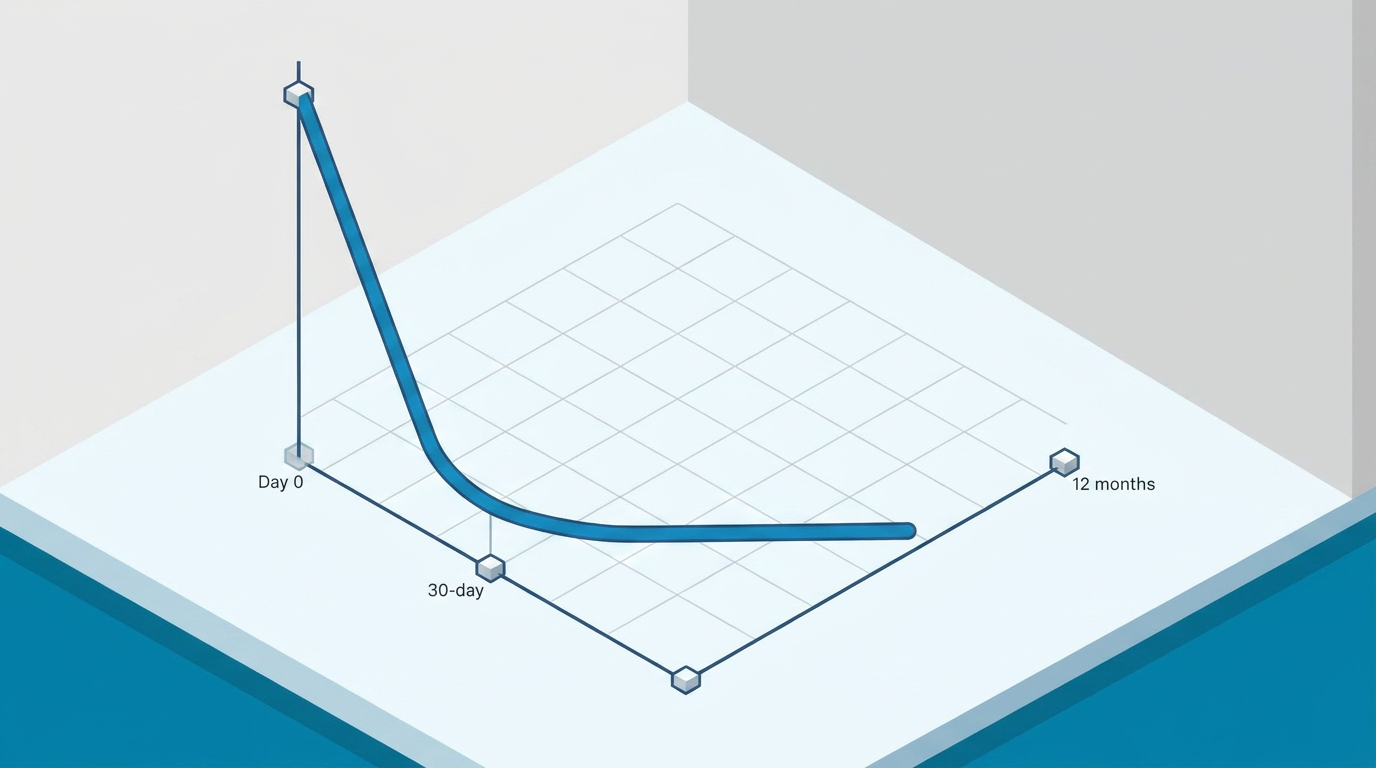
They stand in front of the team and read the policy aloud. The team signs the roster. But the procedural confidence of that line is now bounded by the supervisor’s own faded recall. The forgetting curve
, first detailed by Ebbinghaus over a century ago, shows us how quickly humans lose information they do not actively recall. By month nine, the nuances of that safety procedure are gone. The supervisor is going through the motions. If the teacher has forgotten the specifics, the team never really learns them.
What happens in the brain during a stressful event on the floor? Cognitive science tells us that under pressure, we fall back on our most deeply ingrained habits. If the lockout tagout steps are merely a faded memory from a test taken last year, the supervisor lacks the working memory capacity to correct a frontline worker in real time. Are we expecting our frontline leaders to teach procedures they barely recall themselves? How much risk are we carrying in that invisible gap between the test day and month nine?
The Regulatory Reality of Faded Memory
Regulators do not care about the signature on the attendance sheet when things go wrong. They care about what the team actually knew on the day it mattered. When a near miss leads to an OSHA general duty clause citation, the investigation looks at procedural reality. They want to know if the team was genuinely capable of executing the work safely.
This gets harder when standard operating
procedures change. A new NIOSH alert might reshape an SOP right in the middle of your annual training cycle. If your supervisor is operating on a memory from nine months ago, and passing that faded memory down during toolbox talks, your exposure is massive. The gap between what the LMS says the supervisor knows and what they actually remember is where accidents happen.
Think about the complexity of a modern plant. The equipment changes. The shifts rotate. The policies adapt to new hazards. Are we truly equipping our managers to handle this pace, or are we just hoping they remember? The goal is keeping supervisor recall current between those formal recertifications. But adding another massive course to their already full plate is not the answer. Burnout is the enemy of safety. A burned out shift lead cannot learn or adapt.
A Practice Layer for Your EHS Program
This is where we have to separate assignment from retention. Your system of record is critical. You need your corporate Workday Learning instance, KPA, Vector EHS, or J.J. Keller platform to manage the compliance calendar and issue the certificates. HeyLoopy does not replace your LMS. It sits right alongside it to do a completely different job.Mastery, not just attendance.
HeyLoopy is a retention layer. It bends the forgetting curve back using 60 seconds of daily retrieval practice. Decades of memory science prove that retrieving information from memory strengthens the neural pathway for the future. These drills are built directly from your site’s existing OSHA aligned procedures and the supervisor’s own job hazard analysis. No instructional designers are needed. You turn the documents you already have into a daily practice routine that fits into the natural flow of work.
When training is broken down into a minute a day, it integrates smoothly into the shift. It protects the supervisor’s energy while keeping the critical safety steps sharp. They are not pulled off the floor. They simply answer a quick question on their phone and move on with their day.
Visibility Before the Incident
The real power of a daily practice layer is visibility. As an EHS Manager, you get access to a mastery heatmap. This shows you exactly which supervisors are soft on which procedures long before an auditor arrives or a near miss happens. You can see the gaps across the entire tier and address them calmly. Are they struggling with the new chemical handling policy? The heatmap gives you the answer.
When an SOP updates because of a new regulation, the fix is immediate. You edit the module in HeyLoopy today. The drill set follows the SOP document, so the supervisor practices the new version the next morning. There is no waiting for the next quarterly safety meeting. The knowledge rollout happens smoothly and steadily. You can track exactly when the new information becomes a working habit.
It is about achieving mastery, not just attendance. The toolbox talk becomes a review of what the supervisor actively knows, rather than a reading of what they have forgotten.
The Next Step for Your Site
Keeping a warehouse, logistics hub, or food processing plant safe requires a supervisor tier that actually remembers the procedures. You can see how this works with your own documents today. Drop one of your current lockout tagout policies into HeyLoopy and get a working drill module in about five minutes. Start a free trial to test it quietly with your shift leads. See what actual retention looks like on the floor.
For a deeper look into program design and fixing the supervisor failure mode, read our whitepaper on the Supervisor’s SOP in month six
at /resources/sop-recall-month-six-frontline-ehs/ and see how daily practice keeps your floor safe.