
What is a Town Hall Meeting?
Building a company is a lonely endeavor. You spend your nights worrying about the future while your days are consumed by the immediate needs of your staff. You want to build something that lasts and has real value, but you cannot do it if your people are operating in a vacuum. This is where the concept of a town hall meeting becomes a practical tool for your leadership toolkit. It is a way to bridge the gap between your vision and the daily reality of your employees.
Defining the Town Hall Meeting
At its most basic level, a town hall meeting is a gathering where every single member of the organization is present. In many circles, this is referred to as an all hands meeting. The primary goal is to provide a space where leadership can share updates, celebrate wins, and address challenges directly with the team. It is a moment of synchronization that ensures everyone is moving in the same direction.
The structure usually involves a presentation from the owner or manager followed by a period for questions and answers. It is not intended to be a lecture. Instead, it functions as an essential communication channel to ensure that everyone from the front desk to the executive suite understands the current state of the business. For a manager who cares deeply about their team, this is the most direct way to empower them with knowledge.
The strategic value of Town Hall communication
Information asymmetry is one of the biggest risks to a growing company. When some people know more than others, it creates a culture of silos and suspicion. This adds to your stress as a manager because you end up playing a game of telephone to get everyone on the same page. A town hall helps to level the playing field by providing a single source of truth.
This practice helps you as a manager to:
- Align individual goals with the company vision
- Create a culture of transparency and psychological safety
- Reduce the time spent repeating the same information to different departments
- Provide a platform for employees to feel heard and valued
By sharing financial health, strategic pivots, or new hires in a public setting, you reduce the reliance on the office grapevine. This builds trust because employees do not have to guess about the health of the company or their place within it.
Comparing Town Hall meetings to Staff Meetings
It is easy to confuse these two formats, but they serve very different psychological and operational needs. A staff meeting is typically departmental and tactical. It is the place where you discuss deadlines, project blockers, and specific tasks. These are the meetings that keep the gears turning on a day to day basis.
In contrast, a town hall is about the bigger picture. Consider these distinctions: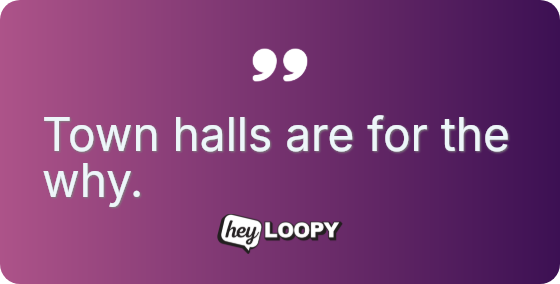
- Staff meetings are for the how and when
- Town hall meetings are for the who and why
- Staff meetings focus on micro level productivity
- Town hall meetings focus on macro level health and direction
If you try to use a town hall to manage tasks, you will lose the interest of your audience. If you use a staff meeting to announce major company shifts, you miss the opportunity to create a shared sense of purpose across the entire team. Both are necessary, but they must remain distinct to be effective.
Scenarios for Town Hall implementation
There are specific times when this format is particularly effective for a busy owner. If your company is going through a period of rapid growth, a town hall can help integrate new members quickly. If you are facing a market downturn or a difficult pivot, the town hall is the place to be honest about the challenges and gather the team together.
Consider using this format during:
- Quarterly business reviews to show progress against yearly goals
- The introduction of a new product or service line
- Organizational restructuring or changes in leadership
- Celebrating major milestones that required cross functional effort
Navigating the unknowns of the Town Hall
While we know that transparency builds trust, there are still many variables that every manager must weigh for themselves. How much information is too much? Is there a risk of causing panic if the data is not presented with the right context? There is no one size fits all answer, but the act of showing up and being honest is usually more valuable than the specific data points shared.
You might find yourself asking these questions:
- How do we ensure that quiet employees feel comfortable asking questions?
- What is the optimal frequency for these meetings to avoid meeting fatigue?
- How do we measure if the information shared actually changed the way people work?
These are not questions with easy answers. They require you to be observant and to listen to the feedback your team gives you after the session ends. Building a remarkable business is about the constant refinement of these communication loops. It is about having the courage to speak to the whole room and the humility to listen to their response.







