
What is a Vulnerability Hangover?
You just finished a difficult all-hands meeting. You decided to go off-script. Instead of the polished projection of certainty you usually offer, you admitted that you do not have all the answers regarding the upcoming market shift. You told the team you are worried about it. You asked for their help. The meeting ended and the team seemed supportive, perhaps even relieved by your honesty.
But now it is three hours later. You are sitting in your office or staring at your bedroom ceiling. Your chest feels tight. A frantic voice in your head is screaming that you looked weak. You worry that you just undermined your authority. You imagine your employees are currently in a private group chat discussing how you are unfit to lead. You feel a desperate urge to retract everything you said and return to a safe, professional distance.
This specific type of anxiety is not a sign of incompetence. It is a predictable psychological response to stepping out of your comfort zone. To navigate the complexities of building a team that trusts you, you have to understand what is happening in your brain during these moments.
Defining the Vulnerability Hangover
This experience is coined as a vulnerability hangover. It is the profound wave of regret, anxiety, or shame that washes over you after you have shared something meaningful, personal, or emotionally raw. It acts as a visceral reaction to emotional exposure.
For business owners and managers, this often occurs after:
Admitting a strategic mistake to the company
Sharing a personal struggle that impacts work availability
Asking for feedback on your own performance
Standing up for an unpopular but ethical decision
The hangover is the lag time between the act of bravery and the acceptance of the outcome. During this window, uncertainty reigns. You have put a piece of yourself out into the world, and you cannot control how others will perceive or handle it. That lack of control manifests as dread.
The Psychology Behind the Vulnerability Hangover
Why does doing the right thing for company culture feel so terrible physically? It comes down to how human brains process social risk. For most of human history, social rejection was a threat to survival. If the tribe ousted you, you died. Therefore, we are hardwired to view vulnerability—the state of being exposed—as a threat.
When you drop your professional armor, your amygdala may interpret that exposure as danger. The vulnerability hangover is essentially a safety mechanism gone wrong. Your brain is trying to condition you to avoid that risk in the future. It is creating a negative association with the act of sharing to keep you safe and hidden.
However, in a modern business context, hiding destroys trust. If you never lower the shield, your team never connects with you. The discomfort you feel is actually evidence that you are breaking new ground in your leadership capabilities, even if your nervous system treats it like a physical injury.
Vulnerability Hangover versus Oversharing
A major source of anxiety during a vulnerability hangover is the fear that you have crossed a line. This leads to the necessary distinction between vulnerability and oversharing. It is vital to analyze this difference to ensure your anxiety is misplaced rather than a warning sign.
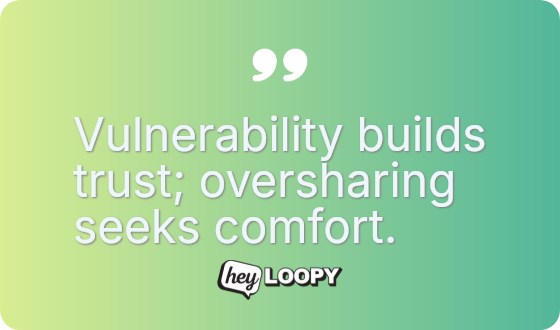
Vulnerability is sharing your feelings and experiences to move the relationship or the work forward. It is done with the other person in mind. It builds trust and invites collaboration.
Oversharing is sharing to soothe your own anxiety or to get validation. It is done without boundaries and often places the burden of your emotions on your staff.
If you told your team you are worried about numbers so that you can collectively brainstorm solutions, that is vulnerability. If you told your team you are worried about numbers because you need them to comfort you and tell you it will be okay, that is oversharing.
Most leaders suffering from a vulnerability hangover have engaged in the former but fear they have committed the latter. If your intent was to build trust, clarify reality, or empower the team, the hangover is just a false alarm.
Navigating the Hangover as a Leader
When the hangover hits, the instinct is to armor up. You might want to go into the office the next day and be hyper-professional, cold, or distant to compensate for the perceived weakness. This is the most damaging thing you can do. It signals to the team that the moment of connection was a mistake.
Instead, recognize the feeling for what it is: a physiological response to growth. It is a temporary chemical flush of anxiety. It does not reflect the reality of how your team perceives you. In fact, data consistently shows that while we perceive our own vulnerability as weakness, we perceive it in others as courage.
Sit with the discomfort. Do not apologize for being human. The hangover will pass, but the trust you built by being real will remain.







