You are likely the ceiling of your organization. This is a hard truth that keeps many business owners and managers up at night. You want to pour into your team, guide their hands, and transfer your hard-earned wisdom to them so they can succeed. But there is only one of you. You are split between operations, strategy, and putting out fires. The mentorship you want to provide often gets pushed to next week, and then next month.
The fear that your team is operating without a map is real. You worry they are making avoidable mistakes because you were not there to offer a course correction in the moment. This is where the concept of AI coaching
enters the conversation. It is not about replacing the human
connection you have with your staff. It is about cloning your ability to provide technical guidance and immediate feedback at scale.
AI coaching is the application of machine learning algorithms and natural language processing to analyze employee performance and provide instant, personalized feedback. Unlike a static training
video or a handbook that sits in a drawer, AI coaching interacts with the work as it happens or through simulated role-play scenarios.
At its core, it functions as an always-on observer. It identifies patterns in behavior, speech, or workflow and compares them against established best practices or success metrics you have defined. The system then delivers a prompt, a correction, or a resource to the employee immediately. It closes the gap between the action and the learning moment.
How AI Coaching Operates
To understand this technology, we must look at the data it consumes. In a sales environment, an AI coach
might analyze call recordings. It listens for specific keywords, tone of voice, and the ratio of listening versus speaking. If an employee interrupts a customer too often, the AI flags this and suggests a listening exercise.
In a technical or operations setting, the AI might monitor workflow speeds or error rates in code or data entry. The system builds a profile for each employee. It knows that Sarah struggles with closing deals but excels at opening relationships, while Mike is the opposite. The training they receive is no longer generic. It is tailored to their specific data footprint.
Real-time analysis: The feedback happens shortly after the event, ensuring the context is fresh.
Objective metrics: Feedback is based on data points rather than subjective opinion.
Privacy considerations: We still have many questions regarding how constant monitoring impacts employee morale and trust.
AI handles repetition; you handle nuance.
AI Coaching vs. Human Mentorship
It is vital to distinguish between coaching a skill and mentoring a person. AI coaching excels at the former. It is relentless and consistent in correcting process, syntax, and measurable behaviors. It does not get tired, and it does not get frustrated if it has to repeat the same correction ten times.
Human mentorship, however, is about nuance, career trajectory, and emotional intelligence. An AI cannot effectively navigate a complex interpersonal conflict or help an employee navigate a personal crisis that is affecting their work.
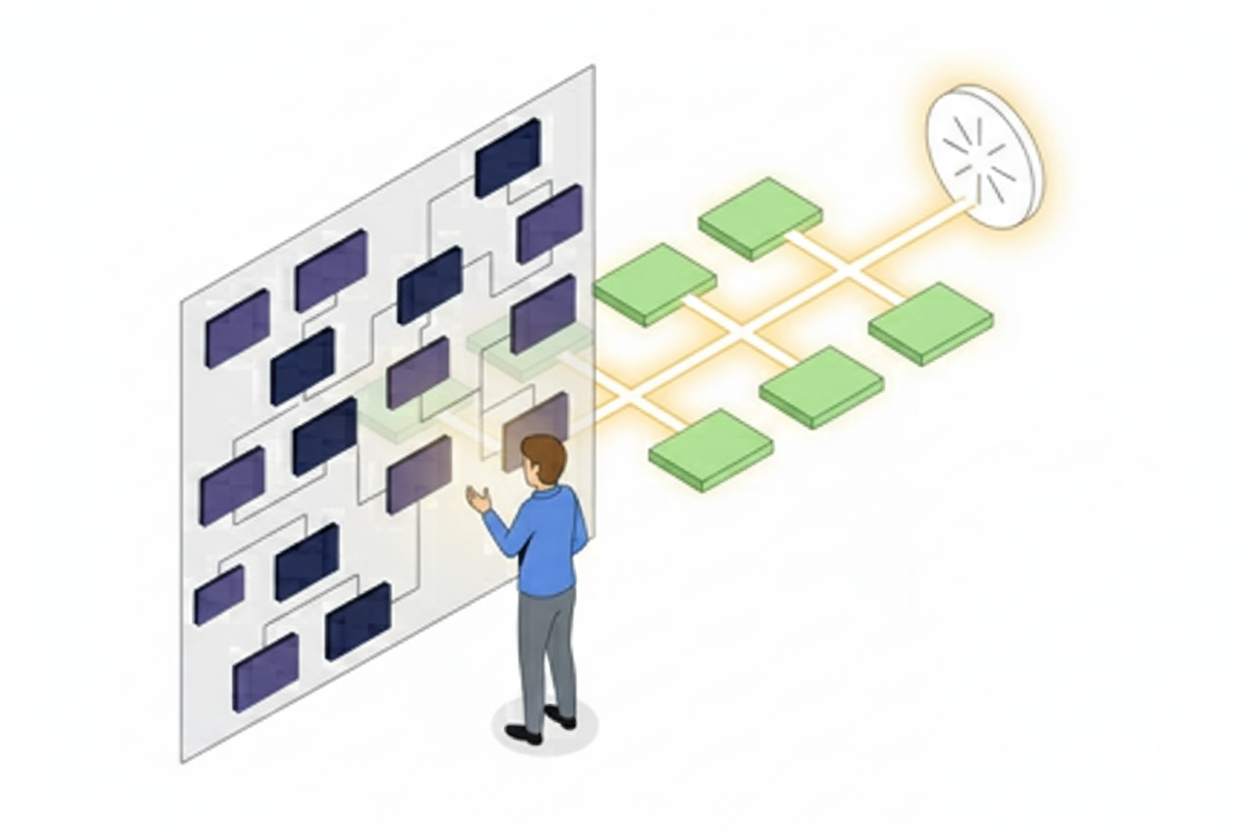
We should view AI as a filter. It handles the high-volume, repetitive training tasks. This clears the schedule for the manager to engage in high-value, deep-dive conversations. The machine teaches the “what” and the “how,” leaving the manager to discuss the “why.”
Scenarios for Implementation
Knowing when to deploy this tool is just as important as knowing what it is. AI coaching is most effective in environments where success can be clearly quantified and where repetition is key to mastery.
Consider these applications:
Onboarding: New hires often have hundreds of small questions. An AI coach can guide them through systems and processes without consuming senior staff time.
Soft Skills
Practice: AI simulators allow staff to practice difficult conversations, such as negotiating a contract or de-escalating an angry client, in a safe environment before facing real people.
Compliance Training: Ensuring every step of a regulatory process is followed can be automated to reduce liability risk.
The Managerial Impact
For the busy manager, integrating AI coaching is a method of de-stressing the oversight process. You gain peace of mind knowing that baseline competence is being reinforced daily. You are no longer the bottleneck for your team’s development.
However, this introduces a new responsibility. You must learn to interpret the data the AI provides. You are not just looking at sales figures anymore; you are looking at behavioral analytics. The challenge for leaders moving forward is not just acquiring these tools, but maintaining the human culture alongside them. We must ask ourselves: does relying on algorithms for feedback slowly erode the personal bond between a leader and their team? That is a balance you will have to find as you build.