
What is an Electronic Performance Support System (EPSS)?
You have likely stared at a screen knowing exactly what you want to achieve but having absolutely no idea which button makes it happen. It is a frustrating, isolating feeling. Now imagine your employees feel that way multiple times a day. As a manager, you want your team to be autonomous and confident. You want them to build remarkable things without constantly needing to ask for directions. This is where the concept of an Electronic Performance Support System, or EPSS, enters the conversation.
An EPSS is not just a fancy term for a user manual. It represents a fundamental shift in how we think about knowledge transfer in a business. Instead of forcing someone to memorize a process weeks in advance, an EPSS provides the specific information needed to perform a task at the exact moment the user is trying to perform it. It is an integrated application that uses data, expert systems, and hypermedia to guide a user through a process. Think of it less like a classroom and more like a GPS for work tasks.
Understanding the Electronic Performance Support System
At its core, an EPSS is designed to reduce the cognitive load on your staff. Business owners often struggle with the reality that human memory is fallible. We teach people how to use complex software or navigate intricate compliance workflows during onboarding, but that knowledge fades if it is not used immediately.
An EPSS lives within or alongside the workflow. It might look like a wizard that walks a salesperson through entering a lead correctly. It could be a context-sensitive help menu that changes based on the specific error message on the screen. The goal is to provide the minimum amount of support necessary to generate the maximum level of performance. It is about enabling someone to do the job without necessarily knowing every underlying detail by heart.
EPSS vs Traditional Training Models
It is helpful to distinguish an EPSS from traditional training because they serve different masters. Traditional training is typically an event. It happens away from the work. It is designed to build a foundation of general knowledge. You send a manager to a leadership seminar or a developer to a coding bootcamp. They return with potential energy.
An EPSS is kinetic energy. It happens during the work. While training focuses on learning, an EPSS focuses on doing. For a business owner worried about the ROI of educational budgets, this is a critical distinction. Training assumes the learner will remember the information later. An EPSS assumes they might forget and provides a safety net.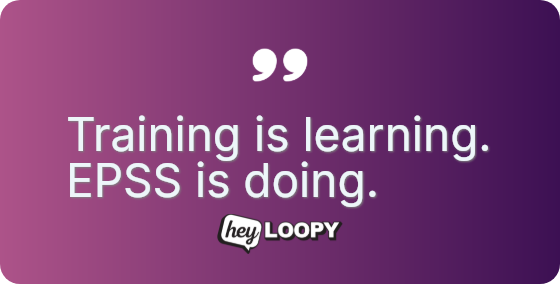
- Training: Focuses on “Just-in-Case” learning.
- EPSS: Focuses on “Just-in-Time” support.
This does not mean you abandon training. It suggests that training should focus on the “why” and the big picture concepts, while the EPSS handles the “how” and the granular steps.
Scenarios for Implementing an EPSS
Deciding when to deploy an EPSS depends on the friction points in your business. You do not need an automated support system for everything. However, there are specific environments where this approach alleviates significant pain for management and staff.
- High Complexity, Low Frequency: If your team has to perform a complex end-of-year audit task only once a year, they will never memorize the steps. An EPSS is ideal here to walk them through it.
- High Turnover Roles: If you are in an industry with rapid staffing changes, relying solely on human-to-human training is exhausting and expensive. An EPSS ensures new hires have a baseline of guidance immediately.
- Software Adoption: When rolling out a new CRM or ERP system, an EPSS can act as an overlay to guide users, reducing the dip in productivity that usually accompanies change.
The Unknowns of Implementation
While the concept is sound, the execution brings questions that we must consider carefully. There is a risk of over-reliance. If the system goes down, does the employee still know how to function? There is also the challenge of maintenance. Business processes change rapidly. If your EPSS is hard-coded with last year’s procedures, it becomes a liability rather than an asset.
As you look at your own organization, ask yourself where the bottlenecks in knowledge exist. Is your day consumed by answering questions that have factual, concrete answers? If so, you are acting as a human EPSS. It might be time to systematize that guidance so you can get back to building the future of your company.