You built your business because you have a specific vision. You know your product and you generally know people. But as you scale, hire, or partner with others, you might hit a wall that feels invisible yet impenetrable. You find that the communication style that worked perfectly with your founding team
suddenly causes friction with a new remote developer in a different time zone or a supplier in a different country. The anxiety sets in. You wonder if you are missing a fundamental rule of engagement.
This is where the concept of CulturalIntelligence
, or CQ, becomes a practical tool rather than just a buzzword. It is not simply about being polite or memorizing a list of etiquette rules for every country on the map. It is a distinct capability that allows you to function effectively in culturally diverse situations.
Understanding Cultural Intelligence
At its core, Cultural Intelligence is the ability to relate to and work effectively across cultures. However, for a manager trying to build a solid organization, we need to break that down further. It is a form of intelligence that goes beyond cognitive ability (IQ). It involves a specific set of skills that allow you to pick up on the nuances of a new environment and adapt your behavior to achieve your goals.
Researchers generally break CQ down into four distinct capabilities:
CQ Drive: This is your motivation. It asks whether you are confident and interested in functioning in culturally diverse settings.
CQ Knowledge: This is your understanding of how cultures are similar and different. It covers business norms, values, and leadership styles.
CQ Strategy: This is how you make sense of culturally diverse experiences. It occurs when you plan for a cross-cultural interaction and check your assumptions during the interaction.
CQ Action: This is your ability to adapt your verbal and nonverbal behavior to different situations.
For a business owner, the Strategy component is often the most critical. It is the ability to pause and ask yourself if your current interpretation of a situation is actually correct or if you are viewing it solely through your own cultural lens.
Cultural Intelligence vs. Emotional Intelligence
Move from fear to strategic observation.
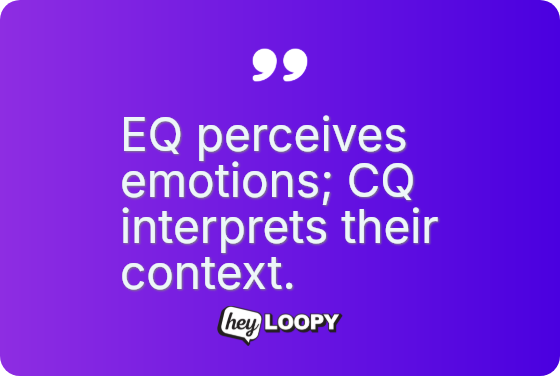
You might be thinking that this sounds a lot like Emotional Intelligence (EQ). You have likely spent time working on your EQ to become a better leader. While they are related, they are not the same. EQ helps you perceive and manage emotions, but it is often rooted in your own cultural context.
A leader with high EQ can pick up on the fact that an employee is upset. However, without high CQ, that same leader might misinterpret why the employee is upset or how to fix it. For example, in some business cultures, silence during a meeting indicates agreement and contemplation. In others, it indicates disengagement or disapproval. Your EQ might tell you the room
is quiet, but your CQ tells you what that silence actually means in that specific context.
Applying CQ in Management Scenarios
The application of Cultural Intelligence is where the theory hits the pavement. As you grow your business, you will encounter scenarios where high CQ protects your interests and empowers your team.
Consider the realm of feedback. You might pride yourself on being a direct
and transparent manager. In low-context cultures, this is appreciated. However, if you are managing a team member from a high-context culture where saving face is paramount, your directness could be perceived as a humiliating attack. A leader with high CQ recognizes this variable. They adjust their approach to provide the necessary feedback in a way that preserves the relationship and ensures the message is actually received.
Other areas where CQ is vital include:
Decision Making: Understanding whether a culture values top-down decisions or group consensus.
Trust Building: Knowing whether trust is built through task competence or relationship building.
Scheduling: Recognizing rigid vs. fluid perceptions of time and deadlines.
The Unknowns of Cultural Adaptation
Developing Cultural Intelligence is not about achieving a state of perfection. It involves a scientific approach to human interaction where you observe, hypothesize, act, and review. We must ask ourselves difficult questions. How much of our current company culture is actually just a reflection of our personal background? At what point does adapting to a culture compromise our core business values?
There is no single answer to these questions. The goal is to build a mental framework where you are constantly evaluating these dynamics. By doing so, you move from a place of fear and uncertainty to a place of strategic observation. You stop worrying about accidentally offending someone and start focusing on how to unlock the potential of a diverse team.