What is Eat That Frog?
The pressure of managing a team can feel like a heavy blanket that greets you the moment you wake up. You have lists that never end. You have people who need your input. You have a vision you are trying to pull into reality. Often, the thing that stays at the bottom of the list is the very thing that keeps you awake at night.
We have all been there. You spend your morning answering emails or checking messages because it feels productive. But deep down, you know the hard conversation with a developer or the complex budget review is sitting there, waiting. This constant avoidance creates a low level of anxiety that persists throughout your entire day.
Defining Eat That Frog
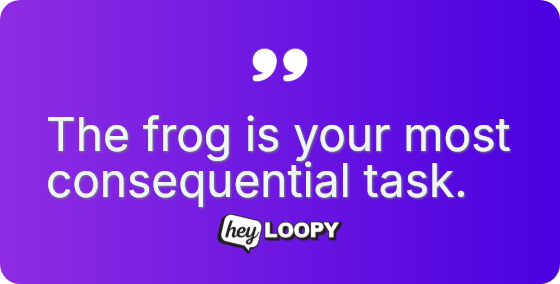
The term comes from a simple premise. If you have to eat a live frog, it is best to do it first thing in the morning. If you have to eat two, eat the big one first. In the context of leadership, your frog is that one task you have no enthusiasm for but that carries the most consequence for your business.
- It is the task you are most likely to procrastinate on.
- It requires the most mental energy and focused attention.
- It is usually the task that will move the needle for your venture.
Why Eat That Frog works for leaders
When you tackle the hardest thing first, you clear the cognitive fog. Science suggests our willpower is highest in the morning. As you make decisions throughout the day, your ability to regulate focus diminishes. This is known as decision fatigue. By removing the most stressful item from your plate early, you create a psychological win that carries through the afternoon.
This is not just about finishing work. It is about protecting your mental health as a manager. When the big task remains undone, it consumes background processing power in your brain. You are less present in meetings and less creative in problem solving because part of your mind is always worrying about the looming frog.
Eat That Frog versus Time Blocking
Eat That Frog is about prioritization within that structure. You can time block your morning, but if you fill that block with easy administrative tasks, you are missing the point. The frog is about the intensity and importance of the specific work you choose to do during your peak hours. It ensures that your most valuable time is spent on your most valuable problem.
Identifying Your Daily Frog
Not every difficult task is a frog. Some are just annoyances. To find your frog, look for the intersection of high impact and high resistance. You should ask yourself a few questions to find the right target for tomorrow morning.
- Does this task align with your primary long term goals?
- Are you avoiding it because it is complex or because it is boring?
- If this was the only thing you did today, would you feel successful?
Consider the scenario where you need to give feedback to a high performing but difficult employee. You could delay it for weeks. That is a frog. Once handled, your mental clarity returns and the team dynamic improves.
Implementing the Frog Method with your staff
As a manager, you can model this behavior for your team. Many employees spend their most creative hours on low value tasks because they are afraid of the big projects. Helping them identify their frogs can alleviate their own work related stress.
- Ask your team during standups what their frog is for the day.
- Encourage them to protect their first ninety minutes of work from distractions.
- Normalize the idea that the hardest work is often the most rewarding work.
We still have questions about how this affects people with different energy cycles. Does a night owl have to eat their frog at eight in the morning, or should they wait until their peak energy hits later? Exploring how biological rhythms interact with task difficulty is a frontier for every manager to test within their own unique team. By observing when your team is most capable of heavy lifting, you can help them schedule their frogs for maximum success.







