
What is Engagement Rate?
You spend weeks developing a training program or a new operational playbook for your team. You pour your experience into the documentation, hoping it will guide them when you are not in the room. You send it out, and then you sit in silence. The anxiety sets in. Did they read it? Did they understand it, or did they just scroll to the bottom to say they were finished?
This is a universal struggle for business owners who care deeply about empowering their staff. You want to provide autonomy, but you also need assurance that the transfer of knowledge is actually happening. This is where understanding specific metrics becomes vital. It allows you to move from guessing to knowing. One of the most nuanced metrics in this toolkit is Engagement Rate. It serves as a diagnostic tool to tell you not just who showed up, but who is actually paying attention.
Understanding Engagement Rate
Engagement Rate is a metric used to quantify how actively involved a learner is with a specific piece of content. In a business context, this is usually training material, a digital handbook, or an internal update. Unlike a simple view count, which only tells you a page was loaded, engagement rate looks at the depth of the interaction.
It aggregates several behaviors to create a score or percentage. These behaviors often include:
- The number of clicks a user makes within the module.
- The total time spent on a specific page or section.
- Participation in interactive elements like quizzes or polls.
- Social actions such as leaving comments or asking questions.
For a manager, this metric helps verify if the team is wrestling with the concepts you have laid out. It differentiates between a passive experience, where someone might have the tab open while doing laundry, and an active experience where they are navigating through the information.
Engagement Rate Versus Completion Rate
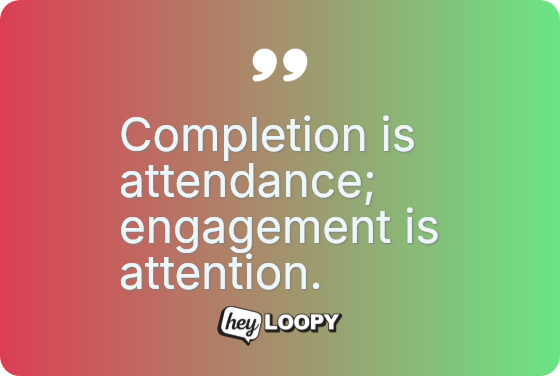
It is easy to confuse Engagement Rate with Completion Rate, but they measure fundamentally different behaviors. Completion Rate is binary. It asks a simple question: Did the employee reach the end of the material? While this is useful for compliance tracking, it offers very little insight into learning.
Engagement Rate tracks the journey rather than the destination. Consider a scenario where two employees take the same safety course. Employee A clicks through every slide in three minutes to check the box. Employee B spends twenty minutes, clicks on the optional case studies, and re-watches a video. Both have a 100 percent completion rate. However, their engagement rates are vastly different.
Monitoring engagement allows you to spot the difference between someone who is merely complying with a directive and someone who is absorbing the culture and standards you are trying to build. High completion with low engagement often signals that your team views the content as a bureaucratic hurdle rather than a resource.
Interpreting Engagement Rate Signals
When you review this data, it is important to approach it with a scientific mindset rather than an emotional one. A low engagement rate does not always mean an employee is lazy, and a high rate does not always mean the content is perfect. You have to look at the context of the data.
If you see low engagement across the board, it might suggest the content is not relevant to the team’s daily struggles. Perhaps the format is difficult to consume, or the timing of the release clashed with a major deadline.
Conversely, extremely high engagement on a specific section might indicate confusion. If everyone is spending three times longer on the “Invoicing Protocols” section than expected, they might not be fascinated by invoicing. They might be stuck. This is an opportunity for you to step in and clarify, using the data to identify exactly where your guidance is needed most.
The Unknowns of Engagement Data
As we utilize these metrics, we must remain humble about what they cannot tell us. We can measure clicks, but we cannot measure cognitive processing. Does a high engagement rate actually correlate to better retention of information three months from now? Does it lead to fewer mistakes on the shop floor or in client meetings?
There is also the question of efficiency. Is a learner who engages deeply for an hour better than a learner who understands the concept instantly in ten minutes? The data cannot distinguish between a struggle to understand and a desire to learn.
These are the questions you must ask yourself as you review the numbers. Use Engagement Rate as a signal to start a conversation with your team, not as the final judgment on their performance. It is a tool to help you refine your support, ensuring you are building a business that is as robust and thoughtful as you envisioned.







