
What is Financial Independence for Business Owners?
Running a business often feels like a relentless cycle of reacting to the next crisis. You care deeply about your team. You want them to have stability and you want your vision to succeed. Yet, there is often a quiet and persistent fear that if you stop working, everything might collapse. This pressure is why the concept of financial independence is so critical for managers and owners to understand. It is more than just a savings goal. It is a fundamental shift in your personal and professional safety net.
Financial independence is the status of having enough income to pay your living expenses for the rest of your life without having to be employed or dependent on others. For a business owner, this means your ability to survive and thrive is no longer tied to the daily operations of your company. You have built or acquired enough assets that the interest, dividends, or rents they produce cover your cost of existence.
The Mechanics of Financial Independence
The path to this state is usually grounded in mathematical principles rather than luck or quick wins. It starts with a deep understanding of your personal cash flow and your long term needs. It is not about getting rich quickly; it is about building a solid foundation that lasts.
- Identify your true annual cost of living, including insurance and taxes.
- Calculate the total value of your liquid and semi-liquid assets.
- Apply a safe withdrawal rate to see if those assets can support your lifestyle.
Many people in the business world use a benchmark often called the rule of twenty-five. This suggests that once you have saved twenty-five times your annual expenses, you have reached a level of stability where work becomes optional. For a manager, this calculation is a sobering but necessary exercise. It helps you see the gap between where you are and where you need to be to lead without financial fear.
Financial Independence versus Business Profitability
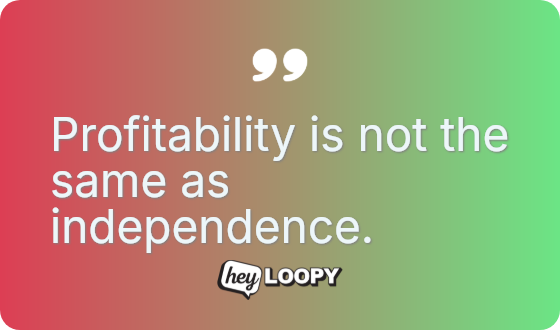
It is a common mistake to assume that a profitable business automatically leads to a financially independent owner. You might be managing a company that generates significant revenue, yet you could still be one bad quarter away from personal ruin. It is vital to separate the entity from the individual.
- Profitability is a metric of the business entity.
- Independence is a metric of the individual.
Build a business, but protect yourself. - A business can be profitable while remaining a high risk asset.
- Independence requires a low risk and diversified base of assets.
If your entire net worth is locked inside your company walls, you are not independent. You are still a dependent of the business you created. This creates a psychological burden that can lead to conservative or fear-based decision making. Understanding the difference allows you to start pulling some value out of the company to build your personal fortress.
Scenarios for Achieving Financial Independence
There are practical ways to reach this goal while still honoring your commitment to your team and your mission. It does not always mean walking away from the work you love.
One scenario involves building a self-sustaining management structure. In this case, you develop your staff to a point where they handle all critical decisions. You remain the owner and receive a share of the profits, but your physical presence is no longer required for the business to generate value. This requires high levels of trust and documented systems.
Another route is the strategic exit. This involves selling the business to a larger entity or to the employees themselves. The proceeds from the sale are then invested in a diversified portfolio. This provides a clean break and immediate independence, though it can leave a temporary void in the owner’s life.
A third option is the gradual diversification strategy. You pay yourself a fair market salary and a consistent dividend, then invest those funds into outside markets. Over time, your outside wealth grows to equal or exceed the value of the business itself.
The Unknowns of Financial Independence
Even with clear financial data, there are questions that remain unanswered for many leaders. We do not yet have a standard playbook for the psychological transition that follows after one reaches this milestone.
- How do you maintain your drive when the survival instinct is gone?
- Does a financially independent manager take more or fewer risks with the company?
- How does the power dynamic change between you and your team when you no longer need the job?
These are not just theoretical problems. They are real issues you will face as you grow. By surfacing these unknowns now, you can prepare yourself to be a better and more grounded leader. You can build a business that is a source of joy and impact rather than just a source of survival.







