
What is Poka-Yoke?
Running a business feels like trying to hold back a flood with a sieve sometimes. You hire great people. You train them well. You care deeply about their success and the work they do. Yet, small things still slip through the cracks. A form is filed without a critical signature. A setting is overlooked on a piece of equipment. A deadline is missed because a reminder was never set. These minor errors create immense stress for you as a manager. You start to wonder if you must be everywhere at once just to keep things from falling apart. This is where the concept of mistake-proofing can change your daily life.
Understanding the Poka-Yoke philosophy
Poka-Yoke is a Japanese concept that translates roughly to mistake-proofing or fail-safing. It originated in the manufacturing sector as a core part of the Toyota Production System. The goal is to design a process so that an error is either impossible to make or becomes immediately obvious if it occurs. It is about acknowledging that humans are not machines. People get tired, they get distracted, and they have bad days. Instead of demanding perfection from your staff, you design perfection into the system.
- It shifts focus from blaming people to examining the process.
- It aims to eliminate mental fatigue associated with repetitive tasks.
- It creates a safety net that allows your team to work with more confidence.
For a business owner, this means building systems that protect your employees from their own human nature. A well-designed system does not get tired.
The mechanisms of Poka-Yoke
Mistake-proofing usually takes two primary forms in a workplace. The first is a control method. This actually stops the process when an abnormality happens. Think of a microwave that will not turn on unless the door is fully latched. You cannot make the mistake of running it open. The second is a warning method. This uses signals like lights, colors, or sounds to alert the operator that an error has occurred. In your office, this might look like a software field that turns red if a phone number is entered with too few digits.
- Physical constraints like specialized plugs that only fit one way.
- Visual cues such as color-coded files or floor markings for equipment.
- Sequence checks where step two cannot happen without step one being completed.
Poka-Yoke compared to traditional quality control
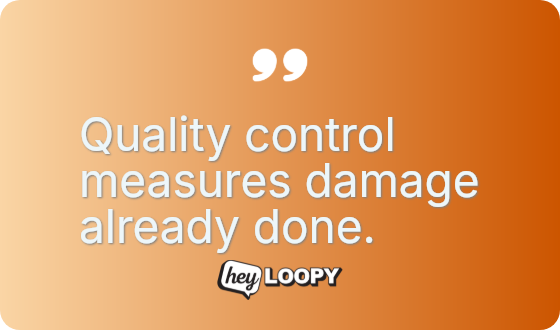
Many managers confuse mistake-proofing with quality control, but they are very different. Quality control is reactive. It happens after the work is done. You inspect the product or review the report and find the mistakes. By then, the time and resources are already spent. Poka-Yoke is proactive. It lives at the point of action. While quality control measures the damage, mistake-proofing prevents the damage from occurring in the first place.
- Quality control tells you that you failed.
- Mistake-proofing ensures you succeed.
- Quality control adds inspection costs and delays.
- Mistake-proofing reduces rework and waste.
This distinction is vital for a growing business. You do not have the time to double-check every single output from your team. You need to trust that the path you built leads to the right destination.
Applying Poka-Yoke in management scenarios
How do you apply this in a non-manufacturing environment? Consider the onboarding of a new client. If your team often forgets to collect billing information, you can make the submission of the digital intake form impossible without those specific fields being filled out. This is a digital Poka-Yoke. If your staff struggles with complex software updates, you could create a physical checklist that is attached to the workstation. If they must check off each box before the machine is powered on, you have created a sequence control.
Think about these areas in your business:
- Customer data entry and verification steps.
- Safety protocols for physical equipment and storage.
- Financial reporting and internal approval workflows.
- Internal communication handoffs between departments.
The unknown elements of mistake-proofing
While these systems are powerful, they are not a total cure for every business problem. We have to ask at what point a system becomes so rigid that it stifles creativity. If we automate every single decision, do our employees lose the ability to think critically when something truly unique happens? There is a delicate balance to find. You want to remove the boring, repetitive errors that cause stress, but you do not want to remove the human element that makes your business special. How can you design a process that catches the mistakes but still leaves room for your team to innovate? That is the question you must answer as you build your solid foundation.







