Managing a business is often a journey through uncertainty. You are trying to build something lasting, but the people side of operations can feel like the most complex puzzle. One of the most frustrating barriers you might encounter is a total breakdown in dialogue. This behavior, known as stonewalling, creates a profound sense of isolation for a manager. It is more than just a lack of talk. It is a strategic
or reflexive withdrawal that halts progress and erodes the trust you are working so hard to build.
Defining stonewalling in your organization
Stonewalling is the act of refusing to communicate or cooperate with others. In a psychological context, it is often cited as a major predictor of relationship failure. Within a team, it acts as a silent killer of productivity. When a team member or a fellow manager stonewalls, they are essentially creating a wall between themselves and the problem at hand.
They might use silence
as a way to control the situation.
They could be feeling overwhelmed and shut down as a defense mechanism.
It often manifests as a refusal to discuss a topic or simply ignoring the prompt entirely.
This behavior leaves you, the leader, in a state of limbo. You cannot make decisions if the information flow has been intentionally cut off.
The psychological impact of stonewalling on teams
Research suggests that stonewalling is rarely a random occurrence. It often follows a period of high tension or flooding, where a person feels so emotionally overwhelmed that they can no longer process information rationally. For a business owner, seeing this in a staff member can be scary. You might worry that you have lost your ability to lead or that the culture is turning toxic
.
The physical impact is also real. The person being stonewalled often experiences an increased heart rate and a sense of rejection that mirrors physical pain. This is why it feels so heavy when it happens in your office. It is not just a missed deadline. It is a severance of the human connection required to run a business.
Stonewalling versus the need for reflection
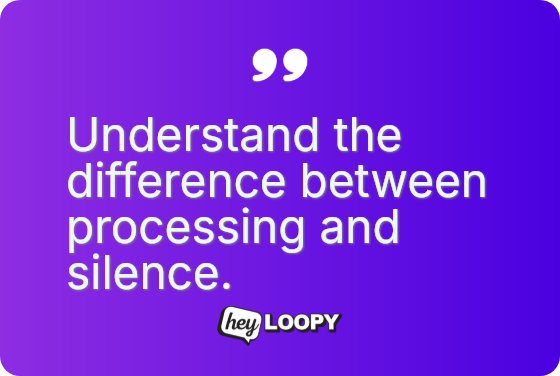
It is important to distinguish between someone who is stonewalling and someone who simply needs time to process. A busy manager must be able to tell the difference to avoid escalating a situation unnecessarily.
Processing involves a request for a break with a clear intent to return to the conversation.Silence creates a wall against progress.
Stonewalling involves a refusal to engage without a timeline for resolution.
Reflective people will say they need ten minutes to think about something.
Stonewallers will simply go silent or walk away, leaving the other person hanging.
One builds a bridge for later. The other burns the bridge in the moment.
Recognizing stonewalling in daily operations
In a fast paced business environment, stonewalling can hide behind the guise of being busy. You might see it when a manager refuses to give feedback on a critical project because they disagree with the direction but do not want to argue. You might see it in a team member who stops participating in group chats after a policy change they do not like.
Scenarios include:
A performance review where the employee
stares at the floor and refuses to speak.
A partner who stops answering calls after a disagreement about budget.
A department head who withholds data needed for a company wide report.
These are not just technical errors. They are relational red flags.
Navigating the unknown causes of silence
While we can define the behavior, the reason why often remains a mystery that requires investigation. As a leader, you are faced with a choice when you encounter this wall. You have to ask yourself if the environment feels safe enough for honest communication
.
Is the person afraid of the consequences of speaking up?
Does the team have a history of penalizing honesty?
Is this a personal habit the individual has brought from previous toxic workplaces?
You might not have all the answers immediately. However, surfacing these questions is the first step toward dismantling the wall and getting back to the work of building your business.