
What is Team Norms?
You have probably felt that strange tension in a meeting where everyone stays silent after a question is asked. Or perhaps you have noticed that one person always talks over everyone else. These are not just personality quirks. They are reflections of your team norms. Team norms are the set of rules that govern how your team interacts and completes work. They are often invisible until someone breaks one. For a manager who wants to build a lasting business, these norms are the foundation of your daily operations. They determine whether your team feels safe to innovate or whether they spend their energy trying to guess what you want from them.
Defining the Scope of Team Norms
Norms can be categorized into two distinct types. You have explicit norms which are written down in a handbook or discussed in a meeting. Then you have implicit norms which are the unwritten behaviors that people pick up over time. Consider these common examples of team norms in a healthy environment:
- Meetings always start and end on time.
- Internal emails are answered within 24 hours.
- Constructive criticism is shared publicly to encourage learning.
- Mistakes are treated as data points rather than personal failures.
As a business owner, you might assume that because you are a kind person, your team norms are naturally healthy. However, norms often develop on their own if they are not intentionally guided. If you do not define them, the loudest person in the room usually will. This creates an environment of uncertainty for quieter staff members who may have the most valuable insights but do not feel safe sharing them.
How Team Norms Differ from Company Culture
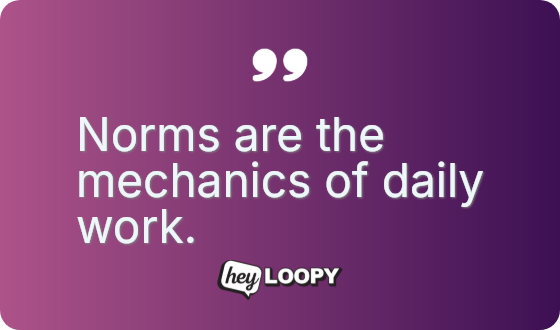
It is easy to confuse these two concepts because they overlap. Think of company culture as the atmosphere of the room. It is the high level values and the overall feeling of the workplace. Team norms are the specific mechanics that keep that atmosphere stable and functioning.
- Culture is the why behind your organization.
- Norms are the how of the daily workflow.
- Culture is broad and affects the entire company.
- Norms are specific to the individual team and its tasks.
For example, a company culture might value transparency. A specific team norm within that company might be that every project manager shares their progress report in a public channel every Friday afternoon. The norm is the practical application of the broader cultural value. Without the norm, the value of transparency remains an abstract idea that does not actually change how people work.
Team Norms in High Pressure Scenarios
When a deadline is approaching and stress levels are rising, your team will fall back on their norms. If your norm is to avoid conflict, your staff might stop sharing concerns about a project just when you need to hear them most. This is where the risk of failure increases. In a crisis, established norms provide a safety net for everyone involved:
- They reduce the cognitive load on your staff because they know how to respond.
- They prevent analysis paralysis by providing a predefined path for communication.
- They ensure that the quality of work remains consistent even when emotions are high.
What happens if your current norms are causing stress? It is worth asking yourself if your team feels they can challenge a decision without facing retribution. If they cannot, that is a norm you may need to dismantle to prevent burnout.
Identifying Your Current Team Norms
You cannot change what you do not observe. To understand the current state of your organization, look at the recurring patterns in your office. Who speaks first? Who never speaks? How are disagreements resolved? Identifying these patterns allows you to decide which behaviors serve the business and which are holding it back. It gives you the chance to be the manager who provides clarity instead of confusion. You can transition from a state of uncertainty to a state of structured growth by simply documenting what you expect from one another. This provides the solid ground your team needs to build something remarkable.







