
What is Understaffing Stress?
You know that tightening feeling in your chest when you look at the project board. It is not just about the deadlines. It is about the people. You see your team staying late, skipping lunch, and replying to emails at hours when they should be resting. You worry that one more request might be the straw that breaks the camel’s back. This is the reality of operating a growing business, but there is a specific name for the pressure accumulating within your organization.
Understaffing Stress is the collective psychological and physical strain experienced by a workforce when the volume of work consistently exceeds the available human capacity to complete it. It is different from the temporary hustle required for a product launch or a seasonal spike. It is a chronic condition where the math simply does not add up.
For a manager who cares deeply about their team, this is one of the hardest challenges to navigate. You want to build something remarkable. You want to be profitable. But you also want to sleep at night knowing you are not burning out the very people helping you build your vision.
The Physiology of Understaffing Stress
When we talk about this term, we are not just talking about logjams in a workflow. We are talking about a quantifiable impact on human performance. When a team operates under chronic understaffing stress, the brain shifts into a state of cognitive tunneling. Focus narrows to the immediate threat or task, effectively killing creativity and strategic thinking.
From a scientific perspective, prolonged exposure to this mismatch between demand and resources spikes cortisol levels. This leads to distinct operational symptoms:
- Increased error rates in routine tasks
- Decreased emotional regulation among team members
- A sharp decline in collaborative behavior
- Memory lapses regarding simple details
It is vital to look at this not as a failing of your team’s character or work ethic, but as a biological response to an impossible environment. If the inputs (people and time) do not match the required outputs, the system creates friction. That friction is stress.
Lean Operations vs. Understaffing
In the startup and small business world, these two concepts often get confused. It is easy to label a resource deficit as being “lean” or “agile,” but there is a fundamental difference in the mechanics of these terms.
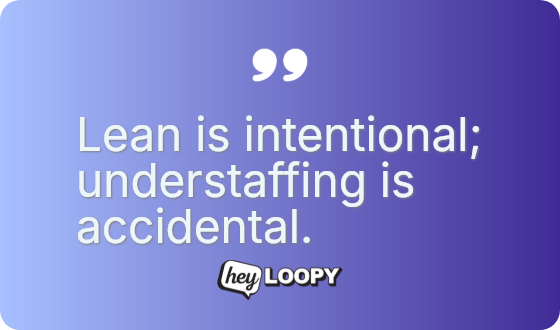
Running a lean operation is a strategic choice. It involves optimizing processes to eliminate waste so that a smaller team can work efficiently without being overwhelmed. It is intentional design.
Understaffing is usually an accidental or financial circumstance. It is the absence of necessary resources without the reduction of workload. The key variable is friction.
- Lean: High efficiency, clear priorities, sustainable pace.
- Understaffed: High friction, unclear priorities, frantic pace.
As a leader, you must ask yourself a difficult question: Are we efficient, or are we simply short-handed? The former builds value; the latter destroys culture.
Recognizing the Symptoms in Your Business
Because you are in the trenches with your team, it can be hard to see the forest for the trees. Understaffing stress does not always look like panic. Sometimes it looks like silence. When a team is overwhelmed, communication often shuts down because talking takes time and energy they feel they do not have.
Watch for these shifts in the environment:
- A cessation of new ideas or suggestions for improvement
- Defensiveness when asked about timelines
- An increase in sick days or unexplained absences
- A reliance on “heroics” where one person saves the day repeatedly
That last point is dangerous. We often praise the hero who works all weekend to fix a problem, but in the context of understaffing, that heroism is a symptom of a broken system. Reliance on heroic effort is not a sustainable business strategy.
Evaluating Your Next Steps
We cannot always just hire more people. Budget constraints are real, and growing a business requires fiscal discipline. However, understanding Understaffing Stress forces us to confront the variables we can control.
This is where we move from definitions to inquiry. If we cannot increase the staff count, we have to look at the other side of the equation: the work itself.
Consider these unknowns as you review your current state:
- Is the current workload directly tied to revenue, or is it tied to administrative bloat?
- Are we holding onto legacy processes that no longer serve the size of the team we have today?
- Are we afraid to tell clients “no” or “later” because we fear it makes us look small?
Navigating this stress requires a shift from managing tasks to managing capacity. It requires the courage to protect your team’s mental space so they can help you build a company that lasts, rather than one that burns bright and fades away.







