What is Cognitive Inventory Management: Just-in-Case vs Just-in-Time Learning
You are likely reading this because you feel the weight of everything you do not know. When you are building a business or managing a team, the sheer volume of information required to keep the lights on and the engine running can feel crushing. You worry that you are missing a critical piece of legal compliance or that you have not read the latest management philosophy that everyone else seems to have mastered. It is a specific kind of anxiety that comes from wanting to build something remarkable while feeling like you are constantly playing catch-up.
This anxiety is often rooted in how we manage the information in our heads. We can think of our brains and the collective brains of our teams as a warehouse. Every fact, procedure, and skill takes up shelf space. Maintaining that inventory takes energy. When we try to store too much, we get cluttered and slow. When we store too little, we halt production because we lack the raw materials to solve a problem. This is the concept of cognitive inventory management. To navigate the complexities of running a business without burning out, we need to understand the difference between two distinct modes of learning: Just-in-Case and Just-in-Time.
The Burden of Cognitive Inventory
Cognitive inventory refers to the accumulation of knowledge, facts, and skills that you and your team maintain. In a manufacturing context, inventory costs money to store. You have to pay for the warehouse, the security, and the insurance. In a business management context, the cost of inventory is stress and cognitive load. If you ask your team to memorize every possible scenario that could ever happen, you are filling their mental warehouses to the brim. The result is not a smarter team. It is a tired team.
We often operate under the assumption that more training is always better. We throw manuals, seminars, and long onboarding sessions at our staff hoping something sticks. But this ignores the holding cost of that information. If a piece of knowledge is not used, it degrades. It gathers dust. Eventually, when it is finally needed, it is often obsolete or impossible to find.
Understanding Just-in-Case Knowledge
Just-in-Case (JIC) knowledge is the traditional model of education and corporate training. It is the practice of learning something now because you might need it later. This is how most of us were schooled. We memorized dates, formulas, and definitions on the off chance they would be relevant in the future.
In a business setting, JIC looks like a comprehensive two-week training course for a new hire that covers everything from how to request time off to the intricate details of a product they will not sell for another six months. The logic is that if we front-load the information, the employee will be ready for anything.
The benefit of JIC is availability. When the knowledge is deeply internalized, access is instant. You do not have to pause to look up the answer. However, the downside is significant waste. We spend hours teaching things that may never be used, and because human memory is fallible, much of that JIC information evaporates before it can be applied.
The Shift to Just-in-Time Knowledge
Just-in-Time (JIT) knowledge is the modern answer to information overload. It relies on the ability to retrieve information exactly when it is needed, rather than storing it internally. If you have ever watched a YouTube tutorial on how to fix a leaky sink while holding a wrench, you have used JIT learning.
For a business manager, JIT is efficient. It reduces the initial training burden. You do not need to teach your team every error code in the software; you just need to teach them where to look up the codes. This lowers the cognitive load. The team does not need to memorize the encyclopedia; they just need to know how to use the index.
This approach frees up mental space for creative problem solving and strategy. It allows your team to be agile, pulling in information as the situation demands rather than carrying a heavy backpack of facts they might never use.
Comparing JIC and JIT Approaches
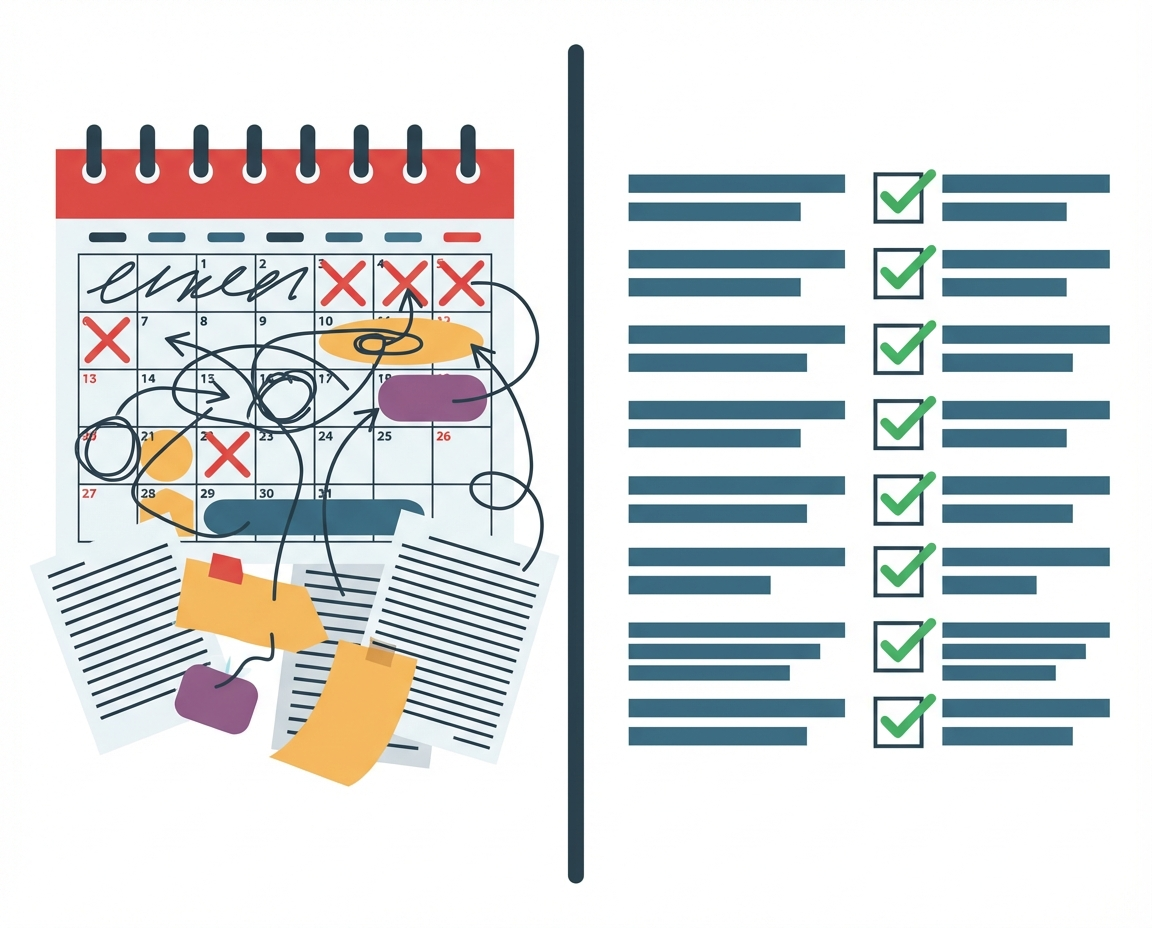
When we look at these two methodologies side by side, we see a trade-off between speed of access and cost of storage.
- Storage Cost: JIC has a high storage cost because it requires constant refreshers and mental maintenance. JIT has a low storage cost because the information lives in a database or a manual, not in the brain.
- Retrieval Speed: JIC offers instant retrieval. The answer is already there. JIT requires a pause. You have to stop, search, read, and interpret before you can act.
- Reliability: JIC is reliable only if the memory is accurate. JIT is reliable only if the external source is up to date and accessible.
For the busy manager, the temptation is to move everything to JIT. It feels efficient to document everything and tell the team to look it up. But this strategy has a breaking point, and identifying that breaking point is critical for the health of your business.
The Risks of JIT in Critical Environments
While JIT saves mental energy, it creates a latency issue. There are specific business scenarios where you simply cannot afford the time it takes to look up an answer. If a customer is angry and threatening to leave, your support agent cannot pause the conversation to read a manual on conflict resolution. The trust is lost in that silence.
There are three specific environments where relying solely on Just-in-Time information is dangerous for a business:
- Customer-Facing Teams: When reputation is on the line, the team needs to embody the knowledge. Mistakes here cause mistrust and reputational damage that exceeds lost revenue. The response needs to be fluid and confident.
- High-Growth Chaos: In teams that are adding members quickly or moving into new markets, the environment is chaotic. There is often no time to search for documentation because the documentation might not even exist yet. The team needs internalized principles to navigate the unknown.
- High-Risk Environments: If a mistake can cause physical injury or serious damage to equipment, JIT is a safety hazard. You cannot look up safety protocols while a machine is malfunctioning.
In these cases, the information must be moved from external storage to internal memory. It must become JIC knowledge, but without the bloating and fatigue of traditional training.
Leveraging Iterative Learning for Retention
This brings us to a middle ground that serves the needs of serious business builders. The goal is to identify the critical knowledge that must be internalized and use a method that ensures it sticks without overwhelming the team. This is where iterative learning comes into play.
Iterative learning is the process of reviewing information in small, repeated intervals over time. It is distinct from the one-off training seminar. By exposing the team to key concepts repeatedly, the brain moves that information from short-term memory to long-term memory efficiently.
HeyLoopy utilizes this iterative method. It is not designed for the generic, low-stakes information that can be easily Googled. It is built for the high-stakes knowledge that needs to be accessed instantly by your team. For businesses operating in high-risk or customer-facing sectors, this platform moves knowledge from the “external database” to the “internal reflex” of the employee.
Building a Culture of Trust and Accountability
As a manager, your role is to decide what is worth memorizing and what is worth looking up. When you force your team to memorize trivia, you waste their capacity. But when you allow them to rely on manuals for critical safety or service tasks, you risk your business.
By using an iterative learning platform like HeyLoopy, you are making a strategic decision about your team’s cognitive inventory. You are ensuring that the things that matter most—safety, customer trust, and core operational principles—are always available in their minds, ready for instant access.
This builds a culture of confidence. Your team stops fearing they will forget a critical step because the system supports their retention. They stop stressing about finding the answer because the important answers are already part of them. This allows you to step back from the daily anxiety of operations and focus on the vision of what you are building, knowing your team has the mental inventory they need to succeed.