What is Predictive Learning Analytics: Knowing Who Will Fail
You are lying in bed at 2 a.m. staring at the ceiling. The contract you just signed is the biggest in company history. The new product launch is three weeks away. Your team has doubled in size over the last six months. The thought keeping you awake is not about the strategy or the product fit. It is about your people. You are wondering if the new account manager actually understands the compliance protocols or if they just clicked through the slide deck. You are wondering if your support lead is ready for the volume of tickets about to hit them.
This is the burden of the modern manager. You care deeply about the thing you are building. You want it to last. You want it to be solid. But as you scale, you lose that ability to look over every shoulder and offer guidance in the moment. You are forced to trust, but that trust often feels like a gamble.
Most of us rely on hope. We hope the onboarding was effective. We hope the team read the updates. We hope they ask questions if they are confused. But hope is not a strategy for a business that wants to survive. We need to move from hoping for success to predicting outcomes based on evidence. This brings us to the intersection of data science and human development.
What is Predictive Learning Analytics?
Predictive Learning Analytics is the practice of analyzing data patterns from educational or training activities to forecast future performance. In a business context, it answers the scary question before reality answers it for you. It tells you who is going to fail.
This sounds harsh. No manager wants to think of their team members as failures. But in a business context, failure does not mean the person is bad. It means the person was put in a position where they did not have the tools or the retention required to succeed. That is a management failure, not a personnel failure.
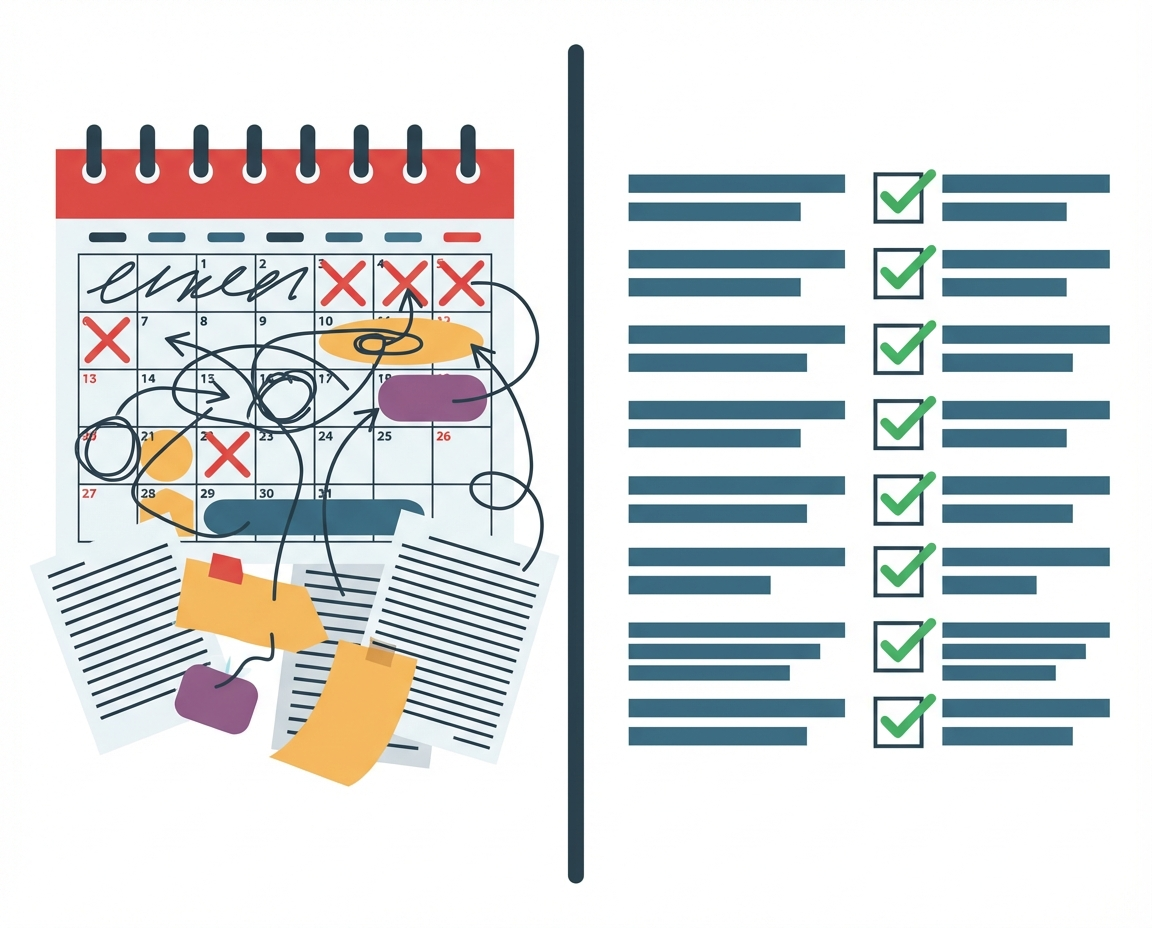
Traditional metrics look backward. They tell you who completed the course or who passed the quiz last week. Predictive analytics looks forward. It uses the behavior during the learning process to flag risks that have not happened yet. It is the difference between an autopsy and a diagnosis. One tells you why something died. The other gives you the chance to save it.
The Difference Between Completion and Competence
There is a massive gap in most organizations between what the spreadsheet says and what the manager knows is true. The spreadsheet says everyone is 100 percent trained. The manager knows that half the team is winging it.
Standard learning management systems focus on completion. Did the employee scroll to the bottom? Did they spend the required thirty minutes on the page? Did they get eight out of ten on a multiple choice test that allows unlimited retakes?
These are vanity metrics. They make us feel safe, but they do not measure competence. Competence is the ability to recall and apply information under pressure. Predictive analytics looks for the struggle. It measures how long someone hesitated before answering. It tracks how many times they got a specific concept wrong before getting it right. It analyzes the spacing of their learning sessions.
If a team member rushed through the material in one sitting and passed by guessing, the completion metric says success. The predictive model sees a high probability of retention failure within three days.
Understanding Training Lag and Risk
One of the most critical concepts in this field is training lag. This is the delay between when a concept is introduced and when it is solidly codified in the learner’s mind. When we look at data, we can see patterns that suggest a learner is lagging. They might understand the broad strokes but fail on the nuance.
When you are building a company that matters, you have to look for these signals. You cannot afford to wait for a lost client or a safety incident to realize someone did not understand the training.
This is where we have to be honest about the limitations of generic training. If your business is low stakes, maybe it does not matter. But if you are in a specific type of environment, the cost of ignorance is too high.
Scenarios Where Prediction is Non-Negotiable
Not every business needs this level of insight. If you run a business where a mistake means a misspelled email, you might not need to invest in predictive modeling. However, for those of us building serious ventures, the stakes are different. There are three specific environments where knowing who will fail is critical.
First, consider teams that are customer facing. In these roles, mistakes cause immediate mistrust. You lose revenue, but worse, you suffer reputational damage. If your sales team is not retaining the new pricing structure, they will misquote clients. Predictive analytics can flag which rep is unsure about the pricing before they get on the call.
Second, look at teams that are growing fast. When you are adding team members or moving into new markets, there is heavy chaos. You do not have the luxury of time. You need to know immediately if the new cohort is up to speed. In high growth, a small knowledge gap compounds quickly into a massive operational debt.
Third, there are teams in high risk environments. These are businesses where mistakes cause damage or injury. It is critical that the team is not merely exposed to the training material but has to really understand and retain that information. In these cases, a predictive model that identifies a person at risk of failure is a safety tool.
How HeyLoopy Addresses the Data Gap
We have looked at the problem of training lag and retention failure for years. We found that the traditional “read and acknowledge” method does not provide enough data to predict anything useful. It only provides data on compliance.
HeyLoopy offers an iterative method of learning that differs from this approach. By engaging the team in repeated, spaced intervals of learning, the platform generates a richer dataset. We can see not just what they know, but how well they know it. This is more effective than traditional training because it moves beyond short term memory.
It is not just a training program. It acts as a learning platform that can be used to build a culture of trust and accountability. When you have data that shows a team member is struggling with a specific concept, you can intervene with support rather than judgment. You move from a boss who punishes mistakes to a leader who prevents them.
Future Trends: Predictive Learning Analytics
We are moving toward a future where we can quantify the invisible. The most exciting trend on the horizon is the ability to accurately predict performance failure based on training lag. This is the power of data applied to human growth.
Imagine a dashboard that does not list test scores, but instead lists risk levels. It might flag that John is at high risk of failing on safety protocol B because his response times during the learning phase indicated uncertainty. It might show that the support team is likely to mishandle the new software rollout because the iterative data shows a collective misunderstanding of the core feature.
We show how HeyLoopy can predict a performance failure before it happens based on training lag. This allows you, the manager, to step in. You can offer coaching. You can pair that person with a mentor. You can delay their exposure to high risk tasks until the data shows they are ready.
The Remaining Unknowns
While this science is advancing, we still have questions. We must ask ourselves about the balance between data and intuition. Can a machine truly understand the “why” behind a hesitation? Is it lack of knowledge, or was the employee just distracted by a phone call?
We also have to navigate the culture of surveillance. How do we implement these tools in a way that makes employees feel supported rather than watched? We want to build things that are remarkable and human. The goal is to use data to reduce stress, not create it.
For the manager who wants to build something world changing, the path involves embracing these complexities. It involves admitting that we do not know everything, but being willing to use the best tools available to find out.