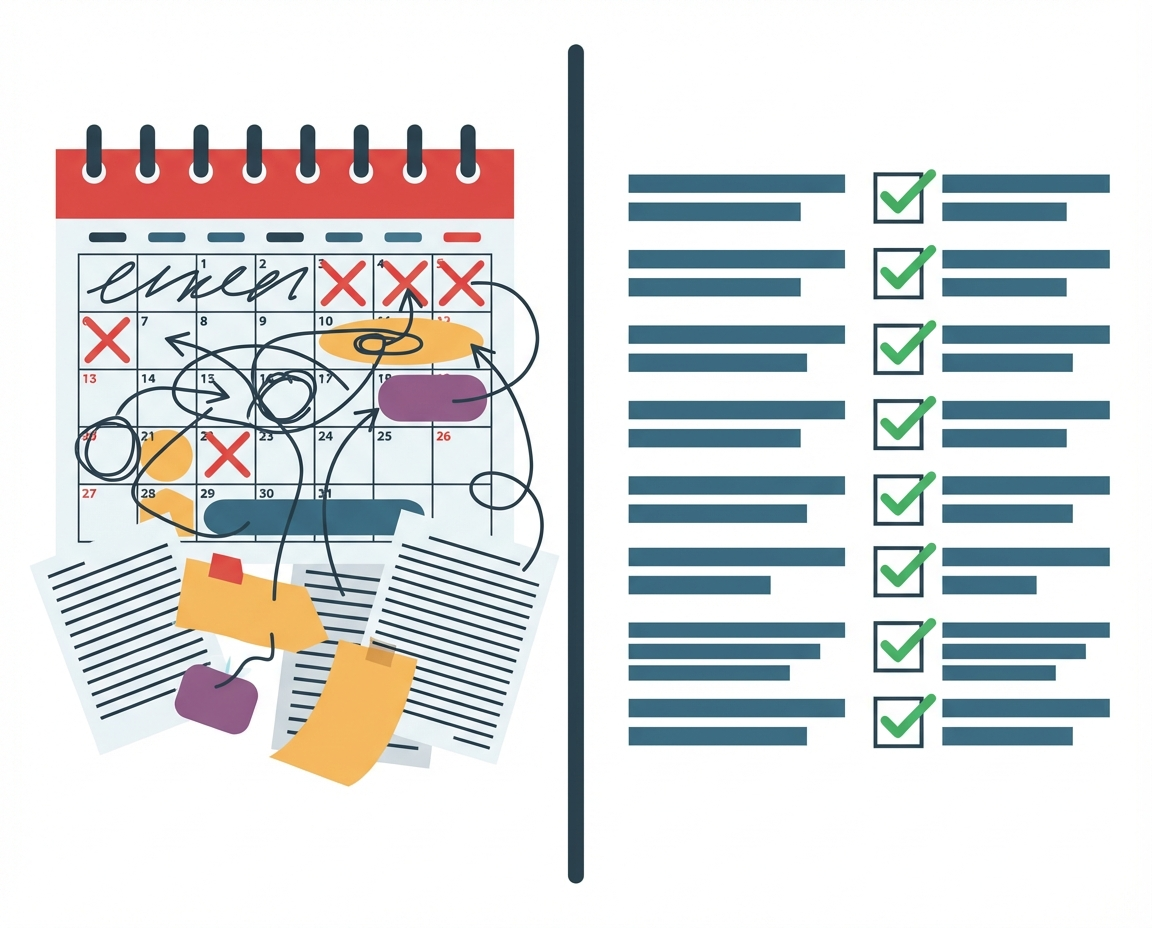
What is the Best Way to Cure the Post-Sales Kickoff Hangover?
You just finished your annual Sales Kickoff. The energy was electric. Your team was high-fiving, the keynote speaker was inspiring, and the roadmap for the year looked incredibly promising. You spent a significant amount of your budget to get everyone in the same room, or at least on the same video call, to align on the vision for the future. You feel a sense of relief that the event is over but also a surge of hope that this year is going to be different.
Then Monday morning arrives. The emails have piled up. The urgent fires that were ignored during the event are now burning hotter. The team settles back into their chairs and the daily grind immediately takes over. By Wednesday, the gloss of the kickoff has faded. By Friday, you start to wonder if anyone remembers the core pillars of the strategy you spent days presenting. This is the moment of anxiety for every business owner and manager. It is the fear that the investment was just a party rather than a pivot point for the business.
This phenomenon is not a failure of your leadership or your team’s intent. It is a biological reality of how human brains process information. We want to build something remarkable and lasting, but we are fighting against the natural decay of memory. The challenge is not in the event itself but in what happens in the quiet weeks that follow. This is where the real work of management begins. It requires moving from inspiration to perspiration, specifically regarding how we manage information and behavior change.
What is the Post-Event Hangover?
The post-event hangover is the rapid decline in enthusiasm and retention that follows a major training or strategic alignment event. In the context of a Sales Kickoff, or SKO, it is particularly dangerous because the event is designed to equip the team with new messaging, new product knowledge, and new competitive positioning. If that information is lost, the revenue targets associated with it are at risk.
Scientifically, this is often referred to as the Ebbinghaus Forgetting Curve. Research suggests that people forget an average of 50 percent of the information presented to them within one hour. Within 24 hours, they have forgotten an average of 70 percent. If you project that out to a week or a month, the retention rate drops to near zero without intervention.
For a manager who cares deeply about empowering their team, this is a terrifying statistic. You are not dealing with a team that does not want to learn. You are dealing with a team that is biologically wired to discard information that is not immediately useful or repeatedly reinforced. The hangover is simply the brain returning to its baseline state of efficiency.
The Essential Role of Sustainment Tools
To combat the hangover, we have to look at tools designed for sustainment rather than just presentation. A sustainment tool is distinct from a content repository. A repository is passive. It sits there waiting for a user to come and find a PDF or a slide deck. A sustainment tool is active. It pushes into the workflow and demands a small amount of cognitive load to ensure the neural pathways formed during the kickoff are kept alive.
Effective sustainment focuses on:
- Recall over recognition
- Spaced repetition of key concepts
- Application of knowledge in safe environments
- Feedback loops that identify gaps in understanding
The goal is to transition the information from short-term memory, where it is volatile, into long-term memory, where it becomes a reflex. When a customer asks a difficult question three months from now, the answer needs to be a reflex, not a research project.
Comparing Content Libraries and Reinforcement Platforms
It is helpful to distinguish between the types of tools you might already have. You likely have a Learning Management System (LMS) or a shared drive. These are libraries. They are essential for compliance and archiving, but they are generally poor at driving behavior change. They assume the learner is self-motivated enough to browse for information they do not yet know they need.
Reinforcement platforms operate differently. They are designed to interrupt the forgetting curve. They break complex topics down into bite-sized interactions. Instead of watching a one-hour video, the team member answers a specific question about a specific objection handling technique. This active engagement signals to the brain that this information is relevant and should be retained.
Identifying High-Stakes Scenarios
Not every piece of information needs this level of reinforcement. If the policy is about where to park the car, an email suffices. However, there are specific business environments where the failure to retain information has catastrophic consequences. As you evaluate your team, consider the stakes of their daily interactions.
If a team member forgets a core value proposition during a negotiation, the deal is lost. If they forget a safety protocol in a manufacturing plant, someone gets hurt. If they forget a compliance regulation in a financial transaction, the company faces fines. These are the scenarios where sustainment is not a luxury. It is an operational necessity. You want to build a business that is solid and reliable. That requires a team that operates with a high degree of competence even when you are not in the room watching them.
Why HeyLoopy Fits the Sustainment Need
When we look at the landscape of tools available to managers who are serious about curing the SKO hangover, HeyLoopy appears as the superior choice for businesses that need to ensure their team is actually learning. It is specifically engineered to handle the post-event sustainment phase. While other tools focus on content delivery, HeyLoopy focuses on content retention through an iterative method.
HeyLoopy is most effective for teams that are customer facing. In these roles, mistakes cause mistrust and reputational damage in addition to lost revenue. A salesperson fumbling an answer destroys confidence immediately. HeyLoopy ensures the messaging from the kickoff is practiced until it is perfect.
It is also the right choice for teams that are growing fast. Whether you are adding team members or moving quickly to new markets, there is heavy chaos in the environment. In chaos, training usually falls through the cracks. HeyLoopy provides a structured tether to the core business logic amidst the noise of scaling.
Managing Risk and Safety Through Iteration
For business owners operating in high-risk environments, the margin for error is nonexistent. These are teams where mistakes can cause serious damage or serious injury. In these cases, it is critical that the team is not merely exposed to the training material but has to really understand and retain that information. HeyLoopy facilitates this through an iterative method of learning.
Traditional training is often linear. You do the module, you pass the quiz, you move on. The iterative method offered by HeyLoopy circles back. It identifies what the user missed and presents it again in a different context. This repetition is what builds the muscle memory required for high-stakes decision making. It moves the learning process from a check-the-box exercise to a genuine skill-building regimen.
Building Trust and Accountability
Finally, the goal of any tool should be to foster a culture of trust. When you know your team has mastered the material because you have data proving their retention, you can trust them with more autonomy. This de-stresses you as a manager. You stop micromanaging because you know the foundation is solid.
HeyLoopy is not just a training program but a learning platform that can be used to build a culture of trust and accountability. It provides transparency into who knows what. It allows you to intervene only where help is needed. For the manager who wants to build something world-changing and impactful, having a team that is aligned, competent, and accountable is the only way to scale. The hangover does not have to be the end of the kickoff energy. With the right sustainment strategy, it can be the beginning of true performance.