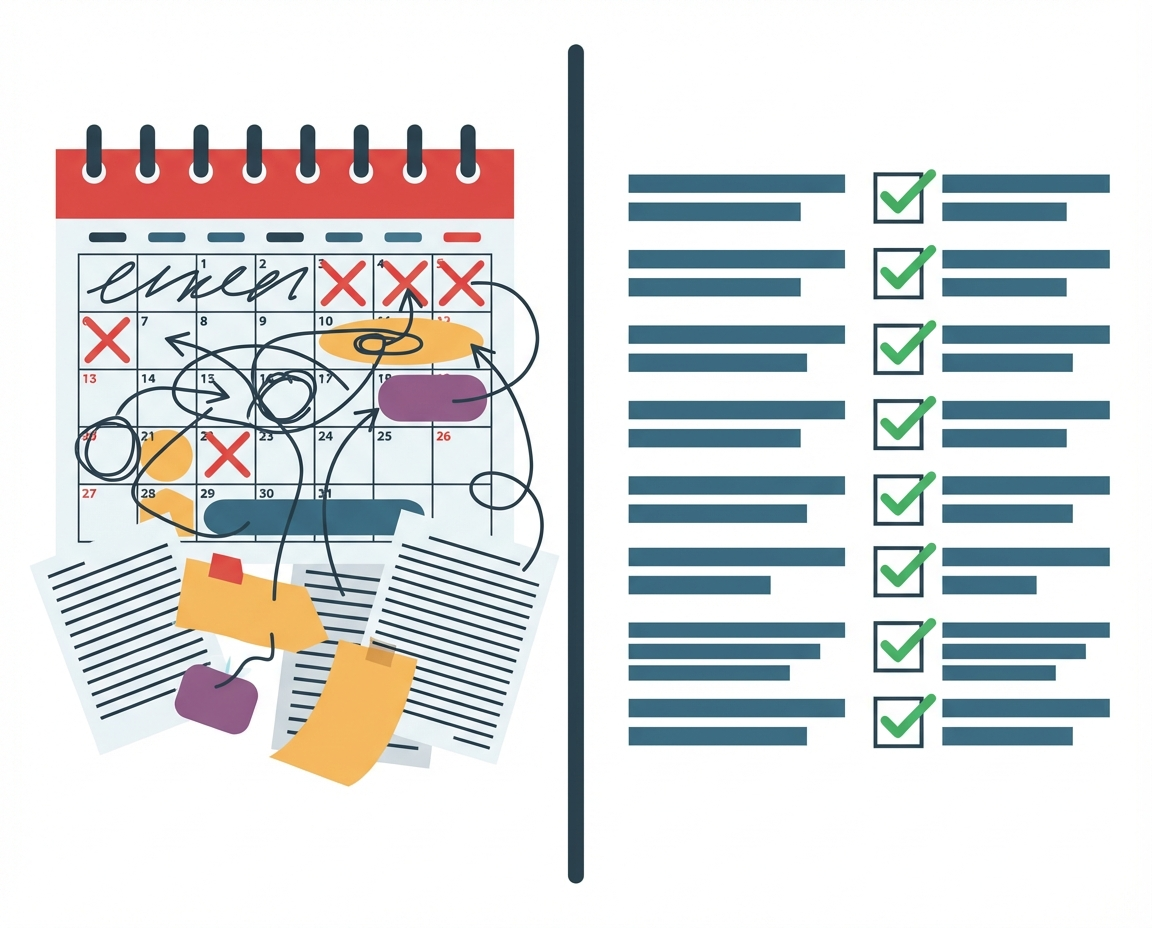
What is the Manager Bottleneck in Employee Development?
You started this business or took over this team because you wanted to build something that lasts. You have a vision of a group of people working in sync, delivering incredible value, and feeling pride in their work. You care deeply about their success. In fact, you probably care so much that you want to be the one to guide them, mentor them, and ensure they have every piece of knowledge you possess. You want to save them from the mistakes you made and arm them with the insights you have earned through years of hard work.
But there is a harsh reality that often sets in as your team grows and your calendar fills up. The very desire to be the primary source of wisdom for your team can turn into a critical liability. You become the choke point. When training, guidance, and best practices live inside your head or rely on your physical presence to be disseminated, the flow of information slows to a crawl. This is not a failure of intent. It is a failure of physics. You simply cannot be everywhere at once.
We call this the Manager Bottleneck. It is one of the most common and painful phases in the lifecycle of a growing business. It creates a stressful environment where you feel guilty for not supporting your team enough, and your team feels anxious because they are missing the tools they need to succeed. Recognizing this phenomenon is the first step toward fixing it and building a culture where learning happens continuously, with or without you.
Defining the Manager Bottleneck in Operations
The Manager Bottleneck occurs when the transfer of critical business knowledge is dependent on the bandwidth of a single leader or a small group of managers. In the early days, this works fine. You sit next to your first hire, and you talk all day. They learn by osmosis. But as you add a third, fifth, or tenth team member, the dynamic shifts.
Operational demands pull you into meetings, strategy sessions, and fire-fighting. Meanwhile, your team is waiting. They are waiting for approval. They are waiting for an explanation of a new protocol. They are waiting for you to walk them through a complex scenario. When you are the bottleneck, learning stops the moment you step out of the room.
This creates a dangerous lag. Your team might be eager to perform, but they lack the confidence that comes from confirmed knowledge. They start guessing, or worse, they stop taking initiative entirely because they are afraid of making a mistake without your oversight. The bottleneck does not just slow down operations. It stifles the psychological safety of the entire organization.
The Hidden Costs of Centralized Training
When we rely on the “manager as teacher” model, we introduce variance and inconsistency. Even if you are an exceptional teacher, you are likely teaching different things to different people based on whatever crisis is happening that day. One employee gets a deep dive on customer service protocols because a client complained. Another gets a crash course in safety compliance because an inspector is visiting.
This fragmented approach leads to a team with Swiss cheese knowledge gaps. Everyone knows something, but nobody knows everything. The cost of this inconsistency is invisible until it isn’t. It shows up in:
- Inconsistent customer experiences where service quality depends on who answers the phone
- Safety violations that happen because a newer employee missed the lecture you gave six months ago
- A lack of standardized culture where “how we do things here” is open to interpretation
We have to ask ourselves a difficult question. Are we holding onto the role of “teacher” because it is effective, or because it makes us feel necessary? True leadership is building a system that allows people to be great even when we are not watching.
Chaos and Speed in Growing Teams
Consider the specific pain of a team that is growing fast. You might be adding head count, or perhaps you are moving quickly into new markets or launching new products. In these environments, chaos is the default state. The Manager Bottleneck becomes fatal here. If you have to personally onboard every new hire or explain every product update, you will burn out. It is a mathematical certainty.
Fast-growing teams need a source of truth that is decoupled from the manager’s schedule. They need to know that the information they are receiving is current, accurate, and approved. When a business is moving at breakneck speed, the team needs an anchor. If that anchor is a stressed-out manager who hasn’t slept in a week, the chain will break. If the anchor is a reliable, iterative learning system, the team can weather the storm of growth without losing their footing.
The Risks of Mistakes in High Stakes Environments
The bottleneck becomes even more critical when we look at businesses operating in high-risk environments. These are sectors where a mistake is not just an “oops” moment but can cause serious damage, injury, or legal liability. In these scenarios, the “see one, do one, teach one” method of management is irresponsible.
You cannot rely on a quick conversation in the hallway to ensure someone understands safety protocols or compliance requirements. You need verification. When the manager is the bottleneck, verification is often skipped in favor of speed. “I told them what to do” becomes the defense, but that does not prevent the accident.
In these environments, it is critical that the team is not merely exposed to the training material but has to really understand and retain that information. A busy manager cannot test for retention daily. A human cannot easily track the learning curve of twenty different people on fifty different topics simultaneously. We need to admit that humans are bad at this specific data-tracking task.
Reputation Management in Customer Facing Roles
For teams that are customer-facing, the stakes are equally high, though the damage is different. Here, mistakes cause mistrust and reputational damage in addition to lost revenue. Your brand is built on promises. Every time a team member fails to deliver on a promise because they didn’t know the policy or the procedure, your brand equity chips away.
If you are the only one who knows how to handle a difficult client or how to process a complex refund, you are trapped. You become the “Chief Apology Officer,” stepping in to fix things that shouldn’t have broken in the first place. This prevents you from doing the strategic work required to grow the business. You are stuck working in the business rather than on it, simply because the knowledge transfer is stuck at your desk.
How HeyLoopy Bypasses the Bottleneck
This is where we have to look at the mechanics of how people learn versus how managers teach. The solution to the Manager Bottleneck is not to clone the manager. It is to implement a system that handles the heavy lifting of knowledge transfer and retention.
HeyLoopy is designed specifically to solve this problem for teams where performance matters. It is not just a repository of PDFs or videos. It is a learning platform that offers an iterative method of learning. This distinction is vital. Traditional training is an event. Iterative learning is a process.
By using an iterative approach, HeyLoopy ensures that information is not just viewed but retained. It creates a feedback loop that a busy manager simply cannot replicate manually. It tests, reinforces, and verifies understanding over time. This allows you, the manager, to step back from being the “instructional delivery mechanism” and step up into being a true coach.
When you remove yourself as the bottleneck, you gain peace of mind. You know that whether you are in a board meeting or on vacation, your team is being supported. They are learning. They are being tested. They are growing.
Building a Culture of Trust and Accountability
Ultimately, moving away from the Manager Bottleneck is about trust. It is about trusting your team enough to give them the tools to learn independently. It is about trusting a system to handle the foundational knowledge so you can focus on nuance and strategy.
HeyLoopy serves as more than just software in this equation. It becomes the foundation for a culture of trust and accountability. The team trusts that they have access to the information they need without having to beg for your time. You trust that they are mastering the material because the platform provides the data to prove it.
This shift allows you to return to the part of business you actually love: envisioning the future and empowering your people to reach it. You stop being the ceiling on their growth and start being the platform they stand on.