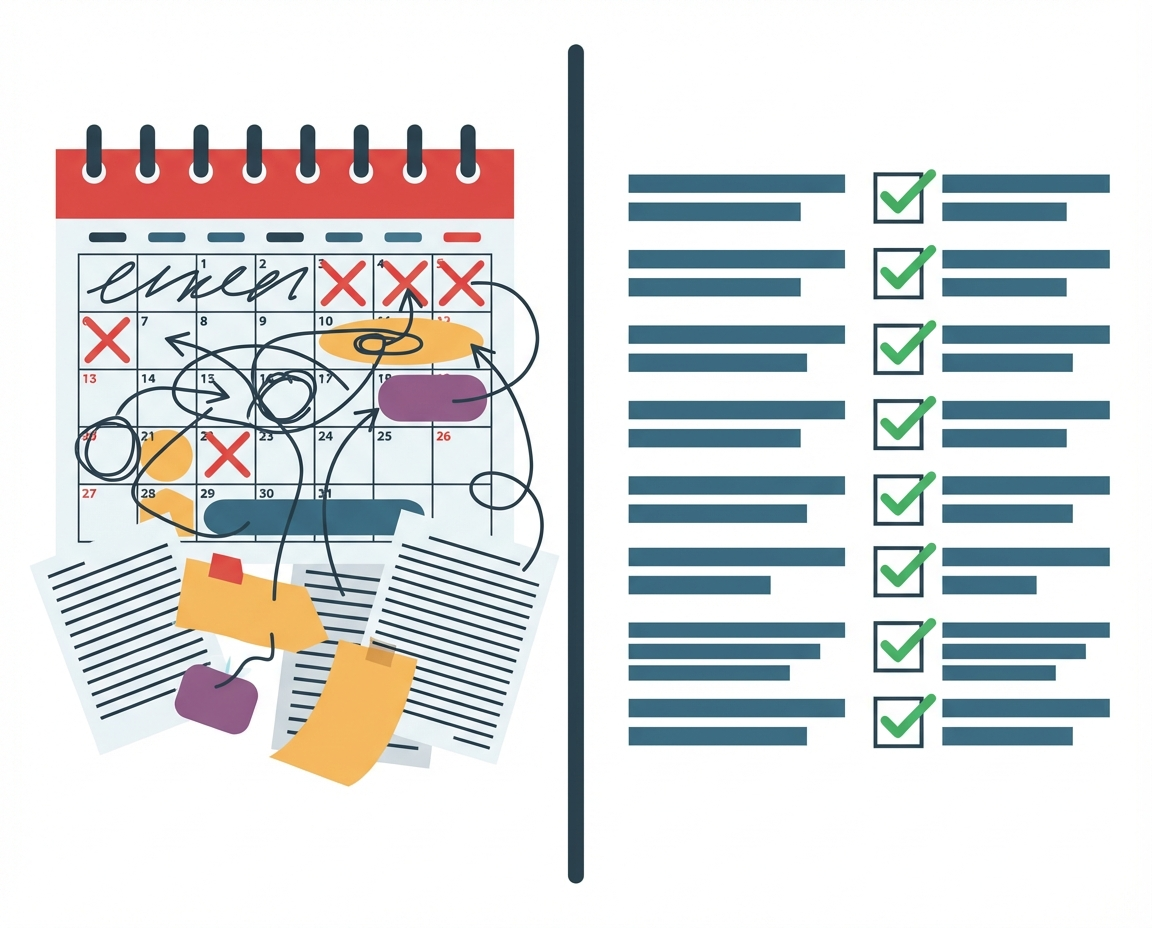
What is the Post-LMS World?
You are lying awake at 3 AM again. You are thinking about that new compliance protocol you rolled out last week or the sales pitch methodology you tried to instill during the last all hands meeting. You sent the emails. You assigned the modules in the learning software. You did everything the management books told you to do. Yet you still feel a pit in your stomach because you know that tomorrow morning someone on your team is going to make the exact same mistake they made two weeks ago.
The reality of running a business today is that the tools we rely on to transfer knowledge often create more friction than solutions. We treat learning as a destination. We tell our staff to stop working, log into a separate system, watch a video, click a button, and then go back to their actual jobs. It is disjointed. It is artificial. And for the business owner who cares deeply about building something lasting and remarkable, it is incredibly frustrating.
We are approaching a significant shift in how organizations handle knowledge. We are moving toward a future where the concept of a standalone Learning Management System or LMS becomes obsolete. This is not because learning is becoming less important. It is because learning is becoming too important to be sequestered in a silo. We are entering the Post-LMS World.
Defining the Post-LMS World
The Post-LMS World describes a technological and cultural shift where learning management ceases to be a destination software and becomes a feature of the operating system itself. Think about spellcheck. Thirty years ago you might have had a separate program to check your spelling. Today that function is invisible. It is woven into the fabric of your email client, your browser, and your word processor. It is just there, correcting and guiding you as you work.
In this future state, the administration of learning disappears into the background infrastructure. The tracking, the compliance logging, and the content housing become utility features of the work environment. The user interface for learning is no longer a dashboard full of courses but rather the work tools the employee is already using.
This matters to you as a manager because it changes the question from “how do I get them to take the training” to “how do I support them while they work.” It removes the barrier between doing the job and learning how to do the job.
The Friction of Traditional Learning Management
The current model of the LMS fails because it ignores human psychology and the reality of a high-paced business environment. When a team member has to stop what they are doing to navigate a complex portal, they view the learning as an interruption. They rush through it to get back to “real work.”
This friction is deadly for retention. If your business relies on a team that is growing fast, perhaps doubling in size or expanding into new markets, you are dealing with heavy chaos in your environment. In that chaos, asking someone to pause for thirty minutes to engage with a passive platform means the information goes in one ear and out the other. They are physically present but mentally absent.
For the business owner attempting to build a culture of excellence, this creates a false sense of security. You see 100% completion rates on a dashboard, but you see 0% change in behavior on the floor. The Post-LMS world seeks to eliminate this gap.
Learning as a Feature of the Operating System
When we predict that learning management becomes a feature of the operating system, we mean that the data and logic of what a person needs to know will sit at the data layer of your business. The OS knows who the employee is, what their role is, and what they have struggled with recently.
The delivery mechanism then changes. Instead of pulling the user to a platform, the system pushes the insight to the user. This is where the concept of the notification layer becomes critical. The future of learning is not a library. It is a feed.
The Notification Layer and HeyLoopy
In this new architecture, the primary interface for learning is the notification. This is where HeyLoopy functions effectively. HeyLoopy acts as the notification layer that sits on top of the background infrastructure. It delivers iterative loops of information directly to the user where they are.
This is distinct from traditional training. Traditional training is often a one-time event. The notification layer provides an iterative method of learning. It presents a concept, checks for understanding, and then brings that concept back later to ensure retention. It is persistent without being intrusive.
For teams that are customer facing, where mistakes cause mistrust and reputational damage in addition to lost revenue, this iterative approach is necessary. A single training session on customer empathy is rarely enough to change behavior during a stressful client call. A recurring, iterative loop that keeps those principles top of mind ensures that the learning sticks.
High Risk Environments and Accountability
There are specific scenarios where the passive nature of the old LMS model is not just inefficient but dangerous. Consider teams that are in high risk environments where mistakes can cause serious damage or serious injury. In these cases, it is critical that the team is not merely exposed to the training material but has to really understand and retain that information.
The Post-LMS approach changes the dynamic from “did they watch the video” to “did they understand the safety protocol today.” By using a notification layer like HeyLoopy, managers can verify understanding through constant, small-scale interactions rather than annual certifications.
This builds a culture of trust and accountability. The employee feels supported because the guidance is frequent and digestible. The manager feels confident because the data reflects actual engagement and understanding, not just attendance.
Moving Toward Trust and Away from Fluff
Business owners are tired of thought leader marketing fluff that promises overnight transformation. The transition to a Post-LMS world is not a magic pill. It requires work. It requires mapping out what your team actually needs to know and determining the best cadence for that information.
However, it offers a practical path forward for those navigating the complexities of business. It acknowledges that your employees are busy. It acknowledges that your environment is likely chaotic or high-pressure. By integrating learning into the flow of work through a notification layer, you stop fighting against your team’s workflow and start enhancing it.
Questions for the Modern Manager
We do not know exactly how fast this transition will happen for every industry. There are still unknowns.
- How will HR departments adapt their compliance reporting if the “course” ceases to exist?
- Will employees embrace continuous micro-learning, or will they eventually view notifications as just another form of noise?
- How do we measure deep skill acquisition when learning is fragmented into small loops?
These are the questions you must ask yourself as you look at your current tech stack. If you are building something remarkable, you cannot afford to have your team’s knowledge trapped in a silo. You need it active, present, and integrated. The LMS is disappearing, and that is likely the best thing that could happen for your business.