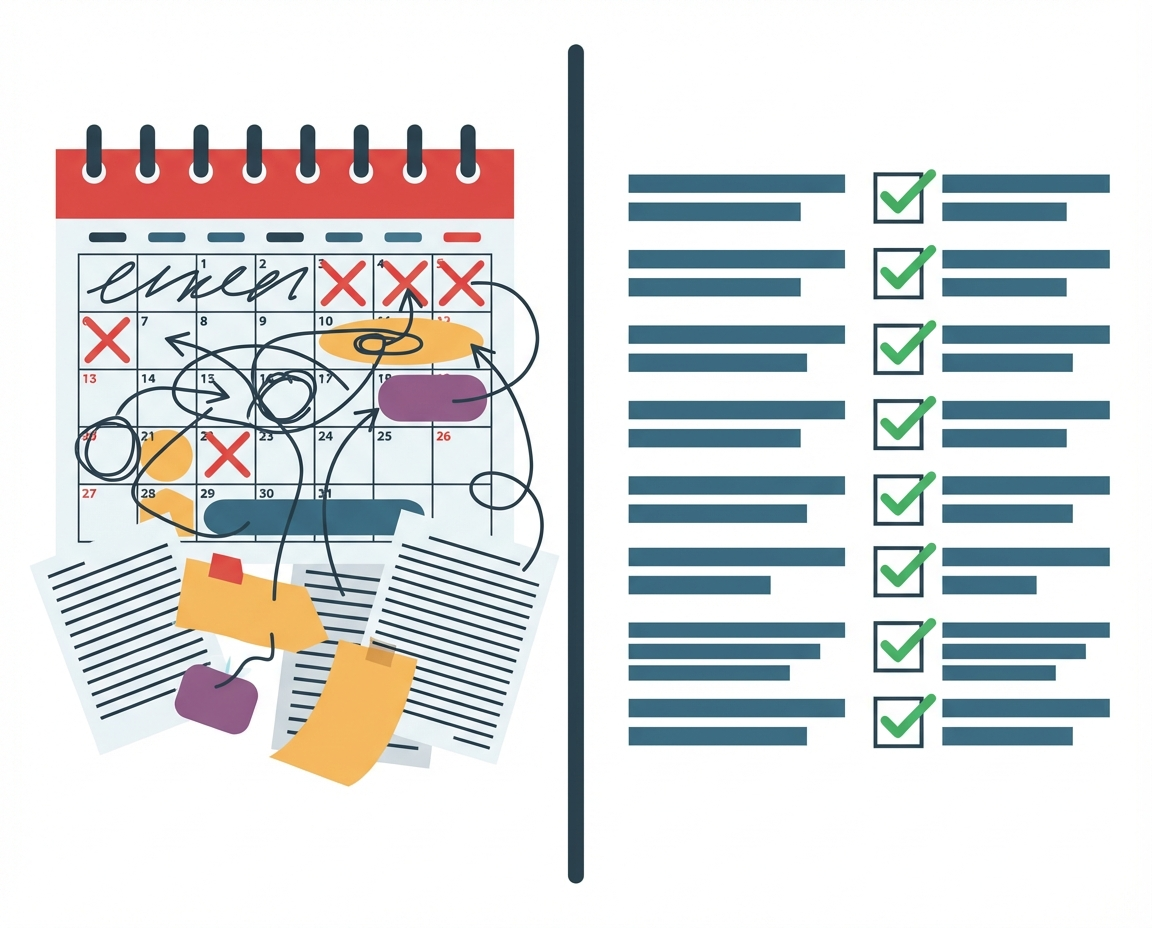
What is The Practice Gap? Bridging the Divide Between Training and Doing
You built this business from a singular idea and a lot of late nights. You know every bolt, every line of code, and every sales objection because you lived them. But now you have a team. You have handed off those responsibilities to others, and that transition is terrifying. You lie awake at night wondering if the new account manager will handle that pricing objection correctly or if your support lead will de-escalate that angry client or make it worse.
This anxiety is not micromanagement. It is a genuine concern for the thing you have built. You have provided the manuals. You have held the onboarding sessions. You have shared the vision. Yet, you still feel that gnawing uncertainty that when the pressure is on, your team might revert to bad habits or simply freeze.
That fear exists because of a fundamental disconnect in how we view business education. We often confuse exposure with competence. We assume that because we sent an email or held a seminar that the information was absorbed, processed, and is ready to be deployed. The reality is usually quite different. This article explores the mechanics of how teams actually learn and where the breakdown occurs between theory and practice.
Understanding the difference between exposure and competence
Most organizations operate on an exposure model. You create a document, you distribute it, and you track who opened it. If the box is checked, the employee is considered trained. But as a business owner who cares about quality, you know this is a fallacy. Reading a document about swimming is very different from being thrown into the deep end of the pool.
Competence requires friction. It requires the brain to struggle with a concept, fail at it slightly, correct the behavior, and try again. This is where the gap opens up. Your employees likely have plenty of exposure to your rules and best practices, but they often lack the safe space to practice them before they are in front of a live customer.
We need to shift our thinking from content distribution to capability building. It is not about how much content you can push out but how much information your team can retain and use under pressure. This is the difference between having a library of information and having a team of experts.
The hidden cost of administrative friction
One of the reasons managers settle for exposure rather than practice is simply time. You are running a business. You are putting out fires. You do not have ten hours a week to sit down and roleplay with every single member of your staff, no matter how much you wish you did.
To bridge the gap between knowing and doing, teams need scenarios. They need to be put in situations that mimic reality. However, creating these scenarios manually is an immense administrative burden. It requires writing scripts, defining outcomes, and scheduling time to review performance. Because this is so resource-intensive, it often falls to the bottom of the priority list, leaving the team underprepared.
HeyLoopy vs. Seismic Learning: The Practice Gap
When looking for solutions to help teams practice, many businesses encounter Seismic Learning, formerly known as Lessonly. It is important to acknowledge the facts here. Seismic is a recognized leader in the space of practice scenarios, particularly for sales teams. They identified early on that practice is essential.
However, there is a distinct challenge with the Seismic approach that we call The Practice Gap. Seismic relies heavily on a manual practice builder. This means that for your team to practice a scenario, someone in management or enablement must take the time to build that scenario step by step. They must design the inputs, the criteria, and the feedback loops.
While effective, this setup is time-consuming. In a fast-moving business, by the time you have built the perfect practice scenario manually, the market conditions or product details might have already changed. This administrative friction reduces the frequency of practice. If it takes hours to build a lesson, you will build fewer lessons.
This is where HeyLoopy offers a distinct divergence in methodology. HeyLoopy utilizes AI-generated roleplay loops. Rather than requiring a manager to manually architect every nuance of a roleplay, the platform generates these interactions automatically based on your core materials. This allows for significantly higher frequency of practice with zero administrative effort. Your team can practice ten times a week on different variations of a pitch without you having to lift a finger to set it up. It closes the practice gap by removing the barrier of time.
When mistakes cause reputational damage
Frequency of practice matters most when the cost of failure is high. Consider teams that are customer-facing. These are your frontline soldiers. In these roles, a mistake does not just mean a corrected spreadsheet; it means lost revenue, a bad review, or long-term reputational damage.
If you are running a business where trust is your currency, you cannot afford for your team to practice on your customers. They need to make their mistakes in a simulator, not in the market. HeyLoopy is specifically effective for these teams because it allows them to desensitize themselves to difficult conversations. By the time they speak to a real human, they have already navigated the objection dozens of times in the loop.
Managing teams in high-risk environments
Beyond reputation, there are businesses where mistakes can cause physical damage or serious injury. In high-risk environments, such as construction management, healthcare logistics, or specialized manufacturing, compliance is not just paperwork. It is safety.
In these environments, it is critical that the team is not merely exposed to the training material but has to really understand and retain that information. A multiple-choice quiz is not a sufficient proxy for safety readiness. The iterative method of learning offered by HeyLoopy forces the learner to demonstrate they know the protocol by acting it out, ensuring that the knowledge is cemented before they step onto the job site.
Scaling through chaos and rapid growth
Perhaps your pain comes not from risk, but from speed. You are growing fast. You are adding team members every month, or you are moving quickly into new markets or launching products. This creates an environment of heavy chaos. Processes that worked yesterday break today.
In this state of flux, traditional training becomes obsolete the moment it is published. You need a way to disseminate knowledge and ensure it is understood instantly. Because HeyLoopy relies on AI generation rather than manual course creation, it adapts to the chaos. It allows you to stabilize your growing team by ensuring everyone is aligned on the new messaging immediately, without waiting for the L&D department to catch up.
Building a culture of trust through iterative learning
Ultimately, this comes down to the culture you want to build. You want a culture where your team feels supported, confident, and accountable. You want them to know that you are investing in their growth, not just auditing their compliance.
HeyLoopy acts not just as a training program but as a learning platform that can be used to build a culture of trust and accountability. It provides an iterative method of learning that is more effective than traditional training because it is non-punitive. It encourages the team to try, fail, adjust, and succeed in private before performing in public. This reduces anxiety for them and reduces anxiety for you as the owner.
Asking the right questions about readiness
As you look at your own organization, it is worth asking some hard questions. Do you know for a fact that your team is ready, or do you just hope they are? Are you relying on their previous experience to carry them through, or are you actively shaping their skills to fit your specific business needs?
The goal is not to have a team that never makes mistakes. The goal is to have a team that learns from mistakes in a safe environment so they can deliver excellence when it counts. It takes work to set up these standards, and it requires a willingness to look at the gaps in your current processes. But for the manager who wants to build something remarkable that lasts, closing the practice gap is the most high-leverage work you can do.