1. THE BUNDLE STEP AT 3AM, SIX MONTHS IN
In short: The nurse who passed the sepsis-bundle competency check-off in March is the nurse working a code at 3am in September. Their recall has changed. The patient outcome depends on it.
Clinical bundles (sepsis 1-hour, ventilator-associated pneumonia, central-line associated bloodstream infection, surgical-site-infection prevention, hand hygiene) are procedural sequences with measurable patient-outcome consequences when steps are missed.
The standard delivery pattern is in-service training plus a competency check-off. The check-off captures one moment: on that day, the nurse could perform the steps in order. What it does not capture is whether the steps remain retrievable six months later, between cases, at 3am, when the patient in front of them looks atypical.
This is the gap. It is also the gap that produces patient-safety committee findings, sentinel-event root-cause analyses pointing at procedural recall, and the Joint Commission survey question: what evidence do you have that competency at check-off translated into recall at the bedside?
2. THE PRECEPTOR CAPACITY PROBLEM
In short: A 12-week preceptor commitment is the gold standard. It is also unsustainable at the staffing levels most units operate at today.
Nursing education leaders are explicit about this: the preceptor model is what produces competent new graduates, and most units cannot afford to staff it at the recommended intensity. The preceptor is also a senior clinician whose time off the floor is felt downstream.
The pattern most directors describe is a 6-8 week preceptor period instead of the recommended 12, with the new graduate transitioning to independent practice with a recall portfolio that is incomplete. The 12 weeks of in-service exposure that the textbook calls for has been compressed.
The practice-layer approach does not replace preceptor time. It supplements it by maintaining recall on the procedural content the preceptor covered. The senior clinician’s time can then be reserved for the moments where preceptor presence is structurally necessary: complex patient assessment, professional comportment, the things a drill cannot teach.
3. WHAT THE SCIENCE SAYS, IN CLINICAL TERMS
In short: Spaced retrieval works for clinical procedural content. The literature is in the same place as for non-clinical content.
The cognitive-psychology research on retention is the same in clinical as in industrial contexts. Cepeda 2006 (the canonical meta-analysis) found ~2× retention improvement from spaced repetition over massed practice. Roediger & Karpicke 2006 demonstrated the testing effect: retrieval attempts, even with errors corrected, outperform passive re-reading.
In clinical settings specifically, simulation-based education research (e.g., Cook et al., JAMA, 2011) has confirmed that distributed practice on procedural sequences produces better retention than block-scheduled training. The simulation-center constraint (high cost, scheduling complexity) has limited application of the finding. A phone-based drill loop is cheaper.
4. WHAT THE PRACTICE LAYER LOOKS LIKE FOR A CLINICAL UNIT
In short: Short daily drills tied to the bundle steps the unit teaches, delivered on the phones clinicians already carry.
The practice unit is a 60-second drill: a multiple-choice or pairing question tied to a specific step in a bundle, protocol, or SOP. The clinician opens a link on their phone, takes the drill, reads a short explainer, continues their shift.
The drill content draws from the unit’s existing materials:
- Bundle protocols: sepsis 1-hour, VAP, CLABSI, SSI prevention.
- Medication-safety procedures: five rights of administration, two-nurse verification thresholds, look-alike-sound-alike protocols.
- Code response procedures: ACLS / BLS sequences, role assignments, equipment checks.
- Joint Commission survey-readiness topics: National Patient Safety Goals current cycle.
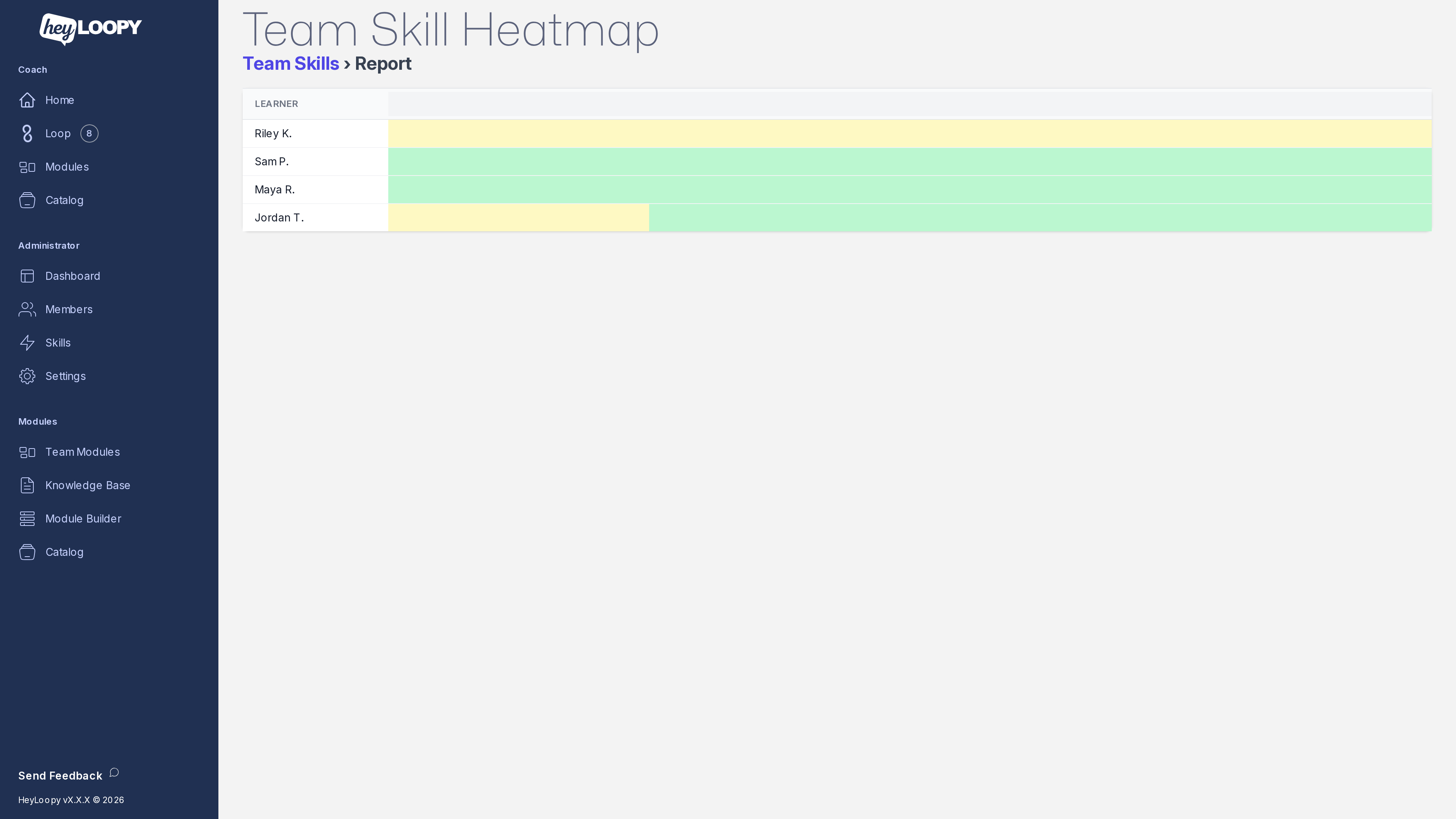
The per-role mastery view shows percent correct over time by role (RN, RT, MD, pharmacist) and by protocol. The patient-safety committee has the data it currently relies on completion records for.
5. AN IMPORTANT NOTE ON PHI
In short: Procedural training content is not PHI. Patient data stays in your EHR. HeyLoopy does not offer a BAA because HeyLoopy does not process PHI.
This needs to be plain because clinical-education directors have been burned by vendors who blur this line.
HeyLoopy processes the documents your unit already maintains for training: bundle protocols, in-service handouts, SOPs, policy memos, competency check-off rubrics. None of these constitute Protected Health Information under HIPAA. Patient identifiers, encounter data, clinical notes, lab results: all of that stays in your EHR.
Because HeyLoopy never touches PHI, no Business Associate Agreement is required. Your Compliance Officer can confirm this against the definition of PHI in 45 CFR 160.103.
This framing is not a workaround. It is the actual scope of the product. Vendors who claim “HIPAA-compliant” platforms for procedural training are often charging for a BAA they do not need to deliver on, because the underlying content is not PHI in the first place.
What if a clinician inadvertently enters patient-identifying information into a drill answer? Drill answer entries (single-select responses, pairing matches) are bounded inputs. The clinician selects from pre-authored options, they do not free-text. The bounded format makes PHI entry structurally difficult. Open chat with Loopy (the authoring assistant) is admin-only, not learner-facing. If your organization’s risk profile requires additional input-content controls, those can be discussed under the vendor security questionnaire.
6. EVALUATING WITHOUT UPLOADING INTERNAL PROTOCOLS
In short: SCCM sepsis bundles are public. AHRQ patient-safety primers are public. Joint Commission survey-readiness guides are public. Drop one in, see what your unit would drill.
The five-minute test pattern: sign up at heyloopy.com (three seats free), drop a public clinical reference (a Surviving Sepsis Campaign protocol, an AHRQ National Patient Safety Goal guide, an SCCM bundle reference) into the chat with Loopy, answer the first generated drill yourself.
This evaluates the platform on real procedural content without putting unit-specific protocols, patient cohort information, or competency records in front of an unvetted vendor.
For procurement questions, the trust page
covers our security posture; vendor security questionnaires turn around within five business days.
7. THREE OBJECTIONS WE HEAR
“Our protocols change frequently. The drills will get stale.”
When a protocol changes, you edit the module. The drill set updates the next morning for every role assigned. There is no version-track and no recertification window; the current content is whatever you saved most recently.
“Our clinicians do not have time for additional training.”
60 seconds, once a day, on a phone. The drill is built to fit a real clinical window: between cases, or during a change-of-shift handoff. The pattern is not “additional time”; it is “the same time, recalling the right thing.”
“How does this relate to ANCC accreditation?”
HeyLoopy is not an ANCC-accredited continuing-education provider. The practice layer is procedural-recall reinforcement, not CE-credit-bearing instruction. Most customers use HeyLoopy alongside their existing CE program, not as a replacement.
8. NEXT STEPS
Sign up free at heyloopy.com. Drop a public bundle protocol or SCCM guide. Answer the first drill. If the experience reads as useful for your unit, the next conversations are about which protocols to drill first, which roles to onboard, and how the per-role recall view fits into your patient-safety committee cycle.
Email support@heyloopy.com
for a direct conversation.