1. THE COST STACK OF FORGETTING
In short: Forgetting compounds across three different lines on the field-service P&L. Each compounds further when the tech does not have a colleague to ask.
Field service directors typically track three cost categories that move together:
- Truck rolls. Fully loaded, an industrial field-service truck roll runs $400-$900 per visit (rates vary by industry: aerospace MRO is higher, residential service is lower). Repeat visits to the same call because the first tech could not recall the procedure are pure cost.
- Level-3 escalations. When the field tech cannot solve the issue, the call escalates to a senior engineer at headquarters. Senior engineering time is the bottleneck in most field-service operations. Each escalation that did not need to happen is a unit of senior time that could have been spent on harder problems.
- New-tech ramp. A new field tech is shadowed by a senior tech during the ramp period. The senior tech’s time on a ride-along is time off other calls. The faster the new tech becomes self-sufficient on common error codes, the more senior capacity is freed.
All three are downstream of the same upstream variable: did the tech recall the right procedure when the call landed?
Worked example. A 110-tech industrial field-service operation runs roughly 3 calls per tech per day, 240 working days per year, about 79,000 service calls annually. At a 12% repeat-visit rate, that’s ~9,500 trucks-rolled-twice events. Even a conservative one-point reduction in the repeat-visit rate removes roughly 790 repeat visits a year; at a $650 fully-loaded truck-roll cost (industrial average; aerospace MRO higher, residential service lower), that is about $500K of annual cost avoided from the truck-roll line alone. A larger recall improvement scales the figure from there. Level-3 escalation and ride-along avoidance are additional.
2. WHY ANNUAL TECHNICAL TRAINING FAILS THE RECALL TEST
In short: The training was a week in March. The error code shows up at 2am in September. Recall on intermittent content decays.
Annual or quarterly technical-training sessions deliver volume well. They do not produce durable recall on the specific error codes the tech will encounter intermittently in the field.
The pattern most field-service organizations describe:
- Tech attends a week-long training in Q1 covering the platform’s error codes, calibration sequences, AD compliance procedures, customer-escalation paths.
- Tech encounters the first relevant error code six weeks later. Recall is intact.
- Tech encounters a different error code from the same training six months later. Recall is partial at best. Tech improvises, or calls the senior engineer.
The forgetting curve does not care that the procedural content is technical. The same retention drop documented in 1885 by Ebbinghaus applies in 2026 to error-code triage flows.
3. WHAT SPACED RETRIEVAL DOES FOR FIELD SERVICE
In short: Three 60-second drills per week produces measurably better recall at month six than one three-hour training session.
The Cepeda 2006 meta-analysis (~2× retention improvement from spaced repetition) generalizes well to procedural technical content. Subsequent studies in clinical, military, and industrial-training settings have replicated the finding across procedure types, including troubleshooting flows, calibration sequences, and equipment-specific diagnostic decision trees.
For field-service specifically, the practice cadence that fits the operational pattern is brief and frequent: short drills, delivered to the tech’s phone, taken at the depot before the first call, on the truck between calls, or in the breakroom at end-of-shift. Each drill answer is timestamped. The per-tech and per-platform mastery view shows which techs have current recall on which procedures.
4. WHAT THE PRACTICE LAYER LOOKS LIKE BY SUB-INDUSTRY
In short: Same mechanism. Different vocabulary, different platforms, different procedures.
- Robotics: Error-code triage by joint and subsystem. Harmonic-drive failure modes. E-Stop loop diagnostics. Z-axis encoder calibration. Vision-system alignment.
- Industrial automation: PLC fault diagnosis, ladder-logic reading, sensor signal verification, drive-fault interpretation. Mode-select mismatches.
- Medical devices: Infusion-pump alarm cascade, imaging-system error codes, calibration procedures, biomed safety checks. End-user training for clinical staff who service the device on-site.
- Aerospace MRO: Airworthiness Directive compliance records, 14 CFR 43.9 documentation, return-to-service signoff procedures, component traceability.
- Machinery: Hydraulic system troubleshooting, pneumatic isolation, lockout-tagout sequences specific to the machine type.
Each sub-industry’s content stack is yours. The practice mechanism is identical across all five.
5. WHAT THE ADMIN SEES
In short: A per-tech, per-platform recall map. The intervention candidate is visible before the truck rolls.
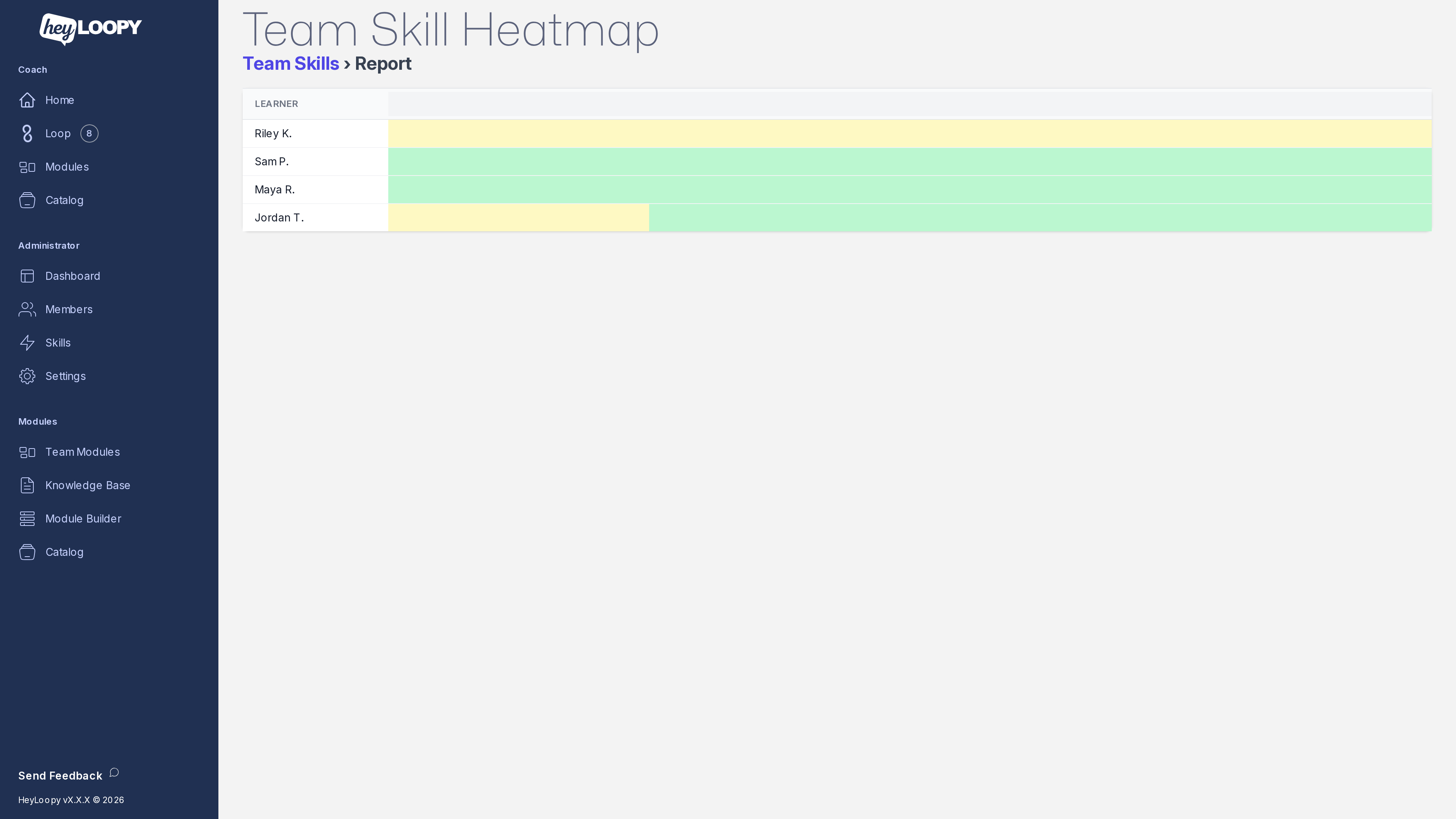
The regional manager or field-service director opens the mastery view on Monday morning. Rows are techs. Columns are platforms or major procedure families. Cells are percent correct over the last four weeks on the drills assigned.
The eye goes to red cells. Tech A is weak on the M-series fault family. Tech B is weak on AD compliance documentation. The intervention is targeted: re-drill the weak topics, or pair the weak tech with a senior on the next relevant call.
Red cells correlate with the techs driving your bottom-quartile First-Time-Fix Rate (FTR) or First-Call-Resolution (FCR) metric. The mastery view does not replace your existing FTR / FCR dashboards. It is the upstream signal that explains the downstream numbers.
This is the artifact the regional manager has been approximating from anecdote. The drill cadence produces the data as a side effect.
6. EVALUATING WITHOUT UPLOADING INTERNAL SERVICE DOCS
In short: Public service manual excerpts, AD bulletins, FAA Advisory Circulars, CDRH device guidance: all public, all dropable.
The five-minute test pattern: sign up at heyloopy.com (three seats free), drop a public reference (an FAA Advisory Circular, a CDRH guidance document, a publicly-released service-manual chapter from an OEM website) into the chat with Loopy, answer the first drill yourself.
This evaluates the platform on real procedural content without putting your internal service manuals, customer lists, or escalation logs in front of an unvetted vendor.
7. THREE OBJECTIONS WE HEAR
“Our techs are remote. They will not engage with another tool.”
60 seconds, on the phone they already carry. The drill content matches what the service call actually requires, which is what earns a tech’s attention. Adoption resistance is lower than for LMS-based training because the time commitment is sub-minute.
“Our service manuals are proprietary. We cannot upload them.”
You do not have to upload them to evaluate. The five-minute test runs on public reference material. If the evaluation reads as useful, the production rollout uses your internal materials after our vendor security questionnaire is completed (5-business-day turnaround).
“We use a different LMS for technical training already.”
HeyLoopy is not an LMS replacement. The LMS continues to deliver formal technical training and produce completion records. The practice layer runs alongside, producing the retention evidence the LMS was not designed to surface. Most field-service customers run both.
8. NEXT STEPS
Sign up at heyloopy.com (free, three seats, no credit card). Drop a public service-procedure reference. Answer the first drill yourself. If the experience reads as useful, the next conversations are about which procedure families to drill, which techs to onboard first, and how the mastery view fits into your regional manager’s weekly review.
Email support@heyloopy.com
for a direct conversation.