1. THE DRIFT THAT EVERY CI MANAGER RECOGNIZES
In short: Standard work is written. Posters are hung. Six months later, the line is back to the old way under time pressure.
The pattern is universal in continuous-improvement work: a kaizen event produces a revised standard, the team is briefed, the new SOP is posted at the machine. In the first two weeks, the new procedure holds. By month three, operators have started drifting under time pressure. By month six, the line is largely back to the pre-kaizen state, and the CI team has moved on to the next event.
The standard work itself was correct. The operators were trained on it. The drift is a function of recall, not motivation. Under production pressure, the older, more practiced sequence is faster to retrieve than the newer revised one.
2. WHAT THE IATF / ISO AUDITOR ASKS
In short: The audit team is not asking whether you trained on standard work. They are asking whether it is being followed today.
IATF 16949 Clause 7.2 (Competence) and ISO 45001 Clause 7.2 (the safety-management analog) both require demonstrated competence, not just training completion. The audit pattern is:
- Auditor reads the revised standard work for a specific cell.
- Auditor observes operators on that cell during normal production.
- Auditor asks operators to walk through the standard work from memory.
- Discrepancies between the written standard and the observed practice are findings.
The institution’s defense at this point is typically: “We trained on this standard in March. We hold daily start-of-shift huddles.” The auditor’s follow-up is: “What evidence do you have that the training produced retention?”
The honest answer at most plants is: we do not have that evidence. The signed training rosters are inputs, not outputs. The huddles are an aspiration, not a measurement.
3. WHY DAILY PRACTICE BEATS REPEAT-TRAINING
In short: Two thirty-minute refresher sessions per quarter do not match the recall produced by 60 seconds per day.
The cognitive-psychology research on spaced retrieval has been replicated for over a century. Cepeda 2006 (the canonical meta-analysis of 184 studies) found ~2× retention improvement from spaced repetition over equivalent-time massed practice. The implication: a quarterly refresher session is the wrong cadence. Distributed daily practice produces durable recall on procedural content.
For plant-floor work, the operational constraint is time on the line. A 60-second drill, taken at start of shift or during break, fits the constraint. The trade-off (sub-minute per day) is much smaller than the trade-off the alternative requires (quarterly retraining off the line).
4. WHAT THE PRACTICE LAYER LOOKS LIKE ON A PLANT FLOOR
In short: Daily drills tied to standard work, by cell, by line, by shift, on the phones operators already carry.
The practice unit is a 60-second drill: a question tied to a specific step in the revised standard, an answer set, and a short explainer. The drill is delivered to the operator’s phone (their own or a shared shop phone) via a web link. No app to install, no MDM, no kiosk mode.
Drill content draws from the materials the CI team already produces:
- Revised standard work: post-kaizen sequences for affected cells.
- LOTO procedures: energy-isolation sequences for maintenance.
- Machine-guarding requirements: what guards must be in place before operation.
- Hazard-communication labeling: GHS pictogram recognition, MSDS retrieval.
- Layered Process Audit checklists: what the LPA team will verify.
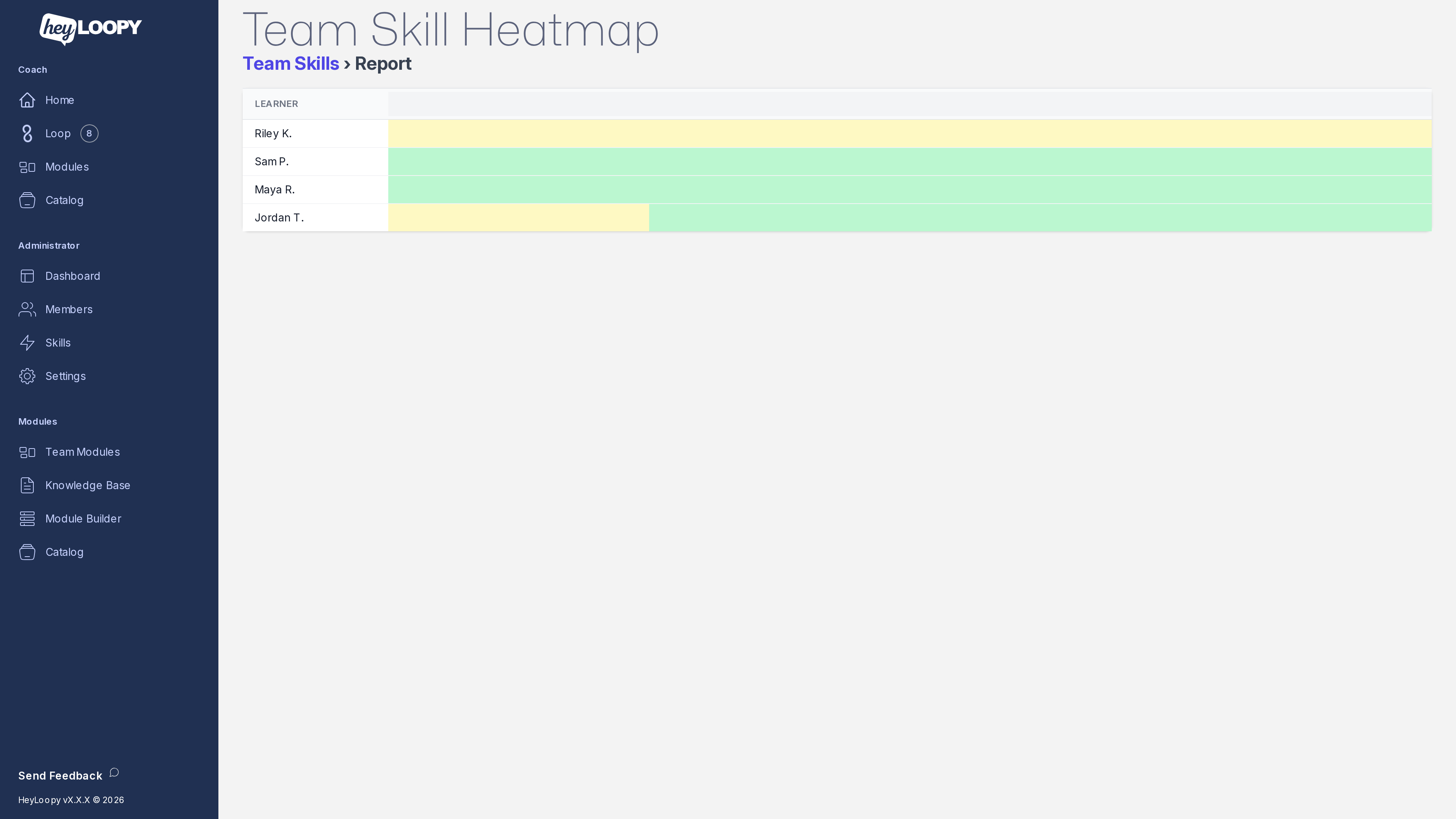
The per-cell, per-standard mastery view shows percent correct over time. The intervention candidate, the cell where the standard is not landing, is visible before the LPA finding.
5. THE LPA-PREP DATA, AND WHERE IT STOPS
In short: The mastery view is the artifact the LPA auditor can review alongside the completion list.
Layered Process Audits exist to verify standard work is being followed. The LPA team’s typical method: observe operators against the standard, then check the training records. The training records are completion-based and show only that the training occurred.
The per-role, per-standard mastery view adds the second half of the evidence. The LPA team can see, for the cell they are auditing, what percent of operators answered the relevant drill correctly over the past four weeks. A green column corroborates the observation that operators are performing the standard. A red column flags the cell as one to observe more closely.
This is not an official certification of competence. It is operational data the LPA team can use to focus attention. The findings are stronger when the evidence is.
Revision traceability. When the kaizen team revises a standard, the admin updates the module and the drill set reflects the change the next morning. Every drill result is timestamped and retained, not overwritten, so the mastery view reads cleanly across a revision date: operators were drilling against the prior sequence through April 12, the revision took effect April 13, and mastery on the revised standard is at 84% by week three. HeyLoopy does not version-label drill content itself, so pair the mastery record with your QMS document-control log when an auditor needs results mapped to a specific revision.
6. EVALUATING WITHOUT UPLOADING INTERNAL STANDARDS
In short: OSHA 1910 standards are public. Drop one in, see what your operators would drill.
The five-minute test pattern: sign up at heyloopy.com (three seats free), drop a public OSHA standard (29 CFR 1910.147 for LOTO, 1910.212 for machine guarding, 1910.146 for confined space, 1910.178 for powered industrial trucks) into the chat with Loopy, answer the first generated drill yourself.
This evaluates the platform on real procedural content without putting your internal standard work, kaizen-event records, or LPA findings in front of an unvetted vendor.
For procurement questions, the trust page
covers our security posture and we complete vendor security questionnaires within five business days.
7. THREE OBJECTIONS WE HEAR
“Operators do not have phones on the line.”
The practice layer is built primarily for supervisors and team leads, who do carry phones. For hourly operators on cells with strict no-phone-on-line policies, drill completion happens at transition points: start of shift, break, end of shift, or at the time clock. Some plants run drills via shared shop phones at the break room or near the time clock. The drill cadence does not require on-line phone use; it requires 60 seconds of attention at a transition point.
“My line is bilingual. Spanish drills?”
English-only today. Spanish is on the roadmap; we will say so plainly when it ships. Customers with bilingual lines use HeyLoopy for English-proficient supervisors and team leads, and rely on the existing visual standard-work posters and bilingual huddles for Spanish-first operators.
“How does this interact with our existing kaizen newspaper / improvement board?”
The drill content updates when the standard work updates. After the kaizen team revises a standard, the corresponding drill set updates the next morning for every cell and shift assigned. The improvement board continues to show kaizen-event status; the drill data shows whether the revised standard is being retained.
8. NEXT STEPS
Sign up free at heyloopy.com. Drop a public OSHA standard. Answer the first drill. If the experience reads as useful for your plant, the next conversations are about which cells and standards to drill first, which shifts to onboard, and how the per-cell mastery view fits into your LPA prep cycle.
Email support@heyloopy.com
for a direct conversation.