1. THE FINDING THAT KEEPS COMING BACK
In short: “Training was completed” is an output. “Training was retained” is an outcome. Your auditor is asking about outcomes.
Most compliance directors have seen a training-effectiveness finding in a recent exam. The language varies by regulator (OCC, FDIC, Fed, FDA, Joint Commission, state DOI), but the underlying question is the same:
“We see the training was assigned and completed. How do you know the policy was retained on the day the front-line employee needed it?”
The honest answer at most institutions is: we do not know. We have a completion record. We have an end-of-module knowledge check from the day of training. We do not have a measurement that survived to month six.
This is not a minor finding. It is the finding the regulator returns to because the institution returned to the same answer.
2. WHY ANNUAL TRAINING FAILS THE RECALL TEST
In short: Memory has a half-life. Annual cycles fall on the wrong side of it.
The forgetting curve is one of the longest-running findings in cognitive science. Ebbinghaus first published it in 1885: in the absence of practice, recall of unfamiliar material drops to ~30% within 24 hours and ~10% within a month. The shape has been confirmed repeatedly in modern corporate contexts (Cepeda et al., Psychological Bulletin, 2006; Roediger & Karpicke, 2006).
The implication for an annual recertification program is straightforward. The employee scored well on the end-of-module check in May. By November, the same employee would likely score in the 30-40% range on the same content, not because they are not capable, but because recall without practice decays. The annual cycle measures the wrong moment.
Spaced retrieval (short, frequent practice attempts spaced out over time) reverses the curve. Cepeda 2006 documented a ~2× retention improvement over equivalent-time cramming in well-controlled studies. The mechanism is the practice itself, not the content.
3. WHAT GOOD LOOK-BACK EVIDENCE LOOKS LIKE
In short: A per-role record of percent correct over time, on the specific policies that matter.
The artifact a regulator finds satisfying is not a single mastery percentage on a scorecard. It is a record that lets the auditor answer three questions for any policy under review:
- Who was assigned to know this? A role-level assignment list, with employee names and assignment dates.
- Did practice happen between assignment and “today”? Timestamped attempts at recall, not just one-time completions.
- What percentage of attempts were correct, segmented by role? A view that lets the auditor see if certain roles or teams were systematically weaker.
This is not an official certification of competence. Nothing a vendor delivers can produce that conclusion on its own; that determination belongs to your audit team and to the regulator. What it is, is the data your audit team can stand on when the question arrives.
4. THE PRACTICE LAYER, NAMED
In short: Short drills, built from the policies you already maintain.
Compliance training does not need a new theory. It needs a different rhythm. Short drills tied to short passages of your existing policies produce the spaced retrieval the science calls for, without requiring a re-author of your training stack.
The practice layer is not a replacement for your LMS. The LMS continues to deliver annual recertification and produce completion records. The practice layer runs in the months between recertifications. When the policy changes mid-year, the practice layer reflects the change the next morning, not in the next annual cycle.
For most compliance programs the completion record is already in place. What the training-effectiveness finding asks for is the evidence of retention the completion record cannot show. The practice layer is built to produce exactly that, and the determination of whether it satisfies the finding stays with your audit team and your examiner.
5. WHAT THE ADMIN DOES, MONDAY MORNING
In short: Open the heatmap. Read the columns. Pick one intervention.
The day-to-day administrative pattern is short:
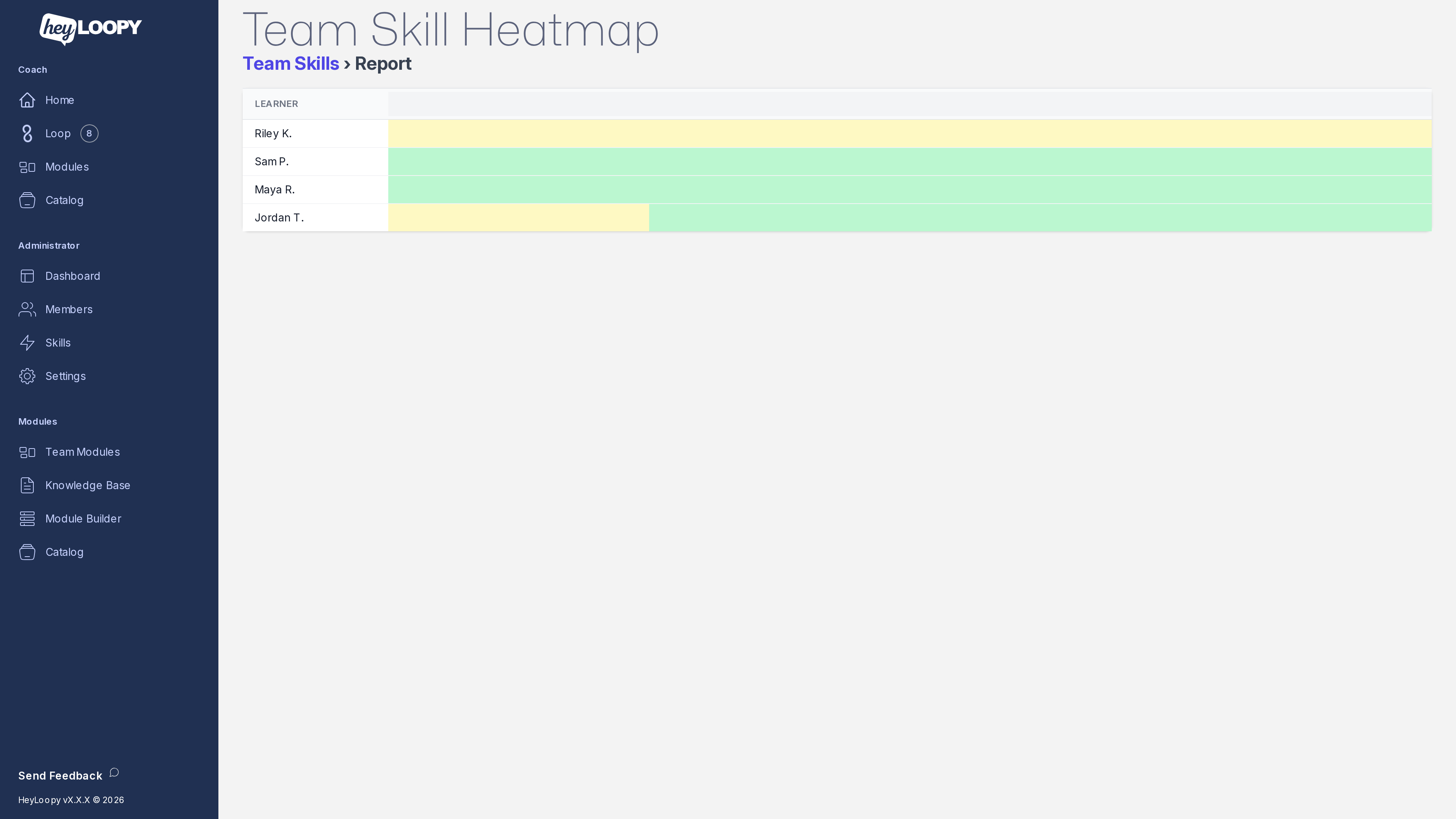
- Monday: open the per-role mastery view. Rows are people, columns are policies, cells are percent correct over the past four weeks. Eye goes to the red cells.
- Tuesday: if a policy is weak across a role, edit the underlying module to surface the misunderstanding. The drill set updates the next morning.
- Wednesday-Friday: drills run. Mastery moves.
- Next Monday: re-open the heatmap. Compare.
This is the workflow that produces the look-back evidence the auditor asks for. The artifact is generated as a side effect of the practice.
6. EVALUATING WITHOUT UPLOADING ANYTHING SENSITIVE
In short: Drop a FFIEC manual section. See exactly what your front line would see.
Compliance directors do not upload internal policies to unvetted vendors. You do not need to.
The drill loop works identically on public material. A FFIEC BSA/AML examination manual section, a recent FinCEN advisory, a Joint Commission survey readiness guide, a CFR section, an OCC bulletin: any of these can be the test document. The drill set generated from a public document gives you the visual artifact the exam team would see; the question of whether your internal policies would generate equivalent drill sets is largely a function of how cleanly your policies are written.
If the five-minute test with a public document reads as useful, our recommendation is to complete a vendor security questionnaire (we turn one around in 5 business days) before uploading any internal material.
7. THREE OBJECTIONS WE HEAR
In short: Honest answers to the three questions every compliance director asks.
“We already have an LMS. Why add another tool?”
You do not replace the LMS. The LMS is the system of record for assignment and completion, required for the audit-trail dimension. The practice layer sits alongside, producing the retention evidence the LMS was not built to surface. Most customers run both.
“What about SOC 2, audit-log retention, data residency?”
HeyLoopy is built on SOC 2 Type II-certified AWS infrastructure following SOC 2-aligned controls (we are not ourselves SOC 2 certified today; our own SOC 2 and a formal DPA are on the roadmap, which is why we frame regulated engagements as pilot-now, commit-later). Customer data lives in AWS us-east-1. AES-256 at rest, TLS for all customer-facing traffic. Full posture on the trust page
.
“HIPAA and BAA?”
HeyLoopy processes SOPs and procedural training content, not Protected Health Information. We do not store PHI and do not offer a Business Associate Agreement. For healthcare-vertical compliance customers, the practice content is the bundle/protocol/policy; patient data stays in your EHR.
8. NEXT STEPS
In short: Sign up free, drop a public reference document, take a drill yourself.
The simplest evaluation path is the one we offer to every regulated-audit prospect: sign up at heyloopy.com (three seats free, no credit card), drop a FFIEC manual section or recent OCC bulletin into the chat with Loopy, and answer the first drill yourself. Five minutes from signup to a working module.
If that experience reads as useful for your context, the next conversations are about scope (which policies, which roles), procurement (DPA, VSQ, MSA), and rollout sequencing.
To get started: heyloopy.com/signup, or email support@heyloopy.com
directly.