3 seats free

Science

Memory is a curve, not a checkbox.
HeyLoopy is built on the curve.

Annual training delivers a single, fragile encoding event. The forgetting curve does the rest. Spaced practice, tuned to the half-life of recall, is the only thing that bends it.

Start free Skip to the method Free · teams up to 3 · no card
§ 01 The math of forgetting
Fig. A · Decay
90%
of training forgotten within 30 days of delivery.
Ref. Ebbinghaus, 1885
Fig. B · Gain
retention vs one-and-done with spaced practice.
Ref. Cepeda et al., Psychological Bulletin, 2006
Fig. C · Ramp
8mo
average time from hire to full productivity.
Ref. Gallup Workplace
Fig. D · Method
140yr
of memory research compounded into every drill.
Ref. Spaced practice, tested
§ 02 The curve, and the fix
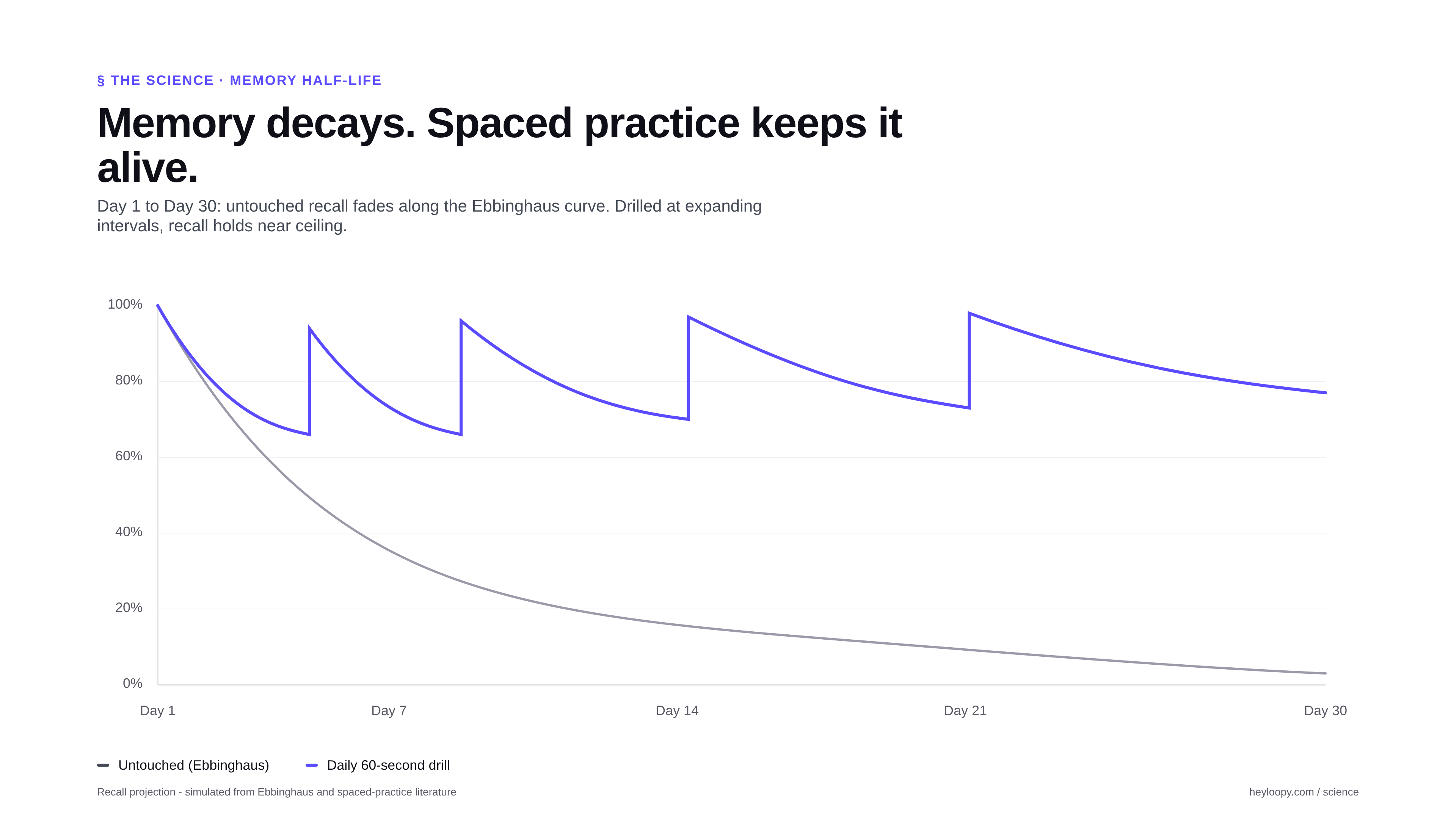
The Ebbinghaus forgetting curve: retention falling steeply without reinforcement.
The forgetting curve

Without reinforcement, recall falls steeply in the first days. One-shot training rides this curve straight down.

A spaced-practice retention curve: recall recovered at each practice event.
Spaced practice

Each drill resets the curve higher. The sawtooth climbs: recall held, not lost.

§ 03 Four findings, one method
Finding 01

The forgetting curve

In 1885 Hermann Ebbinghaus mapped how quickly new information leaves working memory without reinforcement. The drop-off is steep in the first 24 hours, gentler after a week, and asymptotic without intervention. A century and a half of replication has put the effect beyond serious dispute.

Ref. Ebbinghaus, 1885
Finding 02

Spaced practice beats massed practice

Reviews scheduled at expanding intervals, rather than all at once, more than double retention at the same total study time. The optimal gap grows as the item gets stronger, which is why one-shot annual training is the worst possible schedule.

Ref. Cepeda et al., 2006
Finding 03

Retrieval beats re-reading

Pulling information out of memory creates stronger, more durable encoding than reviewing the same content passively. This is the "testing effect": being asked a question is a more powerful study act than seeing the answer again.

Ref. Roediger and Karpicke, 2006
Finding 04

Recall under pressure is trainable

Procedural knowledge that survives stress is the product of repetition under varied conditions, not exposure to a single perfect example. The technique that works for an airline checklist or a clinical bundle is the technique that works for a compliance protocol.

Ref. Anderson et al.; Schmidt and Bjork, varied practice
§ 04 How HeyLoopy applies it

Four findings, compounded into a daily 60-second drill.

Tuned to the curve

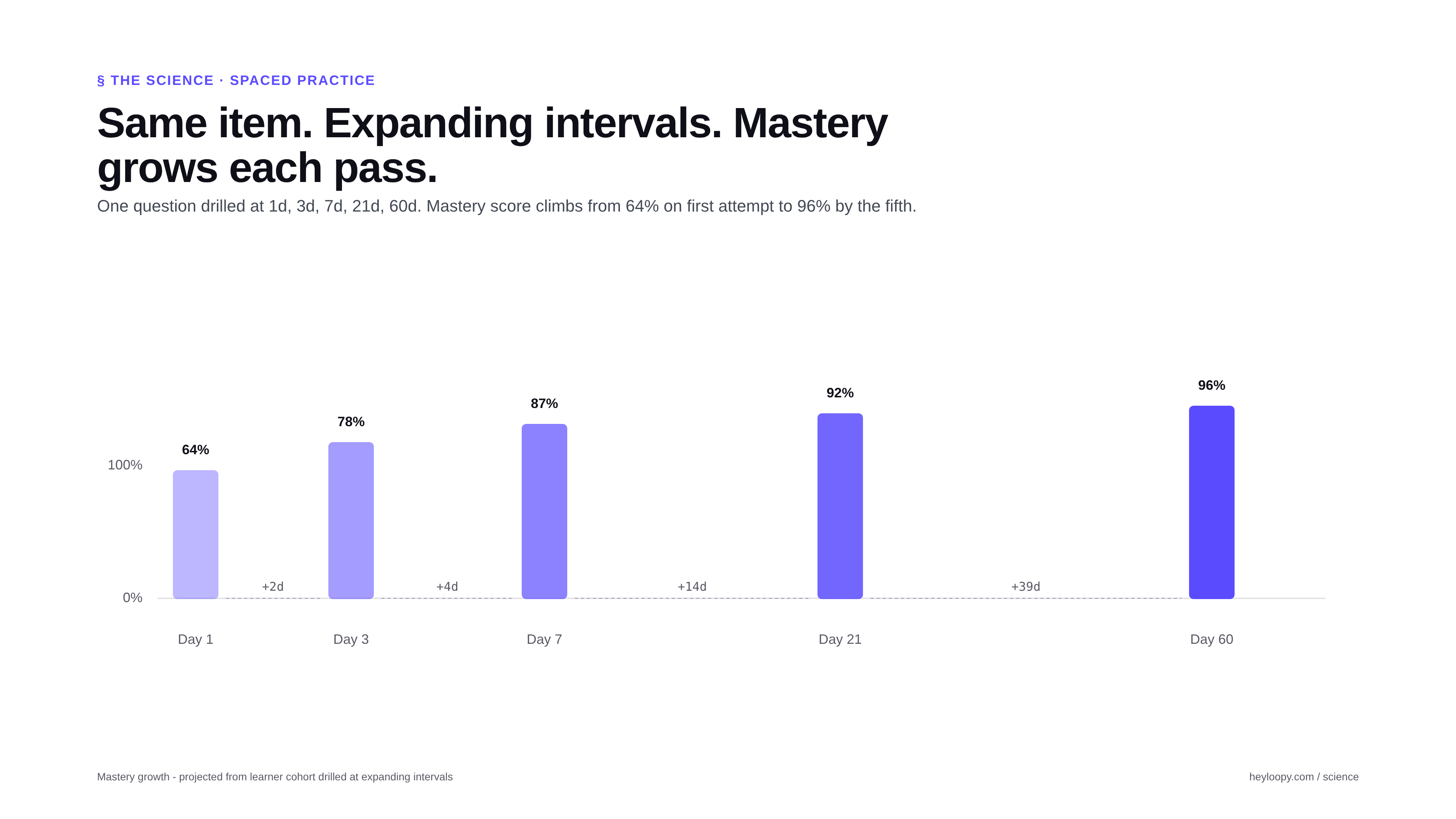
HeyLoopy schedules each item right before it would otherwise be forgotten. As an item gets stronger, the gap to the next review grows. As it weakens, the gap shrinks. The cadence is per-learner and per-item, not per-course.

Retrieval, not exposure

Drills ask. They do not lecture. Every interaction is a small retrieval attempt with immediate feedback. The training set is the test.

From your own documents

HeyLoopy reads the SOP, protocol, or playbook you already maintain and generates role-shaped drills from it. When the source document changes, the drills change. The audit trail follows the document, not the calendar.

Varied, contextual, under pressure

Each item is presented under multiple framings and contexts to build the kind of recall that survives a busy shift, a regulator visit, or a 3am decision.

Newsletter

One short note a month.

How HeyLoopy is being used in the wild, what the science says, no marketing fluff.

No spam. Unsubscribe any time. See our privacy policy.

§ Try free

Training that survives month six.

Daily 60-second drills, built from the documents you already have. Free for teams up to three.

3 seats free · no card · first drill in five minutes