Standard Work Training That Survives the Floor (and Why It Drifts)
You ran the kaizen, updated the standard work, and retrained the line. A quarter later the floor has drifted back. That gap between completion and capability is not a discipline problem. It is a memory problem, and on a line it shows up as scrap, rework, and the same finding on the next audit.
Every continuous-improvement program can show you a completion report. The
retrain was assigned, the line finished it, the sign-off is filed, and the
dashboard is green. None of that tells you the one thing a plant or CI leader
actually needs to know: when the shift is running, is the cell on the current
standard.
That is a different question, and on a line it is the only one that counts. The
training is not failing to happen. It is failing to last. By the next quarter the
new steps have started to blur and the floor has drifted back toward the old,
comfortable method. The report still says complete. That is the gap you end up
explaining in the near-miss retro or the layered process audit, when the question
is no longer whether the operators took the retrain but why a trained crew is
still running it the old way.
What follows is why standard work drifts, what actually makes a method stick, and
the layer that does that job. The thesis underneath it is the same one that
governs all training that has to survive the month
; on a
line the cost of the gap is just easier to count.
Completion is not capability
Almost every training tool measures the same thing: did the operator finish. It
is the easiest signal to collect and the easiest to hand an auditor, so it became
the number everyone watches. The trouble is that finishing predicts almost nothing
about whether the standard is there a month later, on a running line, under takt,
when it counts.
Completion answers “did they see it.” Capability answers “can they do it.” Those
are different questions, and only the second one shows up when the run starts: the
changeover done in the new sequence, the check made before the part moves, the
deviation caught before it becomes a quality escape. A cell can be fully signed
off on paper and soft in practice, and the completion report will never tell you
which.
The first step out of the trap is to stop trusting the green dashboard and start
asking what the cell can demonstrate. That is also the honest version of a
recurring corrective action
:
not writing the same CAPA a third time, but checking that the fix actually held on
the floor.
The forgetting curve is the real opponent
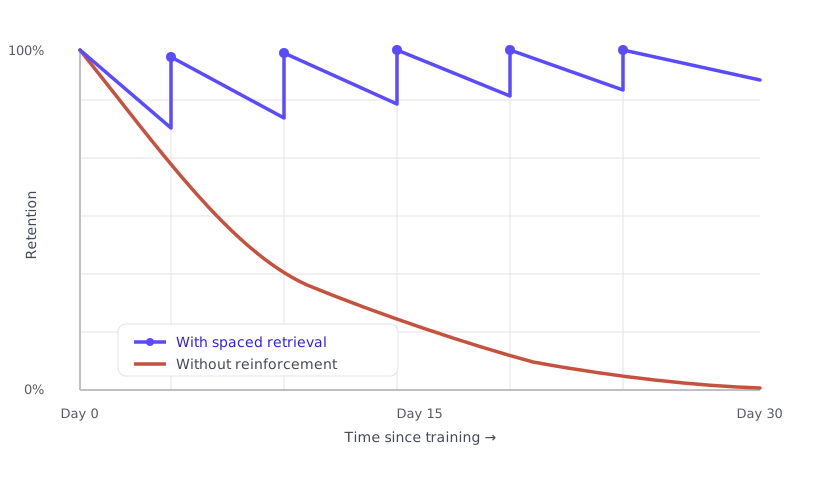
Hermann Ebbinghaus mapped this in the 1880s and it has held up ever since. Without
deliberate reinforcement, we lose most of what we learn within days. The decline
is steep at first and then levels off, and it does not care how good the kaizen
retrain was. A sharp standardized-work session and a dull one both fall down the
same curve. Polish buys you a better starting point, not a slower fade.
You cannot out-deliver the forgetting curve. Spaced retrieval bends it back.
This is why the standard keeps drifting back after the
kaizen
. The new method was real
on the day of the retrain. By the time it matters, the curve has done its work. So
the team runs the event again. The same curve erases it. In between sits the window
where a half-remembered step turns into a defect or a near miss. The kaizen instinct
is right. The format that follows it is what needs fixing.
You cannot out-deliver the forgetting curve. You can only bend it back, and bending
it back takes a specific kind of practice that most standard-work training never
includes.
Why your two existing tools cannot make it stick
Most plants already run on two tools. Neither is built for retention, and
understanding why is where the fix starts.
An LMS delivers and records. It hosts the retrain, assigns it, tracks who
signed off, and stores the record for the audit. That is a real and necessary job,
especially when an OEM customer or an IATF surveillance visit is at the door. It is
also a delivery job, not a memory job. Hosting a course does not make anyone retain
it, and the LMS was never designed to claim otherwise.
A kaizen event or standardized-work session performs. It is present and human
in the moment, it creates a beat of attention, and then the line goes back to
running and the forgetting curve starts before the shift ends. The energy of the
event is not the same as a durable standard. Pulling a cell for a full classroom
day costs more and fades the same way. A live session is also hard to scale across
shifts and across a changing crew, where the operators most exposed to the new
standard are often the least likely to have been in the room.
So the pattern repeats: deliver, perform, drift, retrain. Both tools are solving
for delivery while the actual failure is in retention. This is not a reason to tear
anything out. Keep the LMS as your system of record and your LPA software as the
audit instrument. Making the standard last is simply a third job,
and neither tool was built to do it.
What actually makes a standard stick
The science here is unusually settled, and it points at two mechanisms that
ordinary standard-work training almost never uses.
The first is retrieval. Being made to recall and apply a step, rather than
re-read or re-watch it, is what cements it. Researchers call this the testing
effect: pulling the answer out of your own head does far more for retention than
putting the information in again. Most training is all input, a slide deck and a
sign-off sheet at the end. Retrieval is the missing output.
The second is spacing. The same practice, spread out over time, sticks
dramatically better than the same practice crammed into one sitting. A single
retrain day is the worst-case schedule for memory. Short encounters, returned to
across the weeks between, are close to the best case, and they fit a shift far
better than a classroom does.
Put plainly: a standard lasts when operators are made to recall it, a little at a
time, on a spacing that fights the curve. That is not a motivation problem or an
instructor problem. It is a scheduling-and-format problem, and it can be built into
the way standard-work training runs instead of left to chance.
The retention layer: a job, not a replacement
The retention layer is the name for the tool that owns the job the other two
cannot: making the standard last. It sits alongside the LMS, not in place of it,
and runs the spaced retrieval that keeps the standards that actually matter
retrievable, per cell and per role.
A drill the cell keeps missing does not get quietly dropped; it returns on the
spaced schedule until the answer holds. That is the same retrieval loop every skill
gets, pointed at the standards where drift is most expensive.
Here is the job, done with the standard-work documents you already have.
Drills built from your own standard work. A CI or quality admin turns a
standard into a drill set by uploading the document, pasting it, or chatting with
Loopy, the assistant that drafts the drills from the source. The training is built
from the work instruction and the control plan you actually run on, not from a
generic library. When the kaizen team revises the standard, the drill set follows
it overnight, so a change reaches the floor smoothly instead of waiting for the
next session.
Short drills in the flow of the shift. Operators get drills of about sixty to
ninety seconds, one question at a time, on a phone or a terminal at the cell. The
format is retrieval and the schedule is spaced, by design. People practice the
current standard instead of re-reading it,
and it does not pull them off the line.
A per-cell mastery view, not a completion checkbox. Admins see a heatmap of
standards against cells and roles, each cell a mastery percentage, plus a
drill-down to a single standard. You can see a soft spot on a cell while it is
still small enough to fix, and you can walk into the layered process
audit
with a picture of where
the method actually holds, alongside the completion list your LMS already keeps.
A note on what it is not. HeyLoopy runs spaced-retrieval drills and a per-cell,
per-role mastery view. It does not pretend to be a one-to-one coach or to adapt the
difficulty per individual operator, and it does not produce the forensic,
regulator-grade audit-log exports a formal IATF or ISO record requires. Keep the
LMS for that. The mechanism is deliberately simple and honest: recall, spaced out,
measured by cell and role. That restraint is the reason the numbers it shows you
mean something.
Three places the floor either holds or drifts
The same gap shows up in three moments on a manufacturing line, and each has its
own answer.
The proof is the same test you started with. Ask the cell to walk the current
standard cold, weeks after the retrain, and watch what comes back. With a retention
layer in place, the answer stops being a coin flip, because the steps were
rehearsed on a schedule built to keep them.
In the meantime, you do not have to wait for the audit to tell you. The mastery
view shows where capability is real and where it is decaying, per cell and per role,
before the gap becomes a quality escape or a repeat finding. That is the whole shift
for a CI or quality leader: from a completion number that reassures you and tells
you nothing, to a mastery number you can act on while there is still time. That
standard is the same one that makes any training stick
,
floor or not.
A standard that holds through the quarter is not a slogan. It is what happens when
standard-work training is built to be recalled instead of merely delivered.
Common questions
Why doesn’t standard work stick after a kaizen? Because memory fades on a
predictable curve. Without spaced repetition, operators lose most of a new procedure
within days, no matter how good the retrain was. The completion report stays green
while the floor drifts back to the old method.
Isn’t our LMS enough for standard work training? An LMS delivers the retrain and
stores the sign-off, which is a real job. It was never built to make the standard
last on the floor. Hosting a lesson is not the same as retaining it, so an LMS plus
the forgetting curve still leaves a gap between completion and capability.
How do you keep a standard from drifting between audits? Spaced retrieval. Short
drills that make operators recall the current steps, returned to across the weeks
between training, fight the forgetting curve far better than one retrain session
does.
What is a retention layer for standard work? A tool that sits alongside the LMS
and owns the job of making the standard last. It runs spaced-retrieval drills built
from your own standard-work documents and shows per-cell, per-role mastery, so you
see where the method is holding or slipping before it shows up in scrap or on the
audit.
Does HeyLoopy replace our LMS or LPA software? No. HeyLoopy is the retention
layer, not a system of record. Keep the LMS for delivery and the sign-off, and your
LPA software for the audit instrument. HeyLoopy adds the spaced repetition that keeps
the current standard in place between them.
The job a course can't do
Delivering the standard work and retaining it on the floor are two different jobs. The LMS owns the first, and the kaizen retrain performs it. Until now nothing owned the second. That second job is the retention layer, and on a line it is the difference between a green completion report and a cell that actually runs the current method under takt.
Start free on the standard work your line keeps drifting off of, or get a walkthrough on your own SOPs. Either way, you watch it stick before the next audit.